Friday, April 21, 2023

Historical Mystery and the Amateur Sleuth — Perfect Partners! Guest post by Dianne Freeman

When I began the Countess of Harleigh mysteries, all I knew for certain was that I wanted my protagonist to be one of the Dollar Princesses from the late 19th century. These women fascinated me; American heiresses who could not break into “good” society in the U.S.—often due to the way their fathers made their fortunes. Without access to upper-crust families, there was no chance for them to make an advantageous marriage, which was needed to raise the social status of the whole family. Faced with a choice of never marrying or marrying a man from their fathers’ business, many of them chose a third option and decided to hunt for husbands among the aristocracy of Europe—sometimes with the family’s blessing and sometimes with their insistence. 

The more I learned about these women, the more I admired their courage and audacity. They were well educated, well-traveled, and very well polished. They took those traits, and a large dowry, and traded them for a title and entrĂ©e to British society. Their families, who were now invited to even the most exclusive drawing rooms, thought it a great deal. But what about the young woman? 

Results varied. 
 
My protagonist, Frances, married the self-centered heir to the Earl of Harleigh, who took her money, dropped her off at the country manor, and continued to live the life of a bachelor. He did bring her to London for the season once a year, where she made several good connections and a few close friends. Frances became Countess of Harleigh when his father died. And they did have a daughter together. Still, she wasn’t exactly grief stricken when, nine years after the wedding, her husband died—in the bed of his latest lover. 

I began Frances’ story a year later, right at the end of her mourning period. In my opinion, I had a fascinating protagonist, but here’s the problem—I wanted to write a mystery. How could the Countess of Harleigh be a sleuth? What would someone like her have to do with crime or crime solving? It wasn’t until I did a great deal more research that I learned how perfectly the amateur sleuth fits into historical fiction. 

First of all, while police in 1899 were indeed professionals, they weren’t armed with all the tools investigators of today have. CSI and GPS were just letters of the alphabet. Though they brought cameras to a crime scene to document the scene and any suspicious items, there were no security cameras and no footage that might show them a glimpse of a suspect. Even fingerprint identification was still a couple of years off. There were tests to identify the presence of some poisons in the deceased, but there were more toxins available than tests. Basically, once they were called to a crime scene, the police relied on keen observation, interviews with witnesses and other related people, and instinct that comes from experience. 

Coincidentally, those were all traits an amateur could develop. Aha! Maybe Frances as a sleuth could work after all. 

But there’s more. Though policing was well out of its infancy by 1899, the idea of police investigating a crime was still relatively young. People didn’t like the idea of someone in a uniform having the authority to question them, but they were particularly averse to detectives in plain clothes having that authority. That might have stemmed from a scandal twenty years earlier that revealed deep corruption in Scotland Yard. 

The average Londoner may have distrusted police investigators, but generally, they had to tolerate them. The aristocracy didn’t. If they chose not to speak to the police, there was little the officer could do other than attempt to obtain a warrant, which was time consuming and often led to a rejection. 

My amateur sleuth is already part of the aristocracy. She’s “one of them.” She has access to people and places the police may not. And, as an American living in England, she is something of a fish out of water, which makes her a keen observer. The social skills her mother drilled into her allow her to command and maneuver any conversation. Even if she’s a bit direct in her investigative conversation, few people in London society would want to offend a countess by refusing to answer. 

So far, every advantage for Frances would also be true of any man in her role, but as a woman, she has a couple more points in her favor. One of them is time. I don’t know how anyone other than a professional has the time to investigate a crime in a contemporary setting, but Frances has plenty of it. She has servants to run the house, a nanny to care for her child, and no actual job. In that era, most men did work at something. Even a gentleman had an estate to run or Parliamentary duties. Frances may have social obligations, but that’s a plus, since the crimes she investigates take place among society. 

By far her biggest advantage is just the fact that she’s an aristocratic woman. The average man of the day would never expect her to worry her pretty little head over something as ugly as murder. Nor would they expect her to have the intelligence for it. Fortunately, as long as men have been underestimating women, women have proved themselves to be up to any task. In this case, it’s the task of amateur sleuth in a historical mystery, and it’s such a perfect fit. 


***
Dianne Freeman is the acclaimed author of the Agatha and Lefty award winning Countess of Harleigh Mystery series and a finalist for the Mary Higgins Clark award. Her upcoming novel, A Newlywed’s Guide to Fortune and Murder will be available in June. Visit her at www.DiFreeman.com

Thursday, April 20, 2023

Cartoon of the Day: Family Reunion


Crime Writers of Canada Awards of Excellence in Canadian Crime Writing Shortlists and Derrick Murdoch Award Recipient

Crime Writers of Canada (CWC) announced the Shortlists for the 2023 Crime Writers of Canada Awards of Excellence in Canadian Crime Writing. Since 1984, Crime Writers of Canada has recognized the best in mystery, crime, and suspense fiction, and crime nonfiction by Canadian authors, including citizens abroad and new residents.

Winners will be announced Thursday 25 May 2023.

Jack Batten is the recipient of the 2023 Derrick Murdoch Award. The Derrick Murdoch Award is issued every two years to recognize a member of Crime Writers of Canada who has made significant contributions to the crime/mystery/thriller genre.

Jack Batten is an acclaimed freelancer and award-winning author of dozens of fiction and non-fiction books for adults and young people. He’s written scores of short stories and articles on topics covering music, the law, movies and sports. His Crang mystery, Straight No Chaser, was shortlisted for the Crime Writers of Canada’s 1990 Award for Best Crime Novel.

From 1999 to 2022, Jack wrote hundreds of crime fiction book reviews in his weekly Whodunit column in the Toronto Star, supporting emerging and established authors and encouraging readers to discover more about the genre.

THE 2023 AWARDS OF EXCELLENCE SHORTLISTS

Best Crime Novel sponsored by Rakuten Kobo, with a $1000 prize

Linwood Barclay, Take Your Breath Away, HarperCollins Canada Anthony Bidulka, Going to Beautiful, Stonehouse Publishing
Nicole Lundrigan, An Unthinkable Thing, Viking Canada
Catherine McKenzie, Please Join Us, Simon & Schuster Canada Shelly Sanders, Daughters of the Occupation, HarperCollins Canada

Best Crime First Novel sponsored by Melodie Campbell, with a $1000 prize

T. Lawrence Davis, The Pale Horse, Friesen Press
Bill Edwards, Killer Time, Friesen Press
Adam Frost, The Damned Lovely, Down and Out Books Sam Shelstad, Citizens of Light, TouchWood Editions M.Z. Urlocker, The Man from Mittlewerk, Inkshares, Inc.

The Howard Engel Award for Best Crime Novel Set in Canada sponsored by Charlotte Engel and CWC, with a $500 prize

A. J. Devlin, Five Moves of Doom, NeWest Press
S. M. Freedman, Blood Atonement, Dundurn Press
Joanne Jackson, A Snake in the Raspberry Patch, Stonehouse Publishing Maureen Jennings, Cold Snap, Cormorant Books
Amy Tector, The Foulest Things, Keylight Books

The Whodunit Award for Best Traditional Mystery sponsored by Jane Doe, with a $500 prize

Alice Bienia, Knight in the Museum, Cairn Press
Anne Emery, Fenian Street, ECW Press
Thomas King, Deep House, HarperCollins Canada
Mary Jane Maffini, Death Plans a Perfect Trip, Beyond the Page Iona Whishaw, Framed in Fire, Touchwood Editions

Best Crime Novella sponsored by Mystery Magazine, with a $200 prize

M.H. Callway, Amdur's Ghost, In the Spirit of 13, Carrick Publishing
Hilary Davidson, Dangerous to Know, A Grifter's Song Vol. 8, Down & Out Books
Julie Hiner, Dead End Track, Julie Hiner
Matt Hughes, The Emir's Falcon, Shadowpaw Press Premiere
Alexis Stefanovich-Thomson, The Man Who Went Down Under, Alfred Hitchcock Mystery Magazines

Best Crime Short Story sponsored by Mystery Magazine, with a $300 prize

Craig H. Bowlsby, The Girl Who Was Only Three Quarters Dead, Mystery Magazine M.H. Callway, Must Love Dogs - or You're Gone, Red Dog Press
Blair Keetch, To Catch a Kumiho, In the Spirit of 13, Carrick Publishing
Sylvia Maultash Warsh, The Natural Order of Things, Ellery Queen Mystery Magazine donalee Moulton, Swan Song, Cold Canadian Crime, Crime Writers of Canada

Best French Crime Book (Fiction and Nonfiction)

Geneviève Blouin, Le Mouroir des anges, Éditions Alire Isabelle Lafortune, Chaîne de glace, Éditions XYZ

Guillaume Morrissette, Le dernier manège, Saint-Jean éditeur Suzan Payne, Modus operandi, Éditions Perce-Neige
Richard Ste-Marie, Monsieur Hämmerli, Éditions Alire

Best Juvenile or YA Crime Book (Fiction and Nonfiction) sponsored by Shaftesbury, with a $500 prize

Natasha Deen, Lark Steals the Show, Orca Book Publisher
Marthe Jocelyn, Aggie Morton Mystery Queen: The Seaside Corpse, Tundra Books H.N. Khan, Wrong Side of the Court, Penguin Teen
Wesley King, Butt Sandwich & Tree, Simon & Schuster Books for Young Readers
Jo Treggiari, Heartbreak Homes, Nimbus Publishing Limited

The Brass Knuckles Award for Best Nonfiction Crime Book sponsored by David Reid Simpson Law Firm, Hamilton, with a $300 prize

Michael Arntfield, How to Solve a Cold Case: And Everything Else You Wanted to Know About Catching Killers, HarperCollins Canada
Sharon Anne Cook and Margaret Carson, The Castleton Massacre, Dundurn Press Ltd.
Harley Rustad, Lost in the Valley of Death, Knopf Canada - Penguin Random House Canada
Rosemary Sullivan, The Betrayal of Anne Frank: A Cold Case Investigation, HarperCollins Canada Sarah Weinman, Scoundrel, Knopf Canada - Penguin Random House Canada

The Award for Best Unpublished Manuscript sponsored by ECW Press, with a $500 prize

Jan Garnett, No Safe House
Mary Keenan, Snowed
Joanne Kormylo, Two Knots
Joel Nedecky, The Broken Detective Michael Pennock, The Peaks

***

About Crime Writers of Canada

Crime Writers of Canada was founded in 1982 as a professional organization designed to raise the profile of Canadian crime writers. Members include authors, publishers, editors, booksellers, librarians, reviewers, and literary agents as well as many developing authors. 

Wednesday, April 19, 2023

Should the Next 007 Be a Woman? Guest Post by M.P. Woodward

Should the Next 007 Be a Woman?


Let’s start with the obvious:  James Bond is dead. 

He was obliterated in 2021 by friendly fire when the HMS Dragon struck the weapons base run by Rami Malek’s evil villain, Lyustifer Safin. Though the title of the film is No Time to Die, Bond did just that—in style, of course. 

Tragically, after finally finding love and a daughter, our hero ordered cruise missiles onto his own head to vanquish a rogue whose name was basically Lucifer Satan. It was a noble death. And it marked the first and only time the Bond character was killed. 

Alas.

One wonders if Amazon knew of Bond’s pending demise when it negotiated its acquisition of MGM.  Over 61 years, 25 films, and six actors, Bond franchise box office revenues have totaled $7.4 billion—about $1 billion less than Amazon paid for the studio.   Since the spy makes up a big chunk of MGM's profit, the e-commerce giant-turned-movie maker is going to need someone to strap on the Omega and shake the Vesper martinis—quick. 

Henry Cavill, Idris Elba, and Aaron Taylor Johnson are rumored to be on the shortlist for the next Tom Ford tux. Doubtless, any of these Brits could make Monaco’s backless beauties swoon at the gaming table.  They’re all safe double-oh choices.

But is a safe choice what we need in an unsafe world? 

With Putin, Xi, and Un shining up their missiles, we could use a double-oh that meets the moment, someone to take down these real-world madmen—not just a pinkie-in-mouth Dr. Evil. And given the track record of women in espionage, a female spy might get better results.

Let’s face it—somewhere along the way, Bond’s mission got a little hinky.

It wasn’t always thus. In Ian Fleming’s debut novel, Casino Royale (1953), Bond was a Cold Warrior, rooted in rococo realpolitik. His first mission was to defeat a KGB agent, Le Chiffre, who was financing Soviet espionage by winning high-stakes baccarat games. 

But in the Casino Royale of 2006—itself a reboot to introduce Daniel Craig—Le Chiffre was a mere glutton who manipulated financial securities by causing free market mayhem. Why not? Eighteen years ago, few of us gave a whit about geopolitics. We were too busy enjoying a bull market and an as-yet-unburst housing bubble. 

Not so much today.

Amazon’s new 007 will be born into a world that looks more like 1939 than 2006. With the largest European war since WWII raging, we could go for a grittier double-oh.  Do we really want an Aston Martin-driving dandy going after insecure outcasts like SPECTRE, Goldfinger, and Dr. No when Mad Vlad is running amok in the Kremlin? You have to go back 40 years to find the last time Bond battled a deranged Russian who wanted to nuke something—and that was Octopussy (1983).  Yikes.

At least the crazed Soviet general in that gem had a semi-plausible geopolitical mission.  The plans of most Bond villains over the years have been self-serving fantasies cooked up in dubious island lairs.  No, really.
 
Dr. No (1962), Thunderball (1965), You Only Live Twice (1967), Man With a Golden Gun (1974), Die Another Day (2002), and No Time to Die (2021) all feature private, self-funded maniacs operating from secret island bases with fantastical technical infrastructure.  No wonder James was so distracted by romantic pursuits—so were his enemies. 

Today calls for a more serious operator.

Think of the stakes. We need look no further than the Chinese Communist Party for a true-to-life Bond villain.  Xi Jinping has actually built missile-studded manmade islands to control the shipping lanes of the South China Sea, through which one-third of the world’s commercial traffic passes. Shouldn’t MI6 be sending its best to battle Beijing?

Just over the Yellow Sea, our resurrected 007 will wake to find a hedonistic, nuclear-armed Kim Jong Un regularly lobbing missiles over Japan and South Korea. He too has many traits of an old-school Bond villain. He drives exotic Italian cars, sips expensive French wine, and dines on lobster. A lot of it, from the look of him.

Let’s go, double-oh:  you have a lot of work to do.

Which begs the question—since the man James Bond was killed in No Time to Die, and since the world is currently threatened by actual megalomaniacs, should Amazon really limit the search for the next 007 to Sexiest Man Alive runners-up? Each will inevitably show weakness when confronted with the beautiful “Bond women” anyway.  If we really need our best spy on the intelligence battlefield, shouldn’t we look to professionals with more focus?

The most grimly effective cinematic spies of recent years have come from the fairer sex.  Keri Russell’s Elizabeth Jennings in The Americans (2014-2018) showed a woman easily gliding between minivan-driving soccer mom and cold-hearted killer.  Charlize Theron’s MI6 agent Lorrain Broughton used brains, blood, and guts to thwart East German Stazi and the Soviet KGB in Atomic Blonde (2017).  Angelina Jolie’s eponymous CIA officer in Salt (2010) goes on a ruthless rampage to clear her name when she’s accused of being a Russian spy.  Even Bond’s brilliant boss “M” was Dame Judy Dench from Golden Eye (1995) to Skyfall (2012). And don’t forget Ana de Armas’s charming turn as a gun-wielding CIA assassin in No Time to Die. She made James look lost by comparison.

These baddies are a better fit for the moment because they’re all about getting s**t done.  Unlike Bond, they’re not off shagging in space (Moonraker, 1983).   

And speaking of getting things done, many of our most effective real-world spies have been women. 

Elizabeth Sudmeier was a CIA officer who stole blueprints for the most advanced Soviet fighter jet of the day from an agent in Baghdad in ‘54.  She then went on to handle a vast network of spies in the Soviet military. Her CIA peer, Eloise Page, gained crucial intelligence about the Soviet space program in the sixties by cleverly sending American scientists as tourists into Russia. Another female CIA officer, Adelaide Hawkins, used early imagery intelligence to predict the Suez Canal invasion long before it happened.

Even America’s current top spy is a woman.  Before assuming the post of Director of National Intelligence, Avril Haines served as a CIA deputy director. That same CIA was run by her female contemporary, Gina Haspel, from 2018 to 2021. Before serving as CIA Director, Ms. Haspel was the deputy director of the National Clandestine Service for Foreign Intelligence and Covert Action.  How’s that for a title?

Yes, back in the days of relative world peace, it was fine for Bond to take on villains like Blofeld, who hollowed out a volcano to hide a doomsday device (You Only Live Twice, 1967) or Zorin, who tried to blow up Silicon Valley to sell newspapers (A View To a Kill, 1985). But with madmen threatening civilization in real life, it might be time to consider an expansion of the espionage talent pool.

And ask yourself: whom would a male megalomaniac fear more than a woman of intelligence?  
***

MP Woodward is a veteran of both US intelligence ops and the entertainment industry. As a naval intelligence officer with the US Pacific Command, he scripted scenario moves and countermoves for US war game exercises in the Middle East. In multiple deployments to the Persian Gulf and Far East, he worked alongside US Special Forces, CIA, and NSA. Most recently, Woodward led international distribution for Amazon Prime Video and launched Amazon original content in more than forty countries. The Handler is available now in mass market and Dead Drop will be released on May 24. To learn more, please visit www.mpwoodward.com.

Tuesday, April 18, 2023

A Pogo Stick...And Publication: Guest Post by Shawn Wilson

Shawn Wilson:

    Could a pogo stick actually be the catalyst for fulfilling a long-time goal of becoming a published author? In my case, the answer is yes. But what did these two seemingly unrelated things have to do with each other?
    It was the summer I would turn twelve. Elementary school was over and junior high would start after Labor Day. The hula hoop craze was history, and I was tired of roller skating. I needed a new activity to fill the lazy vacation days. It came in the form of a pogo stick. I don’t know why my father thought it was appropriate and I’m sure my mother thought it was dangerous. I saw it as a challenge.
    To say I was not athletic was an understatement, but what I lacked in coordination I made up for in persistence. I was determined to conquer this odd spring-loaded pole with a handle at the top and footrest near the bottom. After several falls and many failed attempts to jump more than once or twice, I found my balance. Soon I was able to travel the length of the sidewalk in front of our house and go up and down the porch steps. But there was a price to pay. Both my legs, from inner thighs to knees were covered in ugly bruises. While my mother was horrified and feared someone would think I was a victim of abuse, I felt victorious.
     It wasn’t the only worry she had that summer. I was obsessed with a crime story reported in our local newspaper. At an upstate New York camp, a boy had been found dead. Foul play was suspected. It was, to my way of thinking, a far more interesting mystery than the Nancy Drew books I routinely checked out of the library.
    Fast forward to 1969. While astronauts landed on the moon, I started working for the Department of Justice in Washington, D.C. One job led to another while I pursued a degree in Administration of Justice. Over the years, my resume included the U.S. Marshals Service, U.S. Attorney’s Office, Federal Bureau of Prisons and Administrative Office of the U.S. Courts.

     
My government service ended abruptly when my job was abolished. I saw early-out retirement as an opportunity to devote more time and energy to a goal/dream of writing crime fiction. I had completed two manuscripts and despite unsuccessfully finding an agent or publisher, I wrote another. More rejection followed but just as I didn’t give up on the pogo stick, I stuck with it. While attending Bouchercon 2018, the annual mystery conference named for former New York Times critic, Anthony Boucher, I attended a presentation by Oceanview Publishing. I introduced myself, briefly described my manuscript and was invited to submit sample chapters. Weeks later, they requested the full manuscript. I tried to keep my expectations in check as I awaited a response. That changed when I received an email requesting a time to schedule a teleconference. I knew that publishers don’t call to tell you they’re not interested. A week later, I signed a contract. In December 2019, my debut crime novel, Relentless launched.
    Looking back to the summer of the pogo stick, I realize how influential that time was. The bruises faded but the determination to reach a goal despite obstacles encountered along the way defined how I would respond in years to come. And apparently, my interest in a real-life crime story and a passion for mystery novels led to two careers. The second, a published author is, by far, the best job I’ve ever had.

***

Shawn Wilson (shawnwilsonauthor.com) is the author of Relentless featuring homicide detective Brian (Brick) Kavanagh. Duplicity is the second in the series and received a starred review from Publishers Weekly. 

UNFORGOTTEN NEWS: Series 5 and 6

According to RadioTimes and ITV:

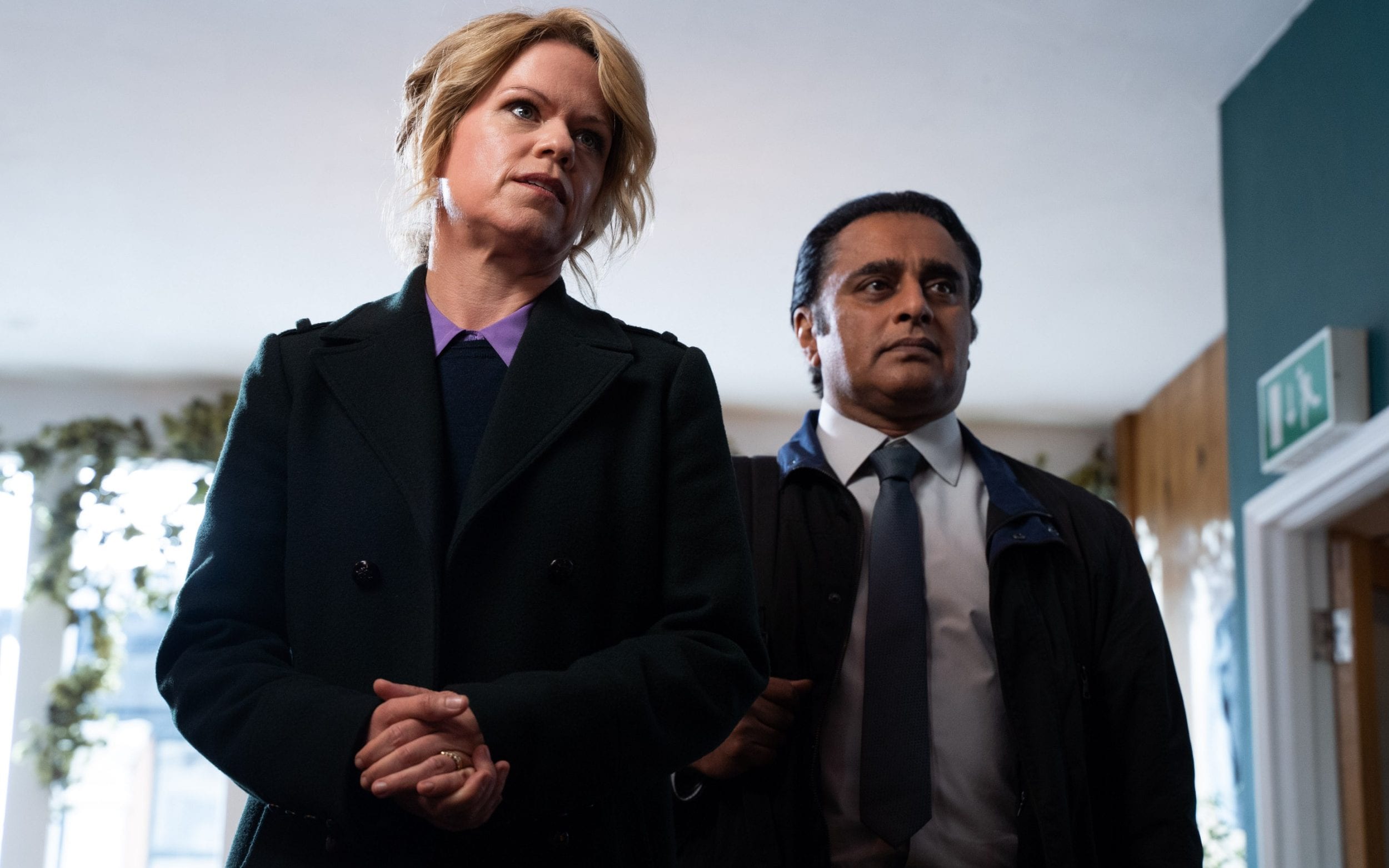
Unforgotten has been renewed for Season 6 with SinĂ©ad Keenan and Sanjeev Bhaskar. All well and good, but we in the U.S. have still to watch Season 5. Season 5 has aired in the UK, but not yet here in the U.S. According to several sources, it will be available later in the year on PBS Passport, PBS Video, and PBS Masterpiece Prime Video channel. There are 6 episodes. 

The latest fifth season sees new lead SinĂ©ad Keenan star as DCI Jessica James, stepping into the shoes left by Nicola Walker's DCI Cassie Stewart after four seasons leading the show. 

I'll keep you post on Series 5 U.S. release date. "Stay tuned"