

Showing posts with label Cats. Show all posts
Showing posts with label Cats. Show all posts
Saturday, September 5, 2026

Saturday, August 15, 2026
AUTHORS & THEIR CATS: CHESTER HIMES
Happy Caturday!
Authors & their Cats: Chester Himes


The following is from a book called Writers and Their Cats, a book about writers and their cats by Alison Nastasi.
Chester Himes, considered the father of the black American crime novel, wrote stories that mirrored the real-life violence and racism happening in the world around him. “American violence is public life, it’s a public way of life, it became a form, a detective story form,” he once said. “So I would think that any number of black writers should go into the detective story form.”
One reprieve from the chaos of everyday life was Himes’s cats, particularly his blue-point Siamese called Griot (1st and Third photos above). “Griot is named after the magicians in the courts of West African kings,” Himes said in a 1972 interview. Griot was Himes’s constant travel companion. When the If He Hollers Let Him Go author didn’t bring Griot along during his adventures, Himes paid the price. In a 1971 interview Himes gave while in Stuttgart, Germany, he claimed he couldn’t stay away from home too long since Griot would “certainly destroy [his] studio back home and chew up all [his] books.”
After Griot passed away, Himes kept a kitty named Deros, who the writer loved for her sweet personality.
Saturday, June 6, 2026


Saturday, March 21, 2026
Writers and their Cats: Mary Stewart
Happy Caturday! Authors and their Cats: Mary Stewart. Mary Stewart was a marvelous author of romantic suspense, historical fantasy, and so much more. Read about her here. In this photo, the cat looks less enthusiastic than Mary Stewart.

Wednesday, February 11, 2026

Sunday, February 8, 2026

Saturday, February 7, 2026
AUTHORS & THEIR CATS: James Joyce
Happy Caturday! Authors & their Cats: James Joyce
Be sure to scroll down for some fascinating information on James Joyces's cat fiction!
 You may not know this, but James Joyce was a big cat lover and children's book author, as well as adult fiction writer.
There are two versions of The Cat and the Devil (1981), both based on a letter James Joyce wrote to his grandson Stephen in 1936 and illustrated by French artist Blachon. The UK edition was published earlier and illustrated by Gerald Rose. They're both wonderful, but I prefer the UK edition.


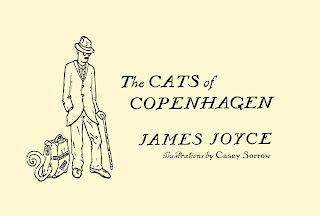
Another wonderful Joyce cat story is The Cats of Copenhagen, also based on another letter to Stephen which was found posthumously and published in 2012. Anastasia Herbert of Ithys Press first published the book in Ireland with a 200 copy illustrated print run. In early August 1936, Joyce had sent his grandson ‘a little cat filled
with sweets’ – a kind of Trojan cat to outwit the grown-ups (see above).
A few weeks
later, while in Copenhagen and probably after hunting for another
gift, Joyce penned ‘Cats’, which begins: ‘Alas! I cannot send you a
Copenhagen cat because there are no cats in Copenhagen.’ Surely there
were cats in Copenhagen! But perhaps not ones filled with candy. The
story proceeds to describe a Copenhagen in which things are not
what they seem…There is definitely an adult subtext here: note the 'fat cat'


There are two versions of The Cat and the Devil (1981), both based on a letter James Joyce wrote to his grandson Stephen in 1936 and illustrated by French artist Blachon. The UK edition was published earlier and illustrated by Gerald Rose. They're both wonderful, but I prefer the UK edition.


Saturday, January 24, 2026
Authors & their Cats: Lilian Jackson Braun
Happy Caturday! What better author to highlight today on my Authors & their Cats series than Lilian Jackson Braun, author of the Cat Who series. Be sure to scroll down and see both photos.


Saturday, January 17, 2026

Wednesday, December 17, 2025

Saturday, December 6, 2025

Sunday, July 27, 2025

Saturday, June 28, 2025

Saturday, June 7, 2025

Saturday, May 31, 2025
Authors & their Cats: Lilian Jackson Braun
Happy Caturday! What better author to highlight today on my Writers & their Cats series than Lilian Jackson Braun, author of the Cat Who series.
Tuesday, May 27, 2025
A Low-Commitment Pet for a Low-Commitment Owner: Guest Post by Tom Spencer

Now, there are cats who do not produce hairballs – my own cat, Coconut, for instance, has never vomited up anything of the kind. But Coconut still creates all kinds of chaos in my house. She baits the dog into attacking her then swipes at the dog’s face with her claws. She runs out of the front door if it’s left open even a crack. She walks on the chopping board right as I am preparing dinner, tracking lord-knows-what across my food preparation surfaces. She flagrantly steals pieces of chicken, ham, bread, whatever I’m making, right in front of my eyes! The only deterrent she respects is the water spray bottle, and that only for a couple of seconds, before she’s right back to thieving the chicken again. No, Agatha would never be able to stand having a cat in her flat.
But still, I thought, Agatha should have a cat. And besides, in Blake Snyder’s famous phrase, main characters ought to “save the cat” somewhere near the beginning of the narrative – especially unsympathetic main characters like mine, whom readers might not be disposed to like much. How better to “save the cat” than by having Agatha look after a literal cat? And also, cats are awesome! They flow down the stairs like water. They come and drape their tails against your face even when they are positive that they do not want to be petted. A cat would be just the thing to get Agatha out of the doldrums in which she finds herself at the start of the novel.
My solution was to get Agatha a feral cat – a cat who stays outside, on her balcony, dividing his time between Agatha and who knows how many other owners. A feral cat whom Agatha can feed expensive cat milk that is gentle on feline digestive systems, but who basically ignores Agatha. This seemed like the perfect solution – a low-commitment pet for a low-commitment owner. This, incidentally, was also the solution we adopted with our own children when they were toddlers, before we got Coconut – we left food out for a black cat who would come into our backyard, eat the food, and leave. But our eldest son was convinced that we “had” a cat – he told all his teachers at preschool that we had a cat named Elsa (he was very into Frozen at the time, and who better to name a completely black cat after than an ice princess?). So for a few years, we escaped having feline chaos invading our own house. When it comes to my novel, though, the only question now is what to do with Agatha’s cat now she’s got him? Maybe I should pull a Rita Mae Brown and have the cat solve the mystery?
***
Tom Spencer is an expat Londoner currently living and working in Montgomery, Alabama. He is the author of the mystery novel The Mystery of the Crooked Man (Pushkin), recently longlisted for the CWA Whodunnit Dagger. He has published creative work in various journals, including a story nominated for a Pushcart Prize and another shortlisted for the Galley Beggar Press Prize. Under his real name, Tom Perrin, he has published an academic book on twentieth-century fiction, as well as having written for the New York Times, the Times Literary Supplement, and elsewhere.
Saturday, May 17, 2025
AUTHORS & THEIR CATS: Chester Himes
Happy Caturday!
Authors & their Cats: Chester Himes
The following is from a book called Writers and Their Cats, a book about writers and their cats by Alison Nastasi.
Chester Himes, considered the father of the black American crime novel, wrote stories that mirrored the real-life violence and racism happening in the world around him. “American violence is public life, it’s a public way of life, it became a form, a detective story form,” he once said. “So I would think that any number of black writers should go into the detective story form.”
One reprieve from the chaos of everyday life was Himes’s cats, particularly his blue-point Siamese called Griot (1st and Third photos above). “Griot is named after the magicians in the courts of West African kings,” Himes said in a 1972 interview. Griot was Himes’s constant travel companion. When the If He Hollers Let Him Go author didn’t bring Griot along during his adventures, Himes paid the price. In a 1971 interview Himes gave while in Stuttgart, Germany, he claimed he couldn’t stay away from home too long since Griot would “certainly destroy [his] studio back home and chew up all [his] books.”
After Griot passed away, Himes kept a kitty named Deros, who the writer loved for her sweet personality.
Monday, April 28, 2025
Saturday, April 26, 2025
Authors & their Cats: Ursula K. Le Guin
Happy Caturday! Authors and their Cats: Ursula K. Le Guin. What an amazing writer. What a fascinating woman! I was so lucky to be on a panel with her once--a highlight of my 'literary' career. Be sure and scroll down to read about her 'cat' books.

In addition to an incredible number of books on fantasy and science fiction, Ursula K. Le Guin wrote Catwings, a children's book, illustrated by S.D. Schindler.
 Review by
Publisher's Weekly Review
Review by
Publisher's Weekly Review
Le Guin also wrote Cat Dreams, illustrated by S.D. Schindler, Jane on Her Own: A Catwings Tale, Wonderful Alexander and the Catwings, and Catwings Return.
Ursula K. Le Guin:
The genre formerly classified as 'science fiction' has become divided into sub-genres, such as fantasy, realistic fiction, alternative history, and other categories. Le Guin resists classifying her own work in any one area, saying that some of it may be called 'science fiction', while other writings may be considered 'realist' and still others 'magical realism' (her term). Le Guin is one of the few writers whose works (which include poetry and short fiction) can be found in public libraries' collections for children, young adults, and adults.
Le Guin's published works include a novel, A Wizard of Earthsea, that won an American Library Association Notable Book citation, a Horn Book Honor List citation, and the Lewis Carroll Shelf Award in 1979. She has been nominated several times for the Nebula Award and the Hugo Award--the highest honors in science fiction/fantasy writing--and has won both awards. Her Earthsea Trilogy is a mainstay of fantasy fiction collections.


Down an alley
in a dumpster, Mrs. Jane Tabby gives birth to four kittens. But these
are no ordinary offspring. Each has a pair of wings. Although Mrs. Tabby
is unperturbed by her kittens' appearance, her neighbors are not so
charitable; when the kittens are old enough to fly, Mrs. Tabby sends her
children out into the world. Because both winged and four-footed
creatures mistrust them, the kittens have trouble finding a place to
live, but eventually discover a loving home. Dark watercolor
etchings by Schindler further convey the plight of these airborne
felines as they go in search of a home.
Le Guin also wrote Cat Dreams, illustrated by S.D. Schindler, Jane on Her Own: A Catwings Tale, Wonderful Alexander and the Catwings, and Catwings Return.
Ursula K. Le Guin:
Arguably one of the
canonical writers of American science fiction, Ursula K. Le Guin was
born in Berkeley, Calif., in 1929, the daughter of Alfred L. and
Theodora Kroeber. After earning an A.B. degree from Radcliffe College
and an A.M. from Columbia University, Le Guin was awarded a Fulbright
fellowship in 1953.
The genre formerly classified as 'science fiction' has become divided into sub-genres, such as fantasy, realistic fiction, alternative history, and other categories. Le Guin resists classifying her own work in any one area, saying that some of it may be called 'science fiction', while other writings may be considered 'realist' and still others 'magical realism' (her term). Le Guin is one of the few writers whose works (which include poetry and short fiction) can be found in public libraries' collections for children, young adults, and adults.
Le Guin's published works include a novel, A Wizard of Earthsea, that won an American Library Association Notable Book citation, a Horn Book Honor List citation, and the Lewis Carroll Shelf Award in 1979. She has been nominated several times for the Nebula Award and the Hugo Award--the highest honors in science fiction/fantasy writing--and has won both awards. Her Earthsea Trilogy is a mainstay of fantasy fiction collections.
Saturday, April 19, 2025
Authors & Their Cats: Lilian Jackson Braun
Happy Caturday! What better author to highlight today on my Authors & their Cats series than Lilian Jackson Braun, author of the Cat Who series. Be sure to scroll down and see both photos.
Subscribe to:
Posts (Atom)