
Showing posts with label Denise Hamilton. Show all posts

Sunday, June 10, 2012

Denise Hamilton: Eat. Pray. Love. Sprintz

Today I welcome back Denise Hamilton. Denise Hamilton's latest crime novel, Damage Control, features a perfumista sleuth. Read her post on Femme Fatale Perfumes: Wanton Ways HERE.

Hamilton is also the editor of the Edgar Award-winning Los Angeles Noir story anthology and the Los Angeles Times Magazine perfume columnist. This post originally appeared in the LA Times, May 25, 2012.  
Reprinted with permission of the author. 

Denise Hamilton: Eat. Pray. Love. Spritz.

Now inhale deeply and feel your life transform.

It's only May, but 2012 is already shaping up as the year perfume wafted from the lively online blogs and into mainstream publishing in a big way.

These days, new fragrance releases are greeted — and critiqued — with the intellectual sophistication formerly reserved for Paris fashion shows. Perfume is an art form and the "noses" who compose cutting-edge fragrances are rock stars.

Writers, always hip to the zeitgeist, are avidly chronicling this renaissance and some books have even inspired their own perfumes.

Recent months have brought a well-reviewed thriller set in the perfume world. A memoir of love, secrets, wedding frocks and sensual awakenings. Witty, erudite reviews of 100 top fragrances. A coffee table-sized fragrance manifesto with black-and-white portraits of top perfumers. And the story of how a world-famous "nose" joined forces with a sensualist writer to create a perfume.

My review copy of Denyse Beaulieu's new memoir The Perfume Lover describes her collaboration with French perfumer Bertrand Duchaufour and was accompanied by a tiny black bottle of their new perfume, Séville à l'aube. It's an intoxicating scent of orange blossom, incense, smoke, beeswax, flowers and musk that went through more than 100 iterations before everyone was happy. It also caught the eye of L'Artisan Perfumers, a major player in the boutique fragrance world, which plans to release it commercially later this year.

Beaulieu hails from Quebec but long ago fled Canada to re-invent herself as a Left Bank Parisian sophisticate. She is a writer, translator, instructor and perfume blogger — the bilingual Grain de Musc. She writes with penetrating intellect about perfume, gender roles, cultural signifiers, the boudoir and her Bohemian life in a style that marries Jacques Derrida with Anaïs Nin.

"I've come to think of perfumes as my French lovers — a way for gifted artists to seduce me, parlez-moi d'amour me and reflect the many facets of my soul in eerily perceptive ways," she writes.

Another book released this year, Scent of Triumph, by perfume consultant and author Jan Moran, also features its own perfume — Chimere — a "floriental" based on the scent the heroine creates in this sprawling World War II epic.

In The Book of Lost Fragrances, author M.J. Rose spins a heady tale of reincarnation, soul mates, ancient Egypt, a French perfume company and a fabled lost book that sparks international intrigue.

The paranormal thriller, published in March, adroitly weaves in lore about perfume distillation and enfleurage; the lavender fields of Grasse, France; the ancient world's long-lost kyphi perfume; the 18th century scented gloves that gave rise to modern perfumery and the industry regulations that — alas — have banned many raw perfumery materials today.

Rose's fictional Maison d'Etoile is a mash-up of dynastic French perfume companies such as Guerlain. One character was inspired by French perfumer (and jeweler) Olivier Durbano, whom Rose befriended while researching the scented world.

But I was most charmed by the author's evocation of the sprawling wooden laboratory desk known as the "perfumer's organ."

"She would sit … and watch the light play on the small glass bottles … [g]iving up ugly and strange and beautiful and powerful smells… Going back over two hundred years, her ancestors had sat there mixing up elixirs from the ingredients.… [S]ome of the oils … were so rare that once [her brother] finished them, he could replace them only with synthetics."

In Coming to My Senses: A Story of Perfume, Pleasure and an Unlikely Bride, Alyssa Harad recounts her Kate Chopin-like awakening to the sensual joys of perfume and the fulfillment, happiness and fragrant friendships that follow.

As a college professor, intellectual and feminist, Harad abjured fashionable, frivolous girly-girl things and viewed the pursuit of pleasure with suspicion. But one night, she read a vivid description of the perfume Paloma online and began to pine for it. When she finally sniffed it in a department store, Harad tumbled down the rabbit hole into perfume obsession and was soon ordering sample vials and lurking on blogs like Victoria Frolova's Bois de Jasmin, Marina Geigert's Perfume-Smelling Things and Robin Krug's Now Smell This, where she devoured their vibrant, passionate prose.

Soon, she would write her own missives: "Perfume tells a story on the skin. It has a beginning, a middle, and if it's good – a long, lingering end. To try a new perfume is to give yourself over to this story."

Harad, whose book is scheduled for release in June, recounts how her slow "coming out" as a perfumista provided a balm against the stress of her upcoming wedding. There are touching tales of her mother's friends throwing her a perfume shower (all the guests brought gifts of scent) and meditations on gender as she suggests perfumes for a fragrance-loving friend transitioning from woman to man.

For an insider's view, a reader can turn to On Perfume-Making by Frederic Malle, a French perfumer with impeccable lineage — he is the grandson of Serge Heftler-Louiche, who founded Parfums Christian Dior in 1947, and nephew of movie director Louis Malle.

Malle's coffee-table book, published in January, includes a foreword by Catherine Deneuve, portraits of each Malle perfumer along with a description of how they created each perfume and illustrations by Konstantin Kakanias. The publisher is Angelika Books, an imprint of Angelika Taschen, ex-wife of art book publisher Benedikt Taschen.

Malle launched his eponymous "perfume publishing house" in 2000 as an antidote to the crassly commercial, "chemical-smelling" perfumes produced by multinational firms that spend millions on marketing and celebrity faces while producing mass market fragrances of little interest and complexity.

"My plan was simple: go back to the roots of perfume making … focus on perfume rather than its image, and most of all, let perfumers take the initiative, by giving them total creative freedom."

Malle also did something revolutionary: He splashed the perfumer's name on each bottle, acknowledging "its true author, to underline the fact that we are dealing with genuine works of art." Gratified, the industry's best noses lined up to create "the classic fragrances of tomorrow:" Dominique Ropion's Carnal Flower; Maurice Roucel's Musc Ravageur; Olivia Giacobetti's En Passant.

Another important book — from late 2011 but I'm sneaking it in — is The Little Book of Perfumes: The Hundred Classics by Luca Turin and Tania Sanchez, who revisited 100 of their favorite perfumes from 2008's "Perfumes, the A-Z Guide." The Guide is widely regarded as the bible of perfume aficionados, many of whom can quote the snarky, funny, brilliant and synasthesiac reviews by heart.

Turin and Sanchez bemoan the fact that classics like Christian Dior Diorissimo and Guerlain's L'Heure Bleue have been defaced by reformulations. But their enthusiasm outshines their gloom, and they list many new classics worth praising.

Thursday, April 12, 2012

Femme Fatale Perfumes: Wanton Ways

Today I welcome Denise Hamilton, author of the Eve Diamond series and The Last Embrace, set in 1949 Hollywood and inspired by the real-life disappearance of starlet Jean Spangler. Hamilton is also the editor of the Edgar award-winning short story anthologies Los Angeles Noir and Los Angeles Noir 2: The Classics. Prior to writing novels, Denise was a Los Angeles Times reporter and Fulbright Scholar. She writes a monthly perfume column for the Los Angeles Times Magazine. This article originally appeared in the Los Angeles Time Image Magazine, April 2012. Reprinted with permission of the author.

DENISE HAMILTON: 
FEMME FATALE PERFUMES: WANTON WAYS

In Double Indemnity, we know Fred MacMurray is a goner the moment he gazes up that wrought-iron staircase and sees Barbara Stanwyck clad only in a suggestively draped towel. In the film adaptation of James M. Cain’s classic noir novel, Stanwyck is a seductress with a femme-fatale scent to match. When MacMurray offers to return the next night to sell her husband life insurance, he asks, “You’ll be here too?...Same chair, same perfume?”

We never learn the perfume’s name, but I imagine it might very well have been Caron’s Narcisse Noir, a narcotic blend of dark florals limned with civet, a dirty animalic note that evokes tangled sheets and illi-cit love—the perfect signature scent for a 1940s bombshell.

Raymond Chandler, a more fastidious writer, once said of Cain that “everything he touches smells like a billy goat.” By that, he meant Cain’s work oozed sex, but truth be told, many classic scents have more than a passing acquaintance with the billy goat: a dollop of darkness from civet, ambergris, musk and castoreum. While aromachemicals mostly replaced ingredients extracted from animals, the seduction continues apace.

So, what perfumes will best liberate your own inner femme fatale? Start with the classics: Ernest Daltroff’s 1919 creation for Caron, Tabac Blond. Its dark florals, incense, tobacco and leather reflected a post–World War I exuberance as the frails finally got to drive, smoke and carouse as heartily as the guys.

Perfume has always played up the bad-girl angle. In 1924, Madame Zed (a good noir name) created Lanvin’s abstract aldehydic floral My Sin. Eight years later came Jean Carles’ convention-breaking Tabu, a strong Oriental with heady spices, amber and civet, said to be worn by Spanish prostitutes to mask the smells of their trade. (Apply today’s drugstore version sparingly or face widespread wrath.)

In 1937, Italian designer Elsa Schiaparelli gave us a dark, spiced narcissus with honey and civet named Shocking and, in 1942, the long-extinct Spanking, which I would give a leather bustier to sniff. Dashiell Hammett never says so, but I’ll bet Brigid O’Shaughnessy in The Maltese Falcon wore Shocking, because she’s that kind of dame.

Temptress perfumes often contain the biting green of galbanum,the smoky birch tar of leather, boozy notes, sweet or astringent tobacco, the peaty darkness of oakmoss and big tropical flowers, especially carnivorous lilies, jasmine and tuberose, with their rubbery, meaty, almost fecal notes. Or they can embrace the sweet and spicy Oriental motif of Guerlain’s 1925 Shalimar, with vanilla, bergamot, spices and civet, which retains its boudoir allure almost a century later.

For a modern twist, try Boudoir by Miss Naughty Knickers—punk couturier Vivienne Westwood. It’s a skanky, amber, vanillic rose that will have men inhaling your arm—or wherever you apply it. Seek out the original reddish juice rather than the current pink version.

Germaine Cellier, a pioneering 1940s female perfumer with noir proclivities, created some of the edgiest, most dissonant perfumes. You’ll have to haunt eBay auctions to find her vintage Vent Vert, with its icy green galbanum blast, because today’s version is a hollow shell. These days, the violet-leather-cumin dominatrix notes of Jolie Madame lounge on electronic street corners for under $30.

Cellier, rumored to be a lesbian, posed for painter André Derain and counted Jean Cocteau among her friends. One infamous Cellier creation is the gorgeously butch Bandit, a smoky, boozy, decidedly unsweet concoction I imagine was a favorite of Brazilian architect Lota de Macedo Soares, tempestuous lover of poet Elizabeth Bishop. Bandit’s femme counterpart, Fracas (both, by couturier Robert Piguet, remain widely available), is a giant, sinister tuberose that pairs well with red lipstick, crimson nails and chain mail.

Nothing screams femme fatale like tuberose. Serge Lutens’ noir Tubéreuse Criminelle pairs the white flower with a genius menthol top note. Madonna’s new Truth or Dare is an altar to tuberose, while Frédéric Malle’s Carnal Flower, as well, oozes creamy naughtiness. Others conjure the tropics and Our Man In Havana betrayals: Manoumalia by Les Nez, Penhaligon Amaranthine, Guerlain Mahora and Givenchy Amarige.

Indolic jasmines like Jean Patou’s Joy also get the blood pumping. Thierry Mugler’s Alien, with its giant mutant jasmine and Seussian woods, is a 21st-century essay on femme noir and what I imagine beautiful replicant Pris would have worn in Blade Runner, the ultimate sci-fi noir movie. (By contrast, Deco beauty Rachael of the Tyrell Corporation would favor the retro glamour of En Avion, Caron’s leather, neroli, anise and amber masterpiece.)

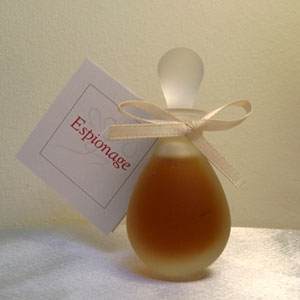
Raymond Chandler found the perfume world so enticing he set scenes in the fictional L.A. perfume company “Gillerlain”—clearly a hat tip to Guerlain—in The Lady in the Lake. But the inspiration went both ways, and perfumers have long mined noir’s archetypes for inspiration. Before going to Hollywood’s Egyptian Theater to attend the 14th Annual Festival of Film Noir this month, dab a little Espionage (peat, musk, vanilla, leather) or Film Noir (chocolate, patchouli, myrrhe) on your pulse points from all-natural perfumer Ayala Moriel.

Online niche perfumer Ava Luxe makes a different Film Noir (leather, black amber, rose, bergamot, tonka) as well as Madame X (coriander, acaciosa, sandalwood, leather, incense).

Perfumes continued to riff on our dark proclivities as the 20th century waned. Yves Saint Laurent had a monster hit with 1977’s Opium, and Dior hit the jackpot with tuberose-grape Poison, the olfactory 50-foot woman of the Reagan years. Haters will rejoice that both have been tamed by reformulation, though Dior evoked dysfunction anew with 2002’s compulsively sniffable Addict.

In 2006, Tom Ford had a giant hit with the neon fruit, tropical florals, chocolate and musk perfume Black Orchid, which evoked the tabloid moniker of a brutally murdered starlet. More recently, niche perfumer By Kilian debuted the L’Oeuvre Noire line, including Liaisons Dangereuses and, my fave, the boozy, peaty Back to Black. Wear it while listening to the Amy Winehouse song and mourning her untimely demise.

Maybe the ultimate femme-fatale scent isn’t a perfume after all. If you want to slay a man while winning his heart, try frying up a $3 package of bacon. Do it often enough, and you might just stop him dead.