
Showing posts with label Murder. Show all posts

Friday, October 14, 2022

FOODIE FRIDAYS: Nibble While You Knit: Chocolate-Orange Sandwich Cookies: Guest Post and Recipe by Peggy Ehrhart

Foodie Fridays. Today I welcome Peggy Ehrhart. Peggy Ehrhart is a former English professor who currently writes the Knit & Nibble mystery series for Kensington. The eighth book in the series, Death of a Knit Wit, appeared in March and her Christmas novella, Death by Christmas Scarf, is included in Kensington’s just-released Christmas Scarf Murder. Her amateur sleuth, Pamela Paterson, is the founder of the Knit & Nibble knitting club, and Peggy herself is a devoted crafter. Visit her at www.PeggyEhrhart.com

***

Peggy Ehrhart: Nibble While You Knit: Chocolate-Orange Sandwich Cookies 

My Knit & Nibble mysteries are set in charming—and fictional—Arborville, New Jersey, where my sleuth, Pamela Paterson, is the founder and mainstay of the Knit and Nibble knitting club. Other club members are Bettina Fraser, Pamela’s co-sleuth and best friend; Nell Bascomb, who is in her eighties; Roland DeCamp, whose doctor advised him to take up knitting as a way to relax from his stressful job as a corporate lawyer; and Holly Perkins and Karen Dowling, the club’s youngest members.


The members take turns hosting the club, and each week’s host serves dessert, a dessert in keeping with that member’s distinctive personality. 


Pamela bakes and serves classic and cozy desserts, like apple cake in Murder, She Knit, peach cobbler in Knit One, Die Two, or rhubarb cheesecake pie in Knitty Gritty Murder. 


Bettina ceded all cooking duties to her husband Wilfred when he retired, and he loves having a larger audience for his creations when it’s his wife’s turn to host the group. In Knit One, Die Two, he makes a glorious lattice-top apple pie, and in A Fatal Yarn, he bakes a shoo-fly pie.


Nell thinks people eat too much sugar. But when she hosts the group in Died in the Wool, she serves a yummy cherry strudel that her husband Harold fetched from a special bakery he patronizes when he’s craving the sweets that she disapproves of. Left to her own devices she makes a sturdy bread pudding using leftover bread in Knit of the Living Dead. 


Holly is a twenty-something who is enamored of mid-century modern style and, in fact, all things 1950s—as only someone who didn’t live through this decade could be. She seeks out vintage cookbooks and likes to reproduce dishes that were popular in the fifties, like baked Alaska in Knit One, Die Two.


Karen, another twenty-something, at first knows how to make only one dessert, chocolate-chip cookies, which she serves in Died in the Wool.  


And Roland DeCamp prides himself on rising to the occasion with a home-made dessert when it’s his turn to host. I let him use shortcuts though—like a “dumpcake” that involves boxed cake mix, canned fruit, and a lot of butter in Murder, She Knit.

The knitting club meetings are not the only occasions on which food is served, however. The series includes many festive meals, often holiday meals. In Death by Christmas Scarf, one of three novellas in Kensington’s recently released Christmas Scarf Murder, Pamela bakes a special cake as her contribution to the Christmas dinner hosted by Wilfred and Bettina. It’s an orange-flavored yellow cake with vanilla cream filling and chocolate buttercream frosting.


Christmas and oranges seem to go together. I imagine that’s because before we could buy any produce flown in from anywhere at any time of year, oranges were one of the few fresh fruits available in the winter—perhaps because they held up even when shipped overland.


The recipe for Pamela’s special cake is included at the end of Death by Christmas Scarf, so I thought it would be fun to combine oranges and chocolate in another recipe for Foodie Fridays: Chocolate-Orange Sandwich Cookies. These are sugar cookies with a “sandwich” filling: a layer of chocolate and a layer of orange marmalade. You can use ready-made sugar cookie dough from the refrigerator case at the supermarket or you can make the cookies from scratch.


Here’s my recipe for the cookies from scratch. It makes about 32 cookies, enough cookies for 16 “sandwiches.”


CHOCOLATE-ORANGE SANDWICH COOKIES


Ingredients for Sugar Cookies:


2 generous cups flour

1 tsp. baking soda

1/2  tsp. baking powder

3/8 tsp. salt

7/8 cup butter, softened (14 tbsp.)

3/4 cup sugar

1 tsp. vanilla

1 egg


Ingredients for Filling:


3 oz. good-quality chocolate, semisweet baking chocolate or from a chocolate bar (semisweet or sweeter if you wish)

2 tbsp. butter

Orange marmalade, about 16 tbsp.
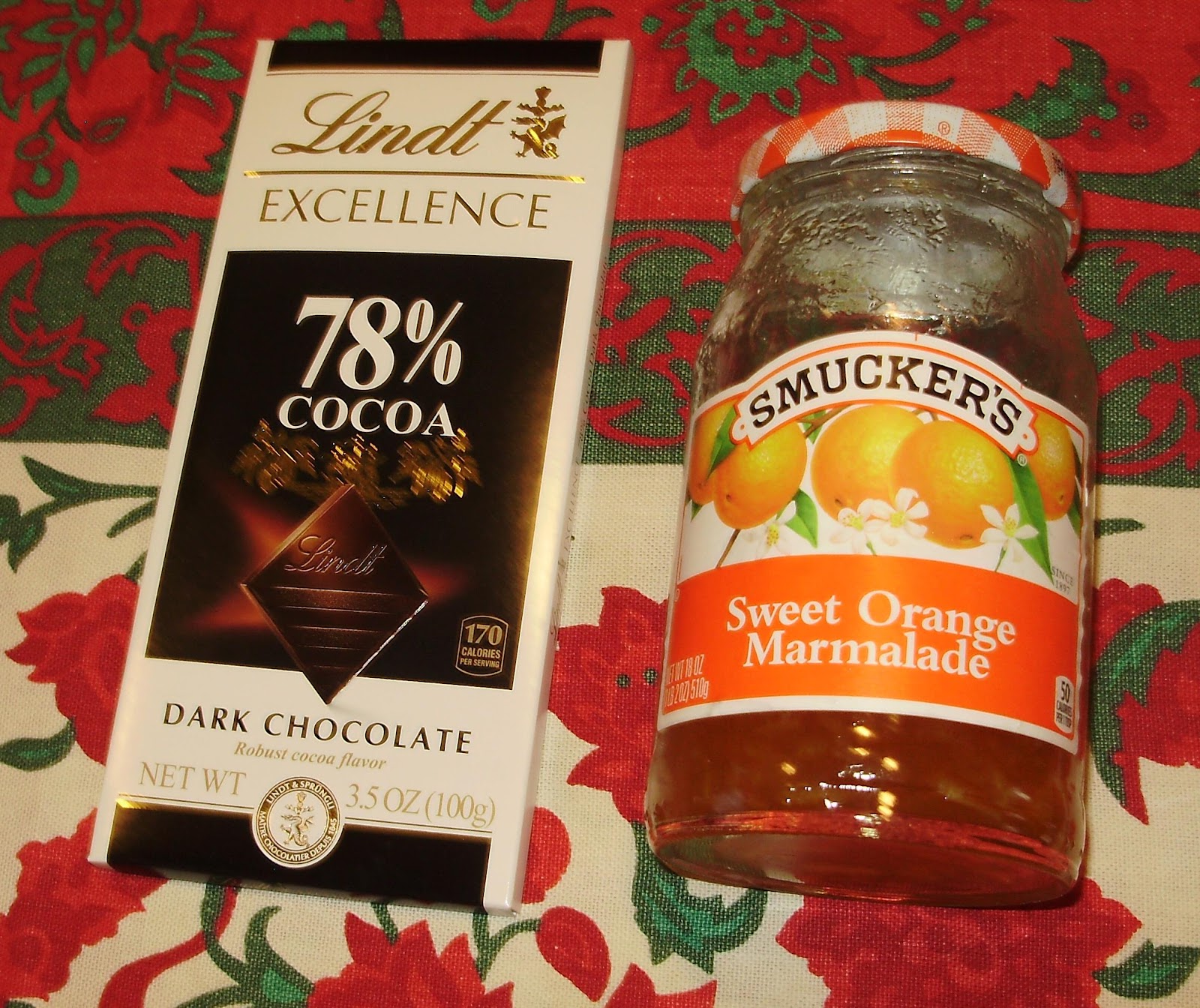
 

Mix flour, baking soda, baking powder, and salt in a medium-sized bowl and set aside. With an electric mixer, cream butter and sugar together in a larger bowl, add vanilla, and beat on high speed until fluffy, about 2 minutes. Add the egg and beat until blended. Add the flour gradually and beat on low speed until all is thoroughly combined. 

Scoop off tablespoon-sized pieces of dough and form them into balls. Arrange the balls on a greased baking sheet with at least two inches between them. Press down on the balls to flatten them slightly.


Bake at 350 degrees for 12 to 15 minutes. (Check them after 12 minutes.) They should be very slightly brown around the edges when done.

Let the cookies cool and remove them from the baking sheet with a spatula. 


Break the chocolate bar into squares and melt it in the top of a double boiler or heavy-bottomed pot with the butter. 


When the chocolate and butter have melted together, remove the pot from the stove and let the mixture cool and thicken slightly. While it’s cooling, spread orange marmalade on the bottom of half the cookies, about one tsp. per cookie. 


Spread the chocolate mixture on the bottom of the rest of the cookies. (Photo is just one cookie.)


Press the cookies together to make sandwiches.


Tuesday, October 11, 2022

ANGELA LANSBURY: R.I.P.

ANGELA LANSBURY: R.I.P.

    What an amazing woman and career...

From the NYT:

Angela Lansbury, a formidable actress who captivated Hollywood in her youth, became a Broadway musical sensation in middle age and then drew millions of fans as a widowed mystery writer on the long-running television series “Murder, She Wrote,” died on Tuesday at her home in Los Angeles. She was 96.

Read more here. 

Monday, November 25, 2019

A Time for Murder...and Something New: Guest Post by Jon Land

JON LAND:
A TIME FOR MURDER . . . AND SOMETHING NEW 

A Time for Murder marks the 50th title in the iconic Murder, She Wrote book series based on the fabulously successful television show. Of those fifty titles, I’ve been lucky enough to pen four now, which carries with it a tremendous responsibility to the series’ fans and followers. After all, Murder, She Wrote has been around since it debuted on CBS in 1984 and was regularly rated among the most-watched shows on the air for a dozen seasons, drawing audiences that often approached twenty million viewers.

The opportunity to take over a series I knew and loved so much (my second favorite TV mystery series after Columbo!) was surreal. As a thriller writer, would I be up to the task? Would I be able to satisfy the legions of fans who followed the television series into the book world or discovered the books separately?

I knew from the moment I put to pen to paper—well, fingers to keyboard—that the answers to both questions was a resounding, YES! That’s because I was able to find Jessica Fletcher’s voice in my first series contribution, A Date with Murder, right from the start. She’s listed as my co-author with good reason, because it’s her voice I hear in my mind when I’m writing (Well, Angela Lansbury’s voice, actually!).

Early on in the process, I thought it would be fun to give the series a bit of a reboot in terms of timing and technology. I didn’t want to leave Jessica stranded in an unchanged past, so my writing evoked Murder, She Wrote updated to the current day with Uber, iPhones, text messages, and a Cabot Cove newly besieged by tourists. But the essence of her character remained the same; she may compose her novels on the latest Mac, but she still does her research at the Cabot Cove Library where she serves as president of the friends group.

At some point during the writing of my next two efforts, Manuscript for Murder and Murder in Red, I asked myself what could I do that no one had ever done before? My thinking on that started with a conversation about how the television series might stage a return someday. CBS has already flirted with the notion, with Octavia Spencer in the lead role. The network, though, ultimately backed off, figuring there was only one Jessica Fletcher and her initials are “AL.”

But what about a younger Jessica Fletcher, I asked myself? A Jessica still married to very much alive husband Frank, raising her nephew Grady, and serving as a substitute English teacher at a Maine high school while trying to get published twenty-five years in the past. What if a murder happened at that high school and Jessica was drawn in, finding that she not only has a knack for solving crime, but also for writing mysteries?

And so A Time for Murder was born. I had an absolute blast reverse-engineering the back story presented and/or hinted at in the television show. For instance, the name of the high school where Jessica taught is never mentioned anywhere on the show or in the previous books in the series. But she met her husband Frank while the two of them were volunteering on a play at the Appleton Playhouse, so I placed them in Appleton. And when the town’s beloved high school principal is murdered, who do you think the detective on the case turns out to be?

Amos Tupper, future sheriff of Cabot Cove fabulously played by Tom Bosley in the TV series. That gave me an excuse to explore the very origins of his relationship with Jessica, as well as incorporating one of the TV series’ most popular characters into the story, no easy task given that he was replaced long ago as sheriff by Mort Metzger.

To say I was off and running with A Time for Murder would be an understatement. Indeed, I was off on a dead sprint following a murder in the present intrinsically connected to that of the high school principal in the past. Add to that the fact that Jessica has been invited to a retirement party for one of her old colleagues at Appleton High and I had the connective tissue that every book demands, in this case through flashback chapters triggered by Jessica’s memories.

I was essentially writing two separate, interconnected stories and having a blast with both of them. And in that respect A Time for Murder became what superhero film fans might call an “origins” story, as it sought to answer many of the questions never addressed by either the previous books or the TV series itself. And I can’t tell you how rewarding it was to bring something new to a series that enjoys such great name/brand recognition, a series that has been around for more than thirty-five years.

I always tell people that one of the real keys to penning a great story is to enjoy writing it as much as the reader will enjoy reading it. And I have every confidence that fans of both the book and television series will love meeting Frank and young Grady, not to mention (spoiler alert!) younger versions of real estate agent Eve Simpson and Seth Hazlitt, along with the aforementioned Amos Tupper. Want more? How about Jessica seeing her beloved home at 698 Candlewood Lane for the first time and wondering whether she and Frank can afford it? We’ll see her in A Time for Murder displaying her incredible powers of observation for the first time in solving a murder twenty-five years in the past that culminates in a Columbo-like twist.

As a thriller writer by nature, I so enjoy exposing Jessica to a bit more danger than she’s been used to in the past; in fact, one critic coined a new literary term in describing my approach to Murder, She Wrote: the cozy thriller. Labels aside, I find America’s favorite sleuth to be an exceptionally strong woman, forging a great life for herself without anyone else’s help. I always found her to be ahead of her time back when the series was on the air, and I continue to see her as a feminist heroine today.

For me, reading a Murder, She Wrote mystery is like visiting twice a year with old friends you haven’t seen in too long. And in A Time for Murder, get ready to take a trip back in time to meet some new ones.

***
Jon Land is the bestselling author over 25 novels. He graduated from Brown University in 1979 Phi Beta Kappa and Magna cum Laude and continues his association with Brown as an alumni advisor.
Jon often bases his novels and scripts on extensive travel and research as well as a twenty-five year career in martial arts.  He is an associate member of the US Special Forces and frequently volunteers in schools to help young people learn to enjoy the process of writing. Jon is the Vice-President of marketing of the International Thriller Writers (ITW) and is often asked to speak on topics regarding writing and research. In addition to writing suspense/thrillers John is also a screenwriter.

Sunday, December 11, 2016

Transferware and Murder! Guest post by Judie Siddall

The following post by my sister, Judie Siddall, and originally appeared on Dishy News: A Transferware Blog. Judie has operated Merlin Antiques (www.merlinantiques.com), specializing in 19th century British transfer printed pottery, since 1990. She is a founding member of the Transferware Collectors Club, and has served as its president and vice president. She is  presently the membership secretary and editor of the animals category and co-editor of children's patterns of the TCC pattern and source print database. 

JUDIE SIDDALL:
TRANSFERWARE AND MURDER!

The Commandments/Thou shalt do no murder" 19th century child's plate
I rarely see transferware patterns that feature murder. I shall qualify this statement by saying I did write a post about the sixth commandment: "Thou shalt do no murder." Arguably, the murder of Abel by his brother Cain is the first and most famous murder. It appears on a plate intended for a child, one of a series illustrating the Ten Commandments. However, the pattern of a unattractive building with a sign over the door, seen below, was an enigma. Luckily, the words on the sign were a key to searching the Internet. I learned that the pattern showed the Bills o'Jacks pub or inn, where a double murder was committed.

"Bills O Jacks April 2nd 1832" 3/12 inch souvenir child's mug
Old photo of Bills o' Jacks Inn (later called the Moor Cock Inn). The Inn was demolished in 1937.
On April 2, 1832, the landlord of the Bills o' Jacks Inn, Thomas Bradbury, and his son, William, were violently murdered. The popularity of the murder, or shall I say infamy of the murder, was because it was so grisly, and the crime was never solved. After nearly two hundred years, the mystery of the murders is still exciting interest. I know this because I have seen many sites on the Internet dedicated to the Bills o'Jacks murders. The inn no longer exists, it was demolished in 1937, but the grave of the victims can still be seen in the churchyard of St. Chad's Church in Saddleworth in Yorkshire, England.

If this mug was really intended for a child, I could add it to my list of inappropriate patterns for children. (For other examples of inappropriate patterns, you might like to see my blog post titled "Inappropriate Or Frightening Patterns For Children.") If you are interested in more history of the murder, take a look at the blog post, "Bills o'Jacks" from the blog titled "Wessyman."

I wrote this post because after collecting and studying transferware for more than 30 years, I am still surprised by some of the patterns. Please let me know about patterns that have surprised you.

Monday, June 27, 2016

Summer Sleuthing: Lazy, Hazy, Murderous Days of Summer

Summertime, and the living is easy. Or is it? I got to thinking about all those mysteries that take place during Summer--on the Beach, at the Lake, and in the City that are filled with murder and mayhem! What follows is a list of Summer Crime Fiction that exudes the heat and the accompanying crime of Summertime.  I've omitted Fourth of July and Labor Day from this list. I'll be updating those lists later this Summer. As always I invite you to add any titles I've missed. This is far from a definitive list.

Summer Mysteries 

Foxglove Summer by Ban Aaronovitch
The Corpse with the Garnet Face by Cathy Ace
A Cat on a Beach Blanket by Lydia Adamson
Moon Water Madness by Glynn Marsh Alam
A Tangled June by Neil Albert
Gold Medal Threat by Michael Balkind (Kids: 7-15)
A Midsummer Night's Killing by Trevor Barnes
Milwaukee Summers Can Be Deadly by Kathleen Anne Barrett
Summertime News by Dick Belsky
The Summer School Mystery by Josephine Bell
Jaws by Peter Benchley (maybe not quite a mystery, but a good read, especially at the Beach)
Bittersweet by Miranda Beverly-Whittemore
Murder by Fireworks by Susan Bernhadt
A Death in Summer by Benjamin Black
The Down East Murders by J.S. Borthwick
The Sweetness at the Bottom of the Pie by Alan Bradley
The Cat Who Saw Stars, The Cat Who Went Up the Creek by Lilian Jackson Braun
Chill of Summer by Carol Brennan
Devils Island by Carl Brookins
Remember Me by Mary Higgins Clark
Beach Music by Pat Conroy
Postmortem by Patricia Cornwell
Death on a Summer Night by Matthew Costello
A Shoot on Martha's Vineyard by Philip Craig
The Trouble with a Hot Summer by Camilla Crespi
A Summer in the Twenties by Peter Dickinson
The Gold Coast, Plum Island by Nelson DeMille
Killer Heat by Linda Fairstein
The Angel of Knowlton Park by Kate Flora
Lord James Harrington and the Summer Mystery by Lynn Florkiewicz
Beneath the Skin by Nicci French
Murder Makes Waves by Anne George
The Caleb Cove Mystery Series  (3 in the series) by Mahrie Reid Glab
The Summer of Dead Toys by Antonio Hill
Summer of the Big Bachi by Naomi Hirahara
Murder at Wrightsville Beach by Ellen Elizabeth Hunter
Magic Hour by Susan Isaacs
Death in Holy Orders by P.D. James
A Summer for Dying by Jamie Katz
The Foxglove Killings by Tara Kelly (YA)
Rainy Day Women by Kay Kendell
Midsummer Malice by M.D. Lake
Dark Nantucket Noon by Jane Langton
The Bottoms by Joe Lansdale
Murder on the Ile Sordou by M.L. Longworth
Nun But the Brave by Alice Loweecey
Swimming Alone by Nina Mansfield (YA)
The Body in the Lighthouse by Katherine Hall Page
Mercury's Rise by Ann Parker
The Heat of the Moon by Sandra Parshall
Beach House by James Patterson
Summer of the Dragon by Elizabeth Peters
5 Dan Marlowe/Hampton Beach, NH mysteries by Jed Power
In the Dead of the Summer; How I Spent My Summer Vacation by Gillian Roberts
Hang My Head & Cry by Elena Santangelo
Miss Lizzie by Walter Satterthwait
Vacations Can Be Murder by Connie Shelton
A Fine Summer's Day by Charles Todd
Trail of Secrets by Laura Wolfe (YA)
An Old Faithful Murder by Valerie Wolzien
Orchid Beach by Stuart Woods
Sins of a Shaker Summer by Deborah Woodworth
Summer Will End by Dorian Yeager
Heart of Stone by James Ziskin

Any titles you'd like to recommend?

Saturday, July 12, 2014

Lou Allin: Murder, Eh?

I was so saddened to learn of the passing of Canadian Mystery author Lou Allin. Lou was funny and witty and generous in her support to the entire mystery community.  She will be missed. This article by Lou Allin appeared in the recent issue of Mystery Readers Journal: Canadian Mysteries.

LOU ALLIN
Murder, Eh? 

North of the 49th, we “don’t get no respect.” Aside from legends like Louise Penny, Giles Blunt, and Linwood Barclay, most crime-writing Canucks fight an uphill battle, a maple-leaf mouse sleeping with a stars-and-stripes elephant.

Knowing this, why in the world in 1995 did I set my books in Northern Ontario? Easy answer. I lived there, and landscape defines the characters.

Blame my late start on Ohio, where I lived from age 3 to 32, the ho-hum urban settings of Cleveland and Columbus, then grad school in Athens and a dismal year in poverty-stricken Portsmouth. No inspiration. I was a bush woman-in-waiting.

Then in 1977 I moved to a natural paradise. Canadians would laugh at that description, because the Nickel Capital around Sudbury was notorious as one gigantic pollution pit. Over a century of ruthless logging, then the discovery of nickel, led to open-air smelting and acid rain. The area had a black-rock moonscape the size of Manhattan. Astronauts trained there.

Just before I arrived, the International Nickel Company (Mother INCO) built the Superstack. Whether it wafted the particulate clouds to North Bay or actually “scrubbed” them remains another mystery, but a thirty-year regreening campaign began in earnest. Business, government, and citizens trundling over that bleak core area the size of Manhattan spread “rye on the rocks,” grass seeds and nutrients along with hardy pines. Lake pH balances were restored, and the area turned green again.

Living forty-five minutes north on a glorious sixty-four-square-mile meteor crater lake with massive oaks and maples and wilderness, I had a different perspective, tramping personal footpaths for the next twenty years. Crown land extended from my cozy cottage for hundreds of kilometres in three directions. With no television, only skis, boots, snowshoes, snowmobiles, and canoes, I learned the landscape fast. I had to. Amoral nature took no prisoners.

I studied birds, beasts, flora and fauna, geology, history, and even bought topo maps for final tweaks. God forbid a stream or hill might be in the wrong place. If only a rail line ran to Thor Lake, so be it.

I judged the winter temperature by inhaling. Icy nostrils said -20C. Coughing meant -30C, and I even saw -45C….NOT including wind chill. The frozen lake was a motion picture, whether highlighting a wolf pack at dawn, or carrying a truck convoy in late March. Ice-hut villages puffing smoke and the rainbow of Northern Lights would have pleased Brueghel.

Tired of reading bad paperback mysteries every weekend, I wrote Northern Winters are Murder in 2000. That was followed by Blackflies are Murder, Bush Poodles are Murder (I got a pup), Murder, Eh?, and appropriately as I left, Memories are Murder. The themes were universal yet Canadian. Mining pollution, residential school abuse, bear hunting and marten trapping. They starred Belle Palmer, a realtor familiar with the outback.

My series was an ongoing love letter to a generous community which had embraced me. The local tourist board sold my books. I had a solid reader base at the college where I taught.

Then I moved to Vancouver Island. Time and place for a new series. Instead of my middle-aged realtor, getting old for life-threatening chases, I chose a young RMCP Sergeant in a small coastal detachment. When I arrived with fifty pages completed, I found out that she couldn’t be a sergeant because the staff was too small. Enter Corporal Holly Martin. Nor could she be officially a detective, but she could look at suspicious or cold cases.

Weary of are Murder titles and a frustrated English PhD, I chose lines from Victorian poems. Tennyson, Browning, and Rossetti:

And on the Surface Die 

She Felt No Pain 

Twilight is not Good for Maidens 

Coming up will be Honour Thy Parents (Clough) and Convergence of the Twain (Hardy).

Thirty-five years past her age, I’m getting used to young Holly, not as sure of herself as worldly-wise, tongue-in-cheek Belle Palmer. Holly lives with her professorial father, who teaches Popular Culture. Norman Martin has a border-collie rescue, a frugal Smart Car and is into dog agility like much of the island. Holly works aside an older woman corporal, a prickly but wise foil, and a young handsome Sikh officer rookie.

I relearned my landscape. 8C is not -40C. Any rare snow on the coast turns to rain. And damp? I’m colder here than in Sudbury, where I had an R 2000 house and long burning oak and maple instead of crummy fir which goes to bed at nine pm. Holly’s house is also only 2X4 instead of 2X6, even though it looks like a Greek villa. Once it had a banana plant, and horticulturists swear that lemons can be grown here.

There are no foxes on the island, nor skunks, nor moose, not even one chipmunk. But lots of deer, bear, elk (farther north), and cougars. Blue herons surf the kelp beds, and bald eagles whistle. River and sea otters run across roads, and barking sea lions camp on the beach, waking us at four a.m.

 But “my” trails are gone. The forest companies own or lease most of the land down south and are intent on fueling the Chinese and Japanese appetites. They’ve closed most mills, shipping raw logs. Loaded trucks pass me on this coastal road, sometimes one every FIVE minutes. When they overturn, it’s pick-up-sticks. At least the companies plant to erect a wind farm on the “Easter Island” hills they’ve despoiled. They are pairing with one of Canada’s greatest First Nations successes, the T’sou-ke tribe, totally solar-powered and a national inspiration.

 What’s new? Banana slugs in three varieties, few if any mosquitoes in the salt air. Douglas fir, Sitka spruce, hemlock, alder, and bigleaf maple have replaced the Boreal hardwoods. Fall’s palate is not as brilliant, but rhodos bloom in March and I see daffodils peeking up Feb. 8.

The land is a banquet with the richest selection of berries on the continent, due to the long growing season and rare frost. Salmonberries, salal, two huckleberry varieties, creeping blackberries, Himalayan blackberries, wild strawberries.

No poison ivy. But invasives like scotch broom, English ivy, and gorse, all brought by homesick Scottish founders. Huge cow parsnips and colourful yellow skunk cabbage begin the parade, followed by edible tubers from the blue camas and chocolate lily. Fungi like chanterelles accompany exotic candysticks and gnome plants.

The sea adds its bounty. Halibut and salmon, each creek marked as “our resource”. Clams, oysters, whelks, shrimp, and octopus. Some seaweed is edible, and the larger bull kelp is made into baskets. Add an abundance of deer and see why our First Nations ate better than most of their eastern relatives.

We’re bound not by distance but by water. Ferries are expensive, a driver and car paying $165 for a round trip to Vancouver. RVs? If you have to ask…. We can see our US neighbours across the Strait of Juan de Fuca, another living water portrait. Behind their shores loom the mighty Olympic Mountains with Little Egypt, a secretive pyramidal peak. The fog toys with us as mounds of whipped cream on one side roll to the other. And freighters, timber ships, oil tankers, and seasonal cruise ships ply the waters. So do the whales, which on a clear day I can see from my bedroom window.

It may rain eternally, but you can “go to the snow,” all twenty feet of it in the hinterland heights. I’ve snowshoed in June to see the avalanche lilies.

With this exotic atmosphere, we should be in the best-selling ranks like the Scandinavians. Take this Icelandic book selection:

“Before going downstairs he telephoned Sigurdur Oli and told him to go with Elinborg to Hafnarfjordur to take Gudlaugur's for questioning.”

You are NOT in Kananaskis anymore, Dorothy. If you think that’s hard to read, you should have heard me pronouncing those names even after consulting with a scholar in Reykjavik. Boiling smoked lamb for holidays. Crawfish Parties. Icelandic details keep the pages turning.

We are not the USA North. We have our own personality and our own plastic money and shiny bi-metal coins and motto: Peace, Order, and Good Government. Two out of three isn’t bad.

Let’s tell the world and use more multicultural names like Etienne, Pierre, Telesphore, Chirakumar, Jorma, Cholmondley, Colin, Siobhan, and Wilfred.

How about places like Dildo, Quispamsis, Ecum Secum, St. Louis de Ha Ha, Buzwah, Wawa, Pickle Lake, Medicine Hat, Moose Jaw, Climax, and Spuzzum?

Platter up our foods: poutine, cod tongue, jellied moose nose, scrunchins, candied salmon.

And while we might not have many handguns, what about bug spray, Bobex deer repellent, Inuit sculptures, and chainsaws?

There might even be a birchbark scroll with a Papal plot involving the Jesuits.

Canada is as criminous as any other country. We have to stop being so gol-darned polite about it.