
Showing posts with label Partners in Crime. Show all posts

Monday, December 2, 2024

PARTNERS IN CRIME: Collaborators Continue the Molly Murphy Series by Rhys Bowen and Clare Broyles

The last issue of Mystery Readers Journal focused on Partners in Crime. It was a great issue with a variety of articles, reviews, and author essays. Here's a link to the Table of Contents. I thought I'd make more of the essays available to my blog readers, so I'm posting Rhys Bowen and Clare Broyles's author essay: Collaborators Continue the Molly Murphy Series.

Want to read the entire issue? It's available as a downloadable PDF.

Collaborators Continue the Molly Murphy Series by Rhys Bowen and Clare Broyles

    RHYS BOWEN: Two years ago my daughter Clare came to me with an unexpected proposition. She said, “I think I’d like to write the Molly Murphy series with you.”

I had put that series on hold after book seventeen because I was already writing two books a year, one of them a big historical stand-alone novel that required loads of research. I simply did not have time for a third book. But as Clare pointed out, I got a constant stream of emails saying “when is the next Molly book coming out?”

I was ambivalent about Clare’s suggestion. I knew she was a good writer, but what if she couldn’t get Molly’s voice or the tone of the novels? She was my daughter. I loved her dearly. What if I had to tell her it wasn’t working out? But I agreed to give it a try. I was so pleasantly surprised. I had expected to do a lot of hand-holding to start with, a lot of rewriting, mentoring.

Instead Clare read all seventeen books again then hit the ground running. She got Molly’s voice perfectly, and she came to that first book with so many good ideas.


CLARE BROYLES: I loved the Molly Murphy series from the first book and didn’t want the series to die. I knew that to be successful as a collaborator I had to get Molly’s voice. So I not only read through all seventeen of the novels taking notes, I also listened to the audiobooks. Early on, Rhys gave me some great advice. She suggested that whenever I felt stuck, I picture myself sitting in Molly’s house at her kitchen table while she tells me a story about her life. I try to be the listener as I write, and that it is Molly who drives the story in her own words.


RHYS: We fell into a smooth way of working. We talk through the main theme of the book, we decide on our characters and their names, do the preliminary research, then we work together on the first chapters. After that it’s all rather organic. Clare might tell me she can picture the party scene so she takes it. I read it through, sometimes tweak here and there, and go on ahead. She reads through my scenes and then goes ahead again. We talk every day, bouncing ideas off each other.


CLARE: It is such a gift to have a co-writer. For one thing, I get instant feedback on each scene that I write. Most writers have to just live with their self-doubt! And each time I write ten pages, Rhys has written ten more, so I get to be a reader as well. We spend hours discussing the tricky details of the murder. We want to play fair and give the readers clues, but also have a clever solution. In All That Is Hidden, our latest Molly Murphy, we blithely gave ourselves the challenge of a locked room mystery. And then we had to figure out how the murderer could have done it!


RHYS: Obviously books set in the early 1900s require a lot of research. Clare has turned out to be the queen of research. She reads the New York Times archives for every day we write about and has come up with great ideas that we’ve incorporated into our plots. I come with the background knowledge of having written almost twenty books set in the time and place. I know Molly’s New York intimately, having walked every street when I was writing the first books, as well as having assembled a collection of photographs of the city, restaurant menus, Sears catalog for 1900 etc etc. So when Clare is writing she will leave details of Molly walking across Manhattan and what she might have seen to me. And I leave it to her to find out details about Tammany Hall corruption, the mayor’s election, dirty dealings at the docks.

Clare, tell the readers what brilliant news items you found for our new book, All That Is Hidden.


CLARE: One of the first articles I read was about a boat catching fire on the Hudson. The New York Times gave an exciting account of the boat being engulfed in flames as the crew struggled to dock and couldn’t, then finally made fast at a small dock that promptly burst into flames. Rhys and I knew we had to put Molly on that boat. And that detail shaped a major character. We knew we wanted a wealthy man involved in our mystery, but when we decided to include the boat it led us to the docks and Tammany Hall. I scoured the Times for mentions of Tammany Hall and read about the Republicans teaming up with William Randolph Hearst’s Independence Party to try to take control away from Tammany. Those stories formed the background to the novel.


RHYS: We have just turned in our third book. This one was exceptionally fun to write because we set it in the Catskill mountains at the very beginning of the Jewish bungalow communities. Again I left it to Clare to do the research. She found videos of a train ride through the mountains, old maps and what were the plums, Clare?


CLARE: I learned that the streets of New York were paved with bluestone that came from quarries in the Catskills. In 1907 Portland cement was replacing blue stone and the quarries were in trouble. A new Catskills state park had just been formed with the first Park Rangers, and chestnut trees were still abundant, although the blight was spreading. My favorite find was an artist’s community that was a summer destination for bohemians like our characters Sid and Gus, and for many professional women. It still exists today with lodging and a theater. We decided to make a fictional version for Molly to visit and have the liberal inhabitants come out in protest against the blue stone quarrying that was disturbing the peace of the Catskills.


RHYS: So now we had plenty of conflict. Plenty of potential for clashes and motives for murder. Obviously we are writing about a community that is not our own. We felt this was okay to tackle as it is all seen through Molly’s eyes, the eyes of an outsider. However we wanted to make sure everything about the Jewish community was completely authentic so I enlisted the help of an old friend in New York, who comes from a distinguished Jewish family and we had her go through the book for us. She is a former editor and she went through with a tooth comb! And miraculously she found very little to criticize or change.


CLARE: I don’t think you could write about the Catskills without including the Jewish community. At that time the large resorts had signs saying, “No Hebrews”. It didn’t matter how wealthy or educated the family was. If you are a fan of the Molly books you know that many of them deal with a group who is excluded because of their gender, race or religion. Including, of course, the Irish who arrived in New York to signs that said, “No Irish need apply.” I hope we are able to continue to tell those stories.


RHYS: It is my plan to step back gradually with each book until I can hand the series over to Clare and I’ll lurk in the background as the mentor. So watch out for her. She’s already coming up with brilliant ideas for her own series.


Rhys Bowen was born in Bath, England, but has called California her home for many years. When she’s not writing, she loves to travel, sing, hike, paint, play the Celtic harp, and spoil her grandchildren.

Clare Broyles is a teacher, and music composer whose work for theater won an Arizona Zoni award. She is now a perfect partner in crime.

 

Monday, October 28, 2024

PARTNERS IN CRIME: MYSTERY READERS JOURNAL (40:3)


 Partners in Crime

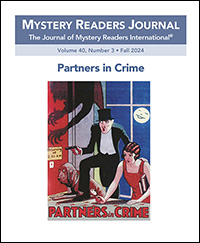
Mystery Readers Journal: Partners in Crime (40:3) is now available as a PDF and Hardcopy. In this issue you’ll find essays, reviews, and articles for both Partners in Crime (a Surfeit of Sleuths) and Partners in Crime (Writers Who Write Together). 

If you're a PDF subscriber, you should have received download instructions. Hard copy subscription copies should be received by the end of the week. International subscribers will receive their issues within two weeks. PDF Contributor copies will go out in the next few days. Thanks to everyone who contributed to this amazing issue.

***
In 2001, we had two separate issues on Partners in Crime.  

 and 
These issues are available as PDFs. The past issues complement this Partners in Crime 2024 issue (Volume 40:3). I know you’ll enjoy them all and find new books and authors to expand your reading! 


Partners in Crime
Volume 40, No. 3, Fall 2024


Buy this back issue! Available in hardcopy or as a downloadable PDF.

TABLE OF CONTENTS

ARTICLES

  • Unforgettable Duos: Fictional Partners in Crime by Ayoola Onatade
  • If You’re Ever in a Jam, Here I Am by Margot Kinberg
  • Morse & Lewis—The Perfect Partners in Crime by Paul Charles
  • Those Loveable “Sidekicks!” Who’s Your Favorite? by Lou Armagno
AUTHOR! AUTHOR!

  • An Author and Her Characters Team Up by Annamaria Alfieri
  • Partners Balance Crime Fighting by Saffron Amatti
  • A Study in Contrasts by Paul A. Barra
  • Why Two by Two? by Albert Bell
  • A Partnership—Not that I Wanted One by J. F. Benedetto
  • Two Voices Morph into a Third by Cordelia Biddle and Steve Zettler
  • Collaborators Continue the Molly Murphy Series by Rhys Bowen and Clare Broyles
  • Partners in Crime: The Pear Mystery Series by Robin Castle
  • Partners in Magic and Murder by Ron Cook
  • The Working Group by Susan Courtwright
  • You Can’t Do It Alone by J. Salvatore Domino
  • Partners Write Partners by Lee Elder
  • Cronies, Chums, and Colleagues by Kate Fellowes
  • The Unique Partnership in The Nest by Hal Glatzer
  • When Two Are Not Enough by Bradley Harper
  • The Birth of “Ticket to Ride” by Dru Ann Love and Kristopher Zgorski
  • The Partner Sleuths in My Mysteries by Adrian Magson
  • (Life) Partners in Crime by Ron Katz
  • One Plus One Makes It More Fun by Tim Maleeny
  • The Equalizer by Jeanne Matthews
  • The Conjuror and the Copper by Tom Mead
  • Why I Write with Partner Sleuths, Sort Of by Mike Orenduff
  • Father/Daughter Detective Duo by Marcy McCreary
  • Multiple Accomplices by Josh Pachter
  • Writing Together Can Be Murder, But That’s Not All Bad by Larry and Rosemary Mild
  • In It Together by Priscilla Paton
  • Bop City Swing—or How I Fell in Step with a Dancing Partner by M.E. Proctor
  • Life Partners/Partners in Crime by Lev Raphael
  • Detecting Partners, Writing Partners by SJ Rozan
  • He Said, She Said: On Writing Devils Island by Midge Raymond & John Yunker
  • Finishing Each Other’s Sentences by Jennifer Slee and Jessica Slee
  • Brainstorms & Nuclear Bombs: Writing with Your Spouse by Alexandra Sokoloff & Craig Robertson
  • Partners in Crime—Michael and Stanley by Michael Sears and Stanley Trollip
  • My Mother, My Partner by Charles Todd
  • Parasols and Poisons: Gilded Age Partners in Crime by N. S. Wikarski
  • Detection in the Harem by Elizabeth Zelvin
COLUMNS

  • Mystery in Retrospect: Reviews by Aubrey Hamilton, Claire Hart-Palumbo, Lesa Holstine, Dru Ann Love, LJ Roberts, and Jonathan Woods
  • Children’s Hour: Partners in Crime by Gay Toltl Kinman
  • Unexpected Partners in Real Crime by Cathy Pickens
  • Crime Seen: Assorted Ampersands by Kate Derie
  • From the Editor’s Desk by Janet A. Rudolph

Wednesday, July 10, 2024

CALL FOR ARTICLES: Partners in Crime: Mystery Readers Journal (40:3)

Call for Articles: 
Mystery Readers Journal (40:3) 
Partners in Crime

We're looking for articles, reviews, and Author essays about Mysteries that focus on Partners in Crime. 

Partners in Crime: A Surfeit of Sleuths
Partners in Crime: Writing Teams

Author Essays are first person, about yourself, your books, and the "Partners in Crime" connection.  500-1000 words. Treat this as if you're chatting with friends and other writers in the bar or cafe (or on zoom) about your work and the "Partners in Crime" theme: either (1) how and why you write with a partner (s) or (2) the Partner Sleuths in your mysteries. Be sure and cite specific titles, as well as how you use Partners in Crime in your books. Add title and 2-3 sentence bio.  

Reviews: 50-250 words. Articles: 500-1000 words. 

Deadline for Partners in Crime (40:3) articles, reviews, author essays: August 1, 2024: 

Send to: Janet Rudolph, Editor. janet @ mysteryreaders.org. 

Please let us know if you're planning to send an article, review, or author essay! 

We had two other issues focusing on Partners in Crime in 2001. They are both still available as PDFs. Check out the ToC or order a copy. 


Themes for 2024: Mysteries set in Southern California; Murder Takes a Holiday (Mysteries that take place while on vacation); Partners in Crime; Mysteries set in London. 

Not sure if you need to renew? email: janet @ mysteryreaders.org  

Many back issues of Mystery Readers Journal are available as single copies in hardcopy or PDF.  


Have titles, articles, or suggestions for these upcoming issues? 

Want to write an Author! Author! essay? 

email Janet Rudolph   janet @ mysteryreaders.org

BLOGS 
 

Monday, June 5, 2023

Partners in Crime: Guest Post by Rhys Bowen and Clare Broyles On Collaborating in Writing the Molly Murphy Series

RHYS BOWEN
: Two years ago my daughter Clare came to me with an unexpected proposition. She said, “I think I’d like to write the Molly Murphy series with you.”

I had put that series on hold after book 17 because I was already writing two books a year, one of them a big historical stand-alone novel that required loads of research. I simply did not have time for a third book. But, as Clare pointed out, I got a constant stream of emails saying “when is the next Molly book coming out?”

I was ambivalent about Clare’s suggestion. I knew she was a good writer, but what if she couldn’t get Molly’s voice or the tone of the novels? She was my daughter. I loved her dearly. What if I had to tell her it wasn’t working out? But I agreed to give it a try. I was so pleasantly surprised. I had expected to do a lot of hand-holding to start with, a lot of rewriting, mentoring.

Instead Clare read all 17 books again then hit the ground running. She got Molly’s voice perfectly, and she came to that first book with so many good ideas.

CLARE: I loved the Molly Murphy series from the first book and didn’t want the series to die. I knew that to be successful as a collaborator I had to get Molly’s voice. So I not only read through all seventeen of the novels taking notes, I also listened to the audiobooks. Early on, Rhys gave me some great advice. She suggested that whenever I felt stuck I picture myself sitting in Molly’s house at her kitchen table while she tells me a story about her life. I try to be the listener as I write, and that was it is Molly who drives the story in her own words. 

RHYS: We fell into a smooth way of working. We talk through the main theme of the book, we decide on our characters and their names, do the preliminary research, then we work together on the first chapters. After that it’s all rather organic. Clare might tell me she can picture the party scene so she takes it.  I read it through, sometimes tweak here and there, and go on ahead. She reads through my scenes and then goes ahead again. We talk every day, bouncing ideas off each other.

CLARE: It is such a gift to have a co-writer. For one thing, I get instant feedback on each scene that I write. Most writers have to just live with their self-doubt! And each time I write ten pages, Rhys has written ten more, so I get to be a reader as well. We spend hours discussing the tricky details of the murder. We want to play fair and give the readers clues, but also have a clever solution. In ALL THAT IS HIDDEN, our latest Molly Murphy, we blithely gave ourselves the challenge of a locked room mystery. And then we had to figure out how the murderer could have done it!

RHYS: Obviously books set in the early 1900s require a lot of research. Clare has turned out to be the queen of research. She reads the New York Times archives for every day we write about and has come up with great ideas that we’ve incorporated into our plots. I come with the background knowledge of having written almost twenty books set in the time and place. I know Molly’s New York intimately, having walked every street when I was writing the first books, as well as having assembled a collection of photographs of the city, restaurant menus, Sears catalog for 1900 etc etc.  So when Clare is writing she will leave details of Molly walking across Manhattan and what she might have seen to me. And I leave it to her to find out details about Tammany Hall corruption, the mayor’s election, dirty dealings at the docks.
            
Clare, tell the readers what brilliant news items you found for our new book, ALL THAT IS HIDDEN.

CLARE: One of the first articles I read was about a boat catching fire on the Hudson. The New York Times gave an exciting account of the boat being engulfed in flames as the crew struggled to dock and couldn’t, then finally made fast at a small dock that promptly burst into flames. Rhys and I knew we had to put Molly on that boat. And that detail shaped a major character. We knew we wanted a wealthy man involved in our mystery, but when we decided to include the boat it led us to the docks and Tammany Hall. I scoured the Times for mentions of Tammany Hall and read about the Republicans teaming up with William Randolph Hearst’s Independence Party to try to take control away from Tammany. Those stories formed the background to the novel. 

RHYS: We have just turned in our third book. This one was exceptionally fun to write because we set it in the Catskill mountains at the very beginning of the Jewish bungalow communities. Again I left it to Clare to do the research. She found videos of a train ride through the mountains, old maps and what were the plums, Clare?

CLARE: I learned that the streets of New York were paved with bluestone that came from quarries in the Catskills. In 1907 Portland cement was replacing blue stone and the quarries were in trouble. A new Catskills state park had just been formed with the first park Rangers and chestnut trees were still abundant, although the blight was spreading. My favorite find was an artist’s community that was a summer destination for bohemians like our characters Sid and Gus, and for many professional women. It still exists today with lodging and a theater. We decided to make a fictional version for Molly to visit and have the liberal inhabitants come out in protest against the blue stone quarrying that was disturbing the peace of the Catskills.

RHYS: So now we had plenty of conflict. Plenty of potential for clashes and motives for murder. Obviously we are writing about a community that is not our own. We felt this was okay to tackle as it is all seen through Molly’s eyes, the eyes of an outsider. However we wanted to make sure everything about the Jewish community was completely authentic so I enlisted the help of an old friend in New York, who comes from a distinguished Jewish family, and we had her go through the book for us. She is a former editor and she went through with a tooth comb! And miraculously she found very little to criticize or change. 

CLARE: I don’t think you could write about the Catskills without including the Jewish community. At that time the large resorts had signs saying, “No Hebrews”. It didn’t matter how wealthy or educated the family was. If you are a fan of the Molly books you know that many of them deal with a group who is excluded because of their gender, race or religion. Including, of course, the Irish who arrived in New York to signs that said, “No Irish need apply.” I hope we are able to continue to tell those stories. 

RHYS: It is my plan to step back gradually with each book until I can hand the series over to Clare and I’ll lurk in the background as the mentor.  So watch out for her. She’s already coming up with brilliant ideas for her own series.

***

Rhys Bowen is the NYT bestselling author of the Molly Murphy and Royal Spyness series as well as several internationally bestselling historical stand alone novels. Her daughter Clare Broyles is a teacher, music composer whose work for theater won an Arizona Zoni award, and now a perfect partner in crime.
 

Tuesday, October 9, 2018

PARTNERS IN CRIME: Rosemary and Larry Mild

Today Rosemary Mild joins me in our continuing feature: Partners in Crime, collaborating writers. Rosemary and Larry Mild, cheerful partners in crime, call Honolulu home. They’ve published six mystery novels; two Hawaii suspense/thrillers; a sci-fi novella; and two books of short stories—with settings reaching from Hawaii to the Far East. Visit the Milds at www.magicile.com.

ROSEMARY MILD:
PARTNERS IN CRIME

When a husband and wife write as a team, how do they create fiction that comes out seamless, sounding like one author? Big question.

Larry and I came from different worlds in 1986. We met on a blind date. He had lost his wife to cancer, and I had been divorced for eight years. In the car on the way home from dinner, he said, “When I retire I’m going to write a novel, and I want you to help me.”

Now neither of us had ever written fiction. I was an editor; Larry was an electrical engineer, and we’d only known each other for four hours! Still, I chirped, “Okay!” We’d gotten along so well that I knew he was Mr. Right. We married a year later.

True to his word, when Larry retired he wrote the first draft of Cry Ohana, Adventure and Suspense in Hawaii. Then he handed it to me—the halt leading the blind! After umpteen drafts, three titles, and a critique group, we published it. It’s always been our most popular book.

Our newest work is the long-awaited sequel: Honolulu Heat, Between the Mountains and the Great Sea, the continuing saga of the Cry Ohana families.

Many readers ask how we started writing together. Early on, with hot-headed arguments and wounded feelings. For example:

Larry: “You cut that whole paragraph. I worked for hours on it.”
Rosemary: “Less is more, darling.”
Larry: “Oh, yeah? You gave a back story to the grocery bagger.”

Somehow we survived as we both improved our writing—and respect for each other’s.

Larry considers himself more devious than I, so he conjures up all our plots and writes the first draft. He’s at the computer writing five to six hours most days. He has a much longer attention span than I have. Then he turns the manuscript over to me. And waits.

Larry rolls his eyes. “Rosemary could work a little faster. We’re getting behind by the day. Her strength as a writer? She has this wonderful feel for human nature. She breathes life into my minimalist characters: physical appearance, sharpening the dialogue, and often adding a defining trait.”

I admit that there are times when his elegant passages don’t work for me; they can stop the action. So I’ll do “judicious pruning,” an expression I learned as an assistant editor at Harper’s. Larry calls it “slash and burn.” But you know how it is. Stephen King said, ‘To write is human. To edit is divine.’ Then, with sleeves rolled up, we negotiate.

According to Larry, “The best thing about working as a team is that we’re never writing in a vacuum. There’s always someone close by to listen to your story’s direction and your choice of words. The helping hand when you can’t find that ever-so-right word or story twist is a godsend. After we agree on the final draft, we read the entire book aloud to each other. Amazing the inconsistencies we discover.”

So what’s the toughest thing about writing as a team?

Larry says, “If you’ll excuse my Latin, there’s this co-writus interruptus thing. Working back-to-back in the same bedroom-turned-office. it’s too easy to stop her and ask: “Does adrenaline have an e? rather than look it up myself.

Writing together does have its tough parts. For starters, I don’t interrupt. I disrupt. I was fishing a hammer out of his toolbox. He asked me, “Where are you going with that?” I told him I was going to discipline the vacuum cleaner; it was stuck on High. He said, “Bring it here.” He turned the vac upside down and in five minutes had it fixed. I asked, ‘Would I have broken it if I had given it a few whacks?’ Larry was quick to reply, “Definitely!”

As a team we do face a potential snag working together. I have my own nonfiction life—personal essays and memoirs. Love! Laugh! Panic! Life with My Mother is my newest. Miriam’s World—and Mine is my second memoir of our daughter Miriam Luby Wolfe, whom we lost in the terrorist bombing of Pan Am 103 over Lockerbie, Scotland. She was 20 and my only child; Larry’s stepdaughter. Larry published an op-ed piece in the Baltimore Sun, “Six Ways To Prevent Airline Terrorism.” Our Maryland congresswoman wrote it into the Congressional Record.

Somehow, we manage to juggle our separate interests. Recently, we gave talks at the University of Hawaii’s Lifelong Learning Institute. Mine was “From Hurt to Healing: Writing Your Personal Story.” Larry’s was on “Engaging Elements of the Mystery.”

In our second series, the Dan and Rivka Sherman Mysteries, we created a Jewish couple very much like ourselves (but younger). Dan and Rivka buy the fictional Olde Victorian Bookstore in Annapolis, Maryland, and become reluctant sleuths.

Larry says, “Rivka is a lot like Rosemary: feisty, super-smart, affectionate, and addicted to chocolate.

Dan, like Larry, is analytical and practical, a born problem-solver—and an incorrigible punster. On our blind date he made a pun and told me he was born in the year of the Zaniac.

We love using our own experiences in our fiction. In Hot Grudge Sunday, sleuths Paco and Molly are on their honeymoon out West. Their itinerary is based on a tour we took, but with hair-raising consequences ending at the Grand Canyon. In Death Steals A Holy Book, the Menorat ha-maor (“Candlestick of Light”) is based on a rare Yiddish book that Larry inherited.

We currently have a series of stories called “Copper and Goldie” in Mysterical-E, an online mystery magazine. Sam, a disabled Hawaiian ex-cop, is a cabbie and P.I. He and his rescue golden retriever (with a dash of Doberman) always land in trouble in Honolulu and still manage to solve crimes. Sam walks with two canes. Larry gave Sam his own chronic back trouble; he too walks with two canes. Sam’s Auntie Momi asks: “You still walkin’ wit’ dem giant chopsticks?”

Larry and I really enjoy working as a team. With more books to come, life is mysteriously good.

Thursday, June 21, 2018

COLLABORATING IN (FICTIONAL) MURDER IS FUN! Guest post by collaborating debut writing team Ashley Dyer

I love our Partners in Crime feature here on Mystery Fanfare. Today I welcome Ashley Dyer. Ashley Dyer is the penname of Dagger-winning crime novelist, Margaret Murphy, working in consultation with forensics expert, Helen Pepper. Their debut novel, Splinter in the Blood, sold in multiple competitive bids across Europe and the US. It’s out now in the US, published by William Morrow.

Ashley Dyer:
Collaborating in (fictional) murder is fun! 

The writer’s perspective 

How we met 

Helen and I had known each other for many years on the crime conference circuit. She’d been advising Ann Cleeves on the Vera and Shetland series from the outset, and Ann and I are friends and fellow Squaddies (members of Murder Squad, a group of crime writers based in northern England). Ann loved working with Helen, so when I started looking for a forensic adviser, I naturally approached her.

How it works 

I will come up with a story idea and usually write a short, two-to-three-page synopsis. After that, we bat ideas back and forth, talking about story, forensic procedures that might come into play, police approaches to particularly categories of crime, and so on. I mull for a bit, then start on the full outline, which may be up to 40,000 words long.

The forensic adviser’s perspective 

Helen: Usually I start talking to the TV scriptwriters at the ideas and storylines stage, checking that they are actually feasible. Once the script writing is properly underway I’ll receive queries that normally start with “what would happen if . . .” or “how can I make this happen?”. Later, I check draft scripts to for procedural inaccuracies. 

Working on the Ashley Dyer novels happens in much the same way – only more intensively. Margaret (Ashley) has an idea for a book and we’ll talk through the themes of the story and discuss the forensic elements we might exploit. She will write a detailed outline, which she sends to me for comment. Then she disappears into her office to write. We stay in touch by e-mail and phone about the work in progress, and she’ll send me batches of completed chapters for comment. This can be quite agonising, as I may have to wait several weeks for the next installment! 

Favourite forensic-type TV series? 

I can’t watch any of them. One of my main bugbears is the clothes TV CSIs wear: Pencil skirts and stilettos are really not going to work well on a building site or in woodland. 

Does it matter that you get procedural elements right? 

We think it does – but then we would, wouldn’t we? However, Splinter In The Blood had some rave reviews in the run-up to the release, receiving a coveted ‘starred’ review from Publishers Weekly, and PW, Booklist and Kirkus reviews, as well as from bloggers and authors. Pretty much all of them commented on the procedural authenticity and power of the forensic elements.

Inspiration for the story: 

Margaret: My earliest jottings on Splinter In The Blood date back to April 2014. It began with an image: a woman with a gun standing over a shooting victim. I wrote, ‘She looks down at him and feels anger and contempt, but also regret.’ I was mystified. She must know the man – you don’t feel such a conflicting mix of emotions unless you know a person – but I had no clue how. I was even more baffled when she began systematically to destroy and then recreate evidence at the scene. It turns out that this is Detective Sergeant Ruth Lake, and the shooting victim is her boss, Chief Inspector Greg Carver.

We learn that a serial killer dubbed the ‘Thorn Killer’ has abducted and murdered five victims using an ancient and excruciatingly painful method of ‘thorn-tapping’. I’ve traced that macabre little detail back to an exhibition at The Wellcome Trust in London in 2010. I was in the city for a meeting, and had a few hours to spare before catching my train home, so I popped in. ‘Skin’ told the story of ritual skin-marking (including tattoos) in pictures, etchings, and even samples of human skin. I was both repulsed and compelled; it haunted me, and I suppose it was inevitable that tattoos would eventually find their way into a story.

Helen: Given a couple of hours to spare in London, I might think, “Oh, good – time for shopping”, or “Mm . . . coffee and cake!”. It’s telling that Margaret’s first thought is to go and look at an exhibition of flayed skin… 

After the shooting, Carver wakes from a coma with a form of synaesthesia. Commonly, a person with the condition might associate a particular word with a colour. Say “envelope”, and they might see yellow, for instance. But numbers, days of the week, sounds and even tastes can trigger colours for a synaesthete. David Hockney, Vladimir Nabukov and Billy Joel, are (or were) synaesthetic. Researching the phenomenon, I found that a few brain trauma survivors do see auras, so I felt okay about having Carver read body language and mood as colour and light. The notion was partly inspired by my own experience: in my early-to-mid thirties, I’d suffered several TIAs – mini-strokes – as a result of a flare of Lupus, after which I experienced, among other things, phantom aromas and distortions of visual perception, one of which is termed the ‘Alice in Wonderland effect’, after Alice’s strange growing and shrinking bouts.

Pros and cons of collaboration 

Pros: I have privileged access to up-to-the-minute advances in forensics and policing, plus a reduced risk of making a complete fool of myself! Helen has attending many thousands of crime scenes, so she knows how they are dealt with, and how people behave, too – so her knowledge also informs character and situation, as well as procedural details. Helen will always go the extra mile to find ingenious solutions to procedural problems, and a big bonus is we’ve had lots of laughs working on the Carver & Lake series. Touring is a lot more fun when you have someone to chat and relax with after all the buzz of a gig.

Cons – None for me as the writer, but I’m not the one who has to deal with a temperamental author…

***

Website: www.ashley-dyer.com For all you need to know about Team Dyer 
Facebook: @AshleyDyerNovels Visit us here for microblogs and videos on the novels, forensics and writing 
Twitter: @AshleyDyer2017 – for quick updates, banter, and events 

Monday, January 29, 2018

Partners in Crime: Marriage Can Be Murder: Guest post by Robert Ryan

Today, I revive our Partners in Crime Feature here on Mystery Fanfare and welcome Robert Ryan, half of the writing partnership known as R.J. Bailey. Safe from Harm has been nominated for a BARRY Award. Writing with a partner can be tricky, and Robert Ryan shares info today on how he and Deborah Ryan have gone about it. Robert Ryan was born in Liverpool. He was a travel journalist on The Sunday Times until his first novel, Underdogs (set in Seattle), was published, when he left to become a freelance author and journalist. Since then he has published twenty novels, including two co-written with his wife Deborah as R J Bailey. His first produced screenplay, Hurricane, about Polish pilots in the Battle of Britain, is scheduled for release in 2019. 

PARTNERS IN CRIME

Robert Ryan:
Marriage Can Be Murder


Double acts are notoriously fractious. Writing books is famously difficult. Marriage is obviously a weighty, tricky undertaking. Who on earth would combine these three things by writing a novel with their wife or husband? Well, we would. We are hardly the first, I know, but it took some serious soul-searching before we agreed that Robert and Deborah Ryan should join forces to become R J Bailey.

First of all, some background. The idea was initially mooted by Deborah when I was writing the final book in my quartet about Dr Watson (yes, that one) working at a medic in World War One, as Arthur Conan Doyle had suggested he would in His Last Bow. The novel, The Sign of Fear, was set in London during the air raids carried out by German Gotha bombers. It was research-heavy because I had to juggle the historical context and era-appropriate medicine for Watson to practice with making sure not to upset the legion of Sherlock Holmes fans. I might have mentioned this in passing once. Maybe twice. Either way, Deborah suggested that for the next book I should write a contemporary novel, something I hadn’t done for quite a time. “You wouldn’t have to spend so much time in libraries then.”

I mulled this over. Crime and thrillers are my area. Does the world really need another damaged detective? Or a hard-drinking PI? A serial killer? Deborah came up with the solution. She found an ad online that began:

“We are looking for an experienced Female CPO/PPO/Driver OR an experienced Driver with a knowledge of security for our clients in Westminster. (The candidate gender restriction is due to cultural reasons.) You will be driving the new Rolls Royce Ghost and MUST have previous experience driving luxury cars.”

A female Close or Personal Protection Officer? (They don’t like the word “bodyguard”.) Had there been one in fiction? Well, yes, but not many and none I could find set in the UK. And London was the centre for female bodyguards, due to the large influx of Middle Eastern families in the summer who don’t want their wives and children to be supervised by a man.

While I did a polish on Sign of Fear, Deborah set about creating a backstory for Samantha Wylde, as we named our embryonic PPO. Most of those in the security industry (“The Circuit”, as they call it) have police or army background, so she made Sam a battlefield medic who had done time in Iraq. She was a single mother, because her husband had been shot and killed by assailants unknown. Her daughter would be thirteen/fourteen and a bit of a handful (we had one of those ourselves, although she is now studying neuroscience at college). There would also be a first husband, the father of the child, who would be trying to get access/custody. Best girlfriends were sketched in (a fellow PPO and a journalist friend of her late husband) and a love interest (who lives on one of London’s canals, an aspect of the city we really enjoy).

Then we went to Dublin, to interview Lisa Baldwin, a friendly female PPO, who shared the highs and lows of the job as well as some funny and not-so-funny incidents with clients. By that time two months had passed and I felt we were ready to go. Enough with the research.

So, we sat down at opposite desks in the same office and typed out various sections of the story. But we couldn’t get the styles to meld. We soon realised that the novel had to be written as first person female. And by one person. Eventually we decided I would write and Deborah would edit each chapter as it came along and suggest re-writes, scenarios, plot points as well as giving me make-up and underwear tips. And the odd wisecrack.

There was one chapter, though, where I passed over a virtually blank page. It said: This is a sex scene. There is only one in the book. Make it a good ‘un.

Because although I felt comfortable describing Sam running, shooting, arguing with her daughter and fighting with Russian mobsters, I wasn’t sure I was ready to get into (or claim to understand) the female psyche for sex.

Anyway, it worked (the book I mean; readers will have to judge for themselves about Deborah’s sex scene). The book – Safe From Harm - was sold on a “partial” (i.e. we had only written half of it) and when Simon & Schuster road tested those pages around the office and asked if the author was a man or a woman, about 70% of people were sure the writer was female.

We repeated the process with the sequel, Nobody Gets Hurt, which came out this month, and have just completed the first draft of Winner Kills All for 2019 release. All three have been optioned by a well-known TV production company in the UK. Will there be a fourth? We’re still married, so there could be. But first, I have an idea for a historical spy novel, narrated by a man. It might be back to the libraries for a while. At least I won’t have to worry about make-up.

Monday, January 8, 2018

Partners in Crime: Guest Post by Nicci French

Today I continue our Partners in Crime (collaborative writing) feature with a guest post by Nicci French, the pseudonym of English wife-and-husband writing team of Nicci Gerrard and Sean French. Their books have sold more than 8 million copies around the world. They began the Frieda Klein series in 2011 with Blue Monday, which was lauded by peers and press alike, with New York Times Book Review calling it, “a neat puzzle,” People Magazine, saying, “fast-paced and spooky,” and Louise Penny, praising, “A fabulous, unsettling, and riveting look at motives and memory and relationships.” Through each day of the week, each new entry into the series, French have delved deeper into their enigmatic—and sometimes not very likeable—protagonist, Freida Klein, who continues to intrigue and allure readers. As she roams the streets of London at night, fighting insomnia, readers explore the atmospheric settings of a well-known city seen through a unique lens. Sunday Silence (Morrow Books) will be released tomorrow in the U.S.

Nicci French: 
Partners in Crime

When we met, we were both journalists. Nicci was an editor and a feature writer on the London Observer. Sean was a columnist and critic, writing mainly about films. So we were writers but we were also readers, passionate readers. If we wrote an article, we should show it to the other person before anyone else saw it. We would pass books between us talking about why we loved it – or didn’t love it.

And then at some point we can no longer remember, one of us said: Why not try writing together some time?

In 1994, we read an article about recovered memory. Women – it was almost always women – were going into therapy and suddenly recalling horrendous abuse committed against them by family members. As a result, fathers, uncles, neighbours were receiving long prison sentences. These memories felt so real. But were they reliable?

As citizens we thought: what a troubling issue. As writers we thought: what a terrific subject for a new kind of thriller. And since we’d come across the idea together, what about that notion of trying to write it together?

So we spent a few months constructing a plot, talking about characters, doing research. Then, at the beginning of 1995, we started writing. We stumbled into the only method of doing it that seemed to work for us. One of us would write a section, send it to the other, who would be free to edit, rewrite, add to, subtract from, or just leave alone. Then they would write another section, send it back, and so on.

It had started as an experiment. Would we simply be able to produce a book – publishable or not? But as we got going, we started to get involved with the ideas, the characters came to a kind of life and wouldn’t leave. It was like a party that was getting going and taking on a life of its own. By August we had written the book, had sold it to a publisher and had become a new writer that we called ‘Nicci French’.

That was then, and now we’re in 2018 writing – can it really be? – our twenty-third novel together. When we began The Memory Game, our youngest child couldn’t read. Now she has a post-graduate degree in English literature. This experiment has been at the heart of our life for most of our marriage. What is that like? What has it done to us?

Firstly, we spend an awful lot of time together. We suspect that many relationships depend on leading separate lives. You have different jobs, different work friends, different interests. You meet in the evening to compare notes. We work together (though, when we’re writing, never in the same room). We don’t work all the time, but even so, wherever we are, whatever we’re doing, there is a bit of our brain thinking: can we use this? Would this be an idea for a book? We go to meetings together, we go to book festivals together, we sign books together. When it’s going well, we can both enjoy it. But when it’s going badly – and there will always be times when it goes badly – then there is nowhere to hide. This is not a life for everyone. We’ve often said that, if you’re in a troubled relationship, don’t try to heal it by writing a book together.

There is another basic question: why do it? All writing is hard; why make it harder, with all the complications, the differences of opinion, of sensibility, of prose style, that two people bring?

There is a French expression: folie à deux. It describes people who act in a more extreme way as a couple than they would alone. Think Bonnie and Clyde. The strange thing about writing together, and one of the surprises, is that writing together isn’t a matter of bargaining, of compromise, on finding something we can both settle for. It’s more like two people goading each other, spurring each other one, writing for each other, trying to surprise each other, to turn each other on.

Separately, we are very different characters. But when we write together, we’ve discovered we become this other person and it’s strangely freeing. It’s like going to a carnival and putting on a mask and behaving in a way you could never do in your normal life.

Nicci French has gone into some dark areas, exploring primal fears, madness, sexual obsession, victimhood, psychological and physical violence. Nicci French is not a better or worse writer than Sean French or Nicci Gerrard, but she’s a different one. In a way we still don’t quite understand after twenty-two years, she goes her own way.

Monday, March 20, 2017

To Team or not to Team, That is the Question: guest post by Steve Hockensmith

Steve Hockensmith is the (solo) author of more than a dozen books, including the Edgar finalist Holmes on the Range. In addition to the two mystery series he's worked on with collaborators, he also created the "Secret Smithsonian Adventures" graphic novels with co-writer Chris Kientz. So maybe he's not as much of a collaboration-hating prima donna as he sometimes pretends. Maybe. 

Steve Hockensmith (and no one else):
To Team or Not to Team, That Is the Question

Until a few years ago, there were only three writing partners I had any interest in working with: Me, Myself and I. And I had my doubts about I, to be honest. Seemed a bit needy and lazy. But Me and Myself…those two I knew and trusted. Sure, they had their faults and quirks, but together we'd always gotten the job done.

At the time, I couldn't even understand how a writing team would work. Bringing in a partner for writing made as much sense as bringing in a partner for making toast. I'm a grownup. I know how to do this. And I don't need someone looking over my shoulder and saying, "Does it smell like it's burning?"

Then I had a revelation. I wish I could say it was about the importance of open-mindedness and the creative vitality that comes from embracing fresh ideas and new perspectives. Nope. It was "I really want to cash this check. Guess I'll have to give that open-mindedness malarkey a try."

The check was from Quirk Books and it was for a series of middle grade mysteries with do-it-yourself science projects woven into the plot. My problem: When it comes to science projects, I am not a do-it-yourself kind of guy. I'm a try-to-do-it-yourself-until-you-break-everything-then-give-up-cursing kind of guy. So if I wanted the new series to happen, I'd have to learn to work with someone other than Me and Myself and that jerk I.

Fortunately, I found a collaborator who was so good with science it was practically his middle name. In fact, it was practically his first name. "Science Bob" Pflugfelder was an educator and do-it-yourself enthusiast who shared my enthusiasm both for middle-grade fiction and cashing checks. So we teamed up to write Nick and Tesla's High-Voltage Danger Lab. Science Bob came up with the projects and science facts. Mystery Steve figured out how to build plots around them. And since we didn't kill each other in the process, we kept doing it, creating six "Nick and Tesla" mysteries in all.

With apologies to Science Bob, I will admit that, although homicide was never a serious possibility, there were times when I did consider a little light assault and battery. Take the time Science Bob suggested that we include a solar-powered hot dog cooker in a book. Would anyone have asked Sir Arthur Conan Doyle to throw some sun-baked weenies into The Hound of the Baskervilles? Could Raymond Chandler have worked out a way to make a delicious, sun-warmed frankfurter an integral plot point in The Big Sleep? I think not. (By the way, the sixth book in the series is Nick and Tesla's Solar-Powered Showdown…and there's a solar hot dog cooker in it. It is not, however, integral to the plot. What am I — better than Chandler?)

With the success of the Nick and Tesla books (which I call a success because we got an Edgar nomination for one of them and I never did kill Science Bob), I felt empowered to branch out beyond Me, Myself and I again. So when a friend told me about a fantastic idea she had — a book about a tarot reader who uses her abilities to help her clients — I said, "That sounds like a mystery. Wanna do it together?"

This April, the third book in the Tarot Mystery series, Give the Devil His Due, was released by Midnight Ink. Both I and my co-author, Lisa Falco, remain very much alive. (For the record, Me and Myself are still alive, too.) So maybe I've gotten the hang of this collaboration thing after all.

Just don't tell me how to make toast.

Monday, July 11, 2016

Destroying Reality and Rebuilding It as Fiction -- Stefan Thunberg & Anders Roslund


Today we have a return of one of the favorite themes on Mystery Fanfare: Partners in Crime. Not only was The Father a collaborative novel, but this guest post is by both authors. The Father is the fictionalized story of Sweden’s most notorious bank robbers who terrorized the country in the early 1990s. It is written by the brother of the three bank robbers, Stefan Thunberg, and Anders Roslund, under the name Anton Svensson. The Father is an amazing novel, and as Macleans (Canada) wrote, "an extraordinary book that works on every level for which it aims, as a fast-paced thriller, as a psychological portrait of the brilliant and charismatic older brother becoming the father he loathed, and as an exploration of the damage violence wreaks on victims even when they are not physically harmed.” Thanks to Sue Trowbridge for translating this great post from Swedish for Mystery Fanfare. And thanks to Stefan and Anders for taking the time to write this--and to write their novel.

Destroying Reality and Rebuilding It as Fiction 

Stefan 

When I was in my twenties, I attended an art school in Stockholm. I wanted to become a painter. At the same time, the people who meant the most to me — my three brothers and two of my best friends — devoted themselves to something completely different. They robbed banks. I never knew when or where the next robbery would take place, but the fact that it would happen was always present, constantly on my mind. I was one of the family. The brother. The second oldest in a close-knit quartet of siblings, in which my eldest brother obviously played the role of “big brother.”

The door to his house was always open to me, and therefore I could, when I least expected, step into his apartment just as they were planning a robbery, or dealing with the aftermath of one.

I particularly remember one evening when I entered my big brother's living room. The television was on and there were reports of a robbery of an armored truck. All five of them, my three brothers and two friends, sat on the couch and spoke with frantic voices. The mood was palpable; the adrenaline had not left their bodies, even as they discussed what had happened that evening. How, for a few intense minutes, they had robbed the very armored truck that I was watching on TV. How, with automatic weapons, they had helped themselves to the spoils. They told me about the robbery, described it in short, disjointed scenes. It was like listening to several people who had all watched a movie I had not seen. A movie that I wanted to watch.

I remember feeling like an outsider. They had crossed a border together. They took out an empty goldfish bowl and filled it with all the money they had taken, and someone commented that a million doesn’t take up a lot of space. And in that moment, I could feel their disappointment that they had not gotten away with as much as they had expected. They had left several million behind the doors of the armored truck, along with two traumatized guards. At that moment, it became obvious to me that they would continue until they made a huge score worth many millions, or until it all went straight to hell.

And continue they did. A spate of armed robberies and a constant search after new objectives, new escape routes from the police. It became routine. The abnormal became normal. And not once did my brother say to me, "You can’t talk about this." In my family, between us brothers, that was completely obvious. It was as though we had been trained by our dad. Never, under any circumstances, betray a family member.

That peculiar but obvious confidence became extremely clear one day when I was walking home from the art school I attended. I would take the commuter train from Stockholm’s Central Station to return home to my big brother, but on this day, it was impossible. All routes had been closed, and there were cordons and police everywhere. I remember being annoyed when I heard the reason: some idiot had put a bomb in a locker at the station. I was still blissfully unaware that it had been my brothers who had placed it there.

Anders 

In that chaos at Stockholm’s Central Station, amidst frightened and shaking people on their way home — but on the other side of the barricades, those high metal fences — there I was.

At the same time.

Holding a microphone in my hand.

At the time, I was working for Sweden's biggest news program, the 7:30 PM Report. I was there to report on a bombing, an event which much later would prove to be a mere diversion to lure Stockholm’s police force to the Central Station, right in the middle of the capital city. In the meantime, the gang that the police were desperately searching for were in a completely different location, and therefore were of course completely uninterrupted as they carried out yet another brutal bank robbery.

This was a time when Sweden, for a few, intense years, was faced with an entirely new type of crime, as well as a type of criminal we had never seen before, and were now forced to confront. And my job was to report on the consequences of criminality; on the forces driving the offenders; and what became of the victims. It was an attempt to get closer to understanding, to increase knowledge, and make sure it never happened again — resulting in even more victims.

That was why I followed the tracks of the faceless criminals who detonated that bomb in order to be undisturbed as they robbed a bank in a different location. A group which came to be known as the Military League, unlike anything we'd ever seen before.

They began by blowing their way into a military armory, committing northern Europe's largest weapons coup, stealing 221 automatic weapons in one night, and doing it so skillfully that it was only discovered six months later.

And then, with their very own weapons cache, they committed bank robbery after bank robbery without ever having to use the same weapons and risk that their robbery methods would be forensically coupled.

After armored vehicle robberies, postal robberies and bank robberies, they committed the first double robbery: two adjacent banks, in the same amount of time they previously spent robbing a single bank.

Then they committed the first triple robbery, three banks in the same place at the same time. That was their philosophy: in 180 seconds, regardless of how many banks were robbed, it was just as likely that the police would get there in time to stop them.

They exhibited extreme madness, extreme ruthlessness, but also, in a very particular blend, extreme brilliance and extreme ingenuity.

Eventually, I stopped reporting on crime on TV. I found a format I thought was so much better: I started writing suspense fiction, crime novels, thrillers with Börge Hellström. Roslund & Hellström.

Entertainment first and foremost, but blended with knowledge about the other reality.

A kind of reality most have not yet faced or waded into. I had sought to know this reality all my life, the consequences of violence that informs and pursues. That was why I became a sort of monitor, that is, someone wearing layman's clothes outside the prison walls who will be there for the person who stayed in the cell on the inside. That was why I, as a journalist, tried to describe the continued violence. What I now, in novel form, continue to search for.

But after fourteen intense years of writing — with books like Three Seconds, Box 21, Cell 8 and The Beast — we decided that the duo of Roslund & Hellström should take a break. We had worked so closely together for so long that our irritations had become increasingly clear, our discussions louder, and we did not want to destroy what we had created. I had already started to sketch out and write three books as a separate series, just Roslund, and I was in the middle of one of them during this break when I met Stefan. And something happened that made me lay my own book aside. Love. A love of writing. It wasn’t just that Stefan was an incredibly gifted screenwriter of box office hits, and not just that he was the fourth brother who had never joined the bank robber gang I had reported on and long been curious about. We had found each other as two storytellers. And we slowly began to approach what Stefan had been a part of, what he had carried around, for so long.

Stefan 

I never became an artist. I became a screenwriter and now I'm an author and when I went into this project, I knew that I would never write a documentary novel about my brothers. I wanted to destroy reality and piece it back together again. Not because the truth is difficult, but because I simply had to find the heartbeat of this story.

When I met Anders, I discovered that we had the same view on fiction. Another thing I discovered was that Anders is always working. I have never met anyone with Anders’ work ethic. He writes like a marathon runner who loves every step he takes. Anders has, with his routine, his experience and talent, brought so much to this story. And I have learned a lot from him. I have shared this story with him and we have made it our own. Another thing I appreciate is that we are very synchronized in our pursuit of those situations, the kind that will not let go of the reader ... like the story that has haunted me for twenty years.

Because on December 23, 1993, they said on the news that three robbers were fleeing in a blizzard after driving into a ditch. Three robbers, one of whom was in his fifties.

Slowly it dawned on me that the third robber was my dad.

The night before Christmas Eve, I watched every single newscast. They all reported on the hunt for the robbers who had fled into a wooded area, and about how the police’s elite unit was slowly closing in on them. The circle was centered around a summer cottage they had broken into in order to escape the blizzard.

My brother would never give up; of that, I was convinced. And the father who so many times during my childhood had solved so many problems with violence, how would he react? The two of them, armed with automatic weapons, under extreme circumstances. I remember my final thought before exhaustion and turmoil drove me to sleep: tonight, they will die.

What happened when my big brother and my father found each other after years of conflict and decided to carry out a robbery together, the gang’s last robbery and this event? How did they land in the summer cottage outside Heby, surrounded by the police’s elite force? What did they say to each other that night? How did they relate to each other during those hours before police fired tear gas grenades? Were there moments of reconciliation? Did they make up? What did their conflict look like when everything was put to the test?

As I told Anders my thoughts around this incident, we suddenly realized that what happened in that cottage on the night before Christmas Eve was the heart of this novel.

Anders 

A novel. Absolutely. A story. Obviously. It became our mantra throughout the writing process: "destroy reality and rebuild it as fiction." But sometimes, it became clear that we had to leave fiction behind in order to seek the reality that our story was based on.

At one point, we needed to access the report on the entire investigation. Or, rather, the reports. There were several: one for each robbery of an armored vehicle, one for each bank robbery, and one for the bombing at the Central Station — public endangerment — and even one criminal offense I had never seen before — attempted aggravated extortion against the police. Six thousand pages of police reports. It would become the skeleton we could surround with the body of our fictional parts, the base we would build our fictional story upon. 


But a long time had passed, making the documents difficult to trace. Until the day we discovered a well-preserved set of copies in a corner at the back of Stefan's youngest brother's basement storage area.

There they were — in a large, black garbage bag.

We returned to my writers’ lair at Reimersholme where for more than two years we shut ourselves in to write. I carried the black garbage bag in my arms up the stairs to the fourth floor and it was like carrying a body, ponderous, heavy, and when I opened the front door of the apartment, I spread the entire contents over the hardwood floors of the room.

And right there, right then, it happened.

What we should have expected, but had turned away from, hoping we would not have to deal with.

Reality suddenly clawed its way out.

The black garbage bag, which served as a reminder of what it was like to carry a body, became exactly that — the moment I emptied out report after report, it was as though I had released the smell of a corpse that had been trapped for over twenty years. A smell that sought out Stefan as he sat in his usual spot on the lair’s small leather sofa.

The reality he had chosen never to be part of.

But there it was, letter by letter, page after page. And he was strongly affected, frightened, suffered severe anxiety, disappeared from me and from the story for quite a long time.

Until we realized together just how he could return.

Once again, we had to destroy reality and rebuild it as fiction; again, we had to approach it as a new story. Now it lay there on the floor, in fragments, ready to be pieced together. It has been a privilege to work with the fourth brother. To witness some of the strongest sibling bonds I've ever seen, for evil and for good.

It has been a long, earth-shaking, staggering and sometimes just a wonderful trip to write about what on the surface appears to be a series of bank robberies — but at its core is a violent father-son showdown.