Saturday, April 18, 2026

The Big Shake: The 1906 San Francisco Earthquake in Mystery Fiction - Guest Post by Randal Brandt


At 5:12 a.m. on April 18, 1906—one hundred and twenty years ago today—the landscape of San Francisco was permanently altered by a 7.9 magnitude earthquake and the massive fires that followed. Countless books on the Great San Francisco Earthquake and Fire of 1906 have analyzed the disaster from every conceivable angle: historical, geological, sociological, political, pictorial, etc. The quake has also proven to be a popular and durable plot device for mystery writers from soon after the calamitous event to the present day. 
 
The events of 1906 provide the backdrop for a significant number of crime and mystery novels. In these works, the disaster drives otherwise law-abiding citizens to commit criminal acts, provides the opportunity for people to change their identities, exposes criminal activity to the harsh light of day, and shows up as the ultimate deus ex machina, providing a solution—sometimes a permanent solution—to a particularly sticky situation. 

The first earthquake novel on the scene was Travers: A Story of the San Francisco Earthquake by Sara Dean. Although not a traditional mystery story, crime plays a central role in the plot. Published in February 1908, Travers is the ripped-from-the-headlines story of a San Francisco socialite named Gwendolyn Thornton who is awoken by a thief in her home. As she confronts the intruder, the earthquake strikes, destroying her house. After escaping—with the help of the intruder—to the safety of a refugee camp on Twin Peaks, Gwen learns that her rescuer, a British ex-army surgeon named Keith Travers, had been dismissed from his regiment following a scandal and forced into a life of crime. The earthquake offers Travers an opportunity to reclaim his reputation and standing in society. Written so soon after the actual earthquake, the novel features graphic descriptions of the city and its residents in the wake of the disaster. 
 
The great California writer Gertrude Atherton used the 1906 earthquake to propel the plot of her one foray into mystery fiction—although the mystery in The Avalanche (1919) is more genealogical than criminal. In San Francisco, in the years immediately following the earthquake, Price Ruyler is married and has firmly established himself in business and society. After he overhears an exchange between his mother-in-law and a man known to have made his living as a pimp and a gambler before the earthquake and fire, he begins to suspect that his wife’s past might not be as innocent as he was led to believe. He hires a private detective to investigate and uncovers a plot involving blackmail, betrayal, and the consequences of losing an entire city’s public records.
 
The earthquake arrives at a key moment and dramatically alters the course of the narrative in Shaken Down (1925) by Alice MacGowan and Perry Newberry. On an evening in April 1906, Patrolman Jerry Boyne of the San Francisco Police Department discovers that four-year-old Jamie Claiborne has been kidnapped and his nurse murdered. The boy’s father is convinced that his older daughter is behind the plot and vows that he will not be shaken down by the kidnappers. After being frozen out of the investigation by his superiors, Jerry decides to conduct his own investigation and soon ends up with both the kidnappers and the police after him. Just as he is about the break the case wide open—and expose the corruption of some of San Francisco’s most powerful men—the earthquake strikes and the city itself is literally shaken down.
 
Phyllis A. Whitney’s The Trembling Hills (1956) is a gothic romance/mystery novel set in 1906, where a woman's search for love unearths a dark secret involving a manipulative family and a sinister matriarch. The story follows Sara Bishop as she goes to San Francisco to pursue her childhood sweetheart, only to find herself entangled in a web of mystery, family secrets, and the devastating earthquake, which finally brings the past to light. 
 
The British join the party in The Golden Crucible (1976) by Jean Stubbs. Retired Scotland Yard Inspector John Joseph Lintott is enlisted to investigate the kidnapping of Alicia Salvador—who is the sister and assistant of the famous magician, Felix Salvador. Lintott follows the kidnappers from London to San Francisco and discovers that the plot is part of an elaborate revenge scheme. He negotiates Alicia’s release from a Barbary Coast brothel and as they are on their way to reunite with her brother the earthquake strikes. This novel stands apart from other earthquake mysteries in that the mystery is effectively solved before the quake hits. However, the disaster does manage to tie up some loose ends, meting out punishments that Lintott has no control over. 
 
Mignon G. Eberhart, who wrote over sixty novels in her long career, set exactly one story in San Francisco: Casa Madrone (1980), which takes place in April 1906. Mallory Bookever travels from New York to San Francisco in order to marry young and wealthy Richard Welbeck. When she arrives in San Francisco, she finds that Richard is an invalid in his Nob Hill mansion. In the aftermath of the earthquake, Richard is shot and killed. At first Mallory and Richard’s best friend, Scott Suydam, believe that a stray bullet fired by a patrolling soldier struck him. However, they soon suspect that Richard has been murdered in order to prevent his marriage. As the fire approaches, they relocate to Scott’s home, Casa Madrone, where they struggle to put their lives back together and unmask the killer.
 
Readers of Dianne Day’s Fire and Fog (1996) do not have to wait long for the earthquake to strike. The story opens precisely at 5:12 a.m. on April 18, 1906 as Caroline “Fremont” Jones, a plucky, independent typist-for-hire, is tumbled out of bed by the earthquake. At her office, she discovers several crates filled with Japanese artifacts, leading her to suspect that her landlords are involved in a smuggling operation. Unable to stay in her room or occupy her office, Fremont relocates to the tent city in Golden Gate Park and makes herself useful driving for the Red Cross. She also becomes entangled in uncovering the mystery of the stolen Japanese treasures. In addition to vivid descriptions of the quake and fire, this novel offers interesting visions of life in a tent city, the emerging importance of the automobile, the relief efforts, and the outdoor kitchens set up around the neighborhoods. 


Michael Castleman’s The Lost Gold of San Francisco (2003) is distinct in the canon of earthquake novels—its plot provides a direct link between the Big One in 1906 and the “pretty big one” in 1989. In April 1906, the San Francisco Mint is preparing to send a large shipment of misstruck gold pieces to Denver to be melted down. In the chaos following the earthquake, the coins disappear. In 1989, the director of a museum slated to receive a donation of one of the 1906 coins is murdered. Reporter Ed Rosenberg, assigned to cover the donation, turns his attention to the murder investigation.  As he reaches the end of the mystery, the Loma Prieta earthquake strikes, causing the death of the killer. Although this novel is filled with an incredible amount of historical detail, the central premise of the lost gold is fictional. However, an item in the San Francisco Chronicle written by columnist Herb Caen in 1987 inspired Castleman’s plot: a laborer digging the foundation for a Financial District high-rise discovered a gold coin minted in 1849 by the Miner’s Bank of San Francisco. 
 
Readers do not even have to open the cover of James Dalessandro’s 1906 (2004) to know that the earthquake and fire play a major role in this novel. The dust jacket features a photograph of a devastated San Francisco street with the burning Call Building in the foreground. Marketed with the tag line “Every disaster has a backstory,” Dalessandro’s tale is told by young newspaper reporter Annalisa Passarelli. Annalisa is secretly assisting Chief of Detectives Byron Fallon to gather evidence of the graft and corruption of the city’s mayor, police chief, and political boss Adam Rolf (an obvious reference to the notorious “Boss” Abe Ruef). When Fallon is murdered, his son Hunter takes up the investigation. The earthquake hits just as Hunter, Annalisa, and a group of honest police officers are about to enter Rolf’s Nob Hill mansion to make the arrests. Rolf and his thugs use the ensuing chaos to turn the tables on their enemies and Annalisa and Hunter have to battle both the killers and the fire in order to save themselves and their city.
 
Locked Rooms (2005) is the eighth book in Laurie R. King’s long-running series about Mary Russell, the wife and partner-in-crime-detection of Sherlock Holmes. In 1924, Russell and Holmes are in San Francisco so that she can sell the Pacific Heights house that she inherited after her family’s death in an automobile crash ten years earlier. When an unknown assailant shoots at Mary, she and Holmes begin an investigation into the secrets of the long-shuttered house and her family. Holmes hires a young, ex-Pinkerton agent/struggling writer named Dashiell Hammett to assist him. Hammett quickly uncovers evidence that the “accident” that claimed her family was no accident—it was murder. Although all of the action in this novel takes place years after the earthquake, the solution to the murders eventually leads directly back to the chaotic days of April 1906, when extraordinary events caused ordinary people to commit drastic, and sometimes illegal, acts. 
 
In the third novel in the Cree Black series, Bones of the Barbary Coast (2006), author Daniel Hecht blends historical mystery with the supernatural as a psychologist investigates a mysterious human skeleton from the 1906 San Francisco earthquake unearthed in the foundation of a fine Victorian home, uncovering secrets from the city’s infamous Barbary Coast through historical research and the 1889 diary of a woman with secrets of her own.
 
Anthony Flacco’s The Last Nightingale (2007) tells the story of twelve-year-old Shane Nightingale who survives the 1906 quake only to witness the horrific murder of his adoptive mother and two sisters at the hands of budding serial killer Tommie Kimbrough. After the fire destroys the Nightingale home, all evidence of the killings is erased, and Shane becomes just another anonymous orphan in the city. Before the quake, Sergeant Randall Blackburn of the San Francisco Police Department had been on the trail of a Barbary Coast killer nicknamed “The Surgeon” for the mutilation he performs on the bodies of his victims. When Blackburn meets up with Shane, the two become an unlikely detective duo. Shane has an unusual sense of intuition and deductive reasoning and Blackburn is experimenting with new methods of police work. 
 
Shortly before the Great Earthquake, Pirate Vishnu sailed into San Francisco Bay. In Gigi Pandian’s second book in the Jaya Jones Treasure Hunt mysteries, Pirate Vishnu (2013), globe-trotting historian Jaya Jones is drawn into the story when she learns about a map of the Barbary Coast drawn by one of her ancestors who came to San Francisco from India and died in the earthquake. Her quest to uncover her ancestor’s secrets and decipher the cryptic treasure map takes her to India. Along the way she also has to solve two murders that took place a century apart and untangle a love triangle. 
 
Rhys Bowen’s series heroine Molly Murphy ventures to San Francisco in Time of Fog and Fire (2016). After seeing a newsreel showing that her husband, New York City police captain Daniel Sullivan, is in San Francisco, Molly travels across the country with her young son. She discovers that Daniel is in danger and arrives just as the 1906 earthquake and subsequent fires devastate the city.
 
In the days before the great earthquake and fire of 1906, Levi Hayes returns from San Quentin Prison with a plan of revenge in Dietrich Kalteis’ House of Blazes (2016). After serving five years for the theft of $30,000 in gold coins from the San Francisco Mint, Levi is ready to take back what’s his from the now-powerful Healey brothers who set him up. Levi recruits his nephew, Mack Lewis, in a wild scheme that propels them through saloon halls, gambling dens, back alleys, and brothels before it backfires. In lock-up as the earthquake hits, Levi and Mack must escape the collapsing building and burning city to get to the gold coins, with the Healeys now after them.
 
Violet is one of three people grateful for the destruction of the big earthquake in The Two Mrs. Carlyles (2020) by Suzanne Rindell. The temblor leaves Violet and her two best friends unexpectedly wealthy—as long as the secret that binds them together stays buried beneath the rubble. A whirlwind romance with the city’s most eligible widower, Harry Carlyle, lands Violet in a luxurious mansion as the second Mrs. Carlyle. But all is not right and Violet soon finds herself trapped by the lingering specter of the first Mrs. Carlyle, and by the inescapable secrets of her own violent history.
 
As described in The Phoenix Crown (2024) by Kate Quinn and Janie Chang, San Francisco in 1906 is a city bustling with newly minted millionaires and scheming upstarts. Gemma, a golden-haired, silver-voiced soprano whose career desperately needs a boost, and Suling, a petite and determined Chinatown embroideress who is resolved to escape an arranged marriage, are two very different women hoping to change their fortunes. Their paths cross when they are drawn into the orbit of Henry Thornton, a charming railroad magnate whose extraordinary collection of Chinese antiques includes the fabled Phoenix Crown. His patronage offers Gemma and Suling the chance of a lifetime, but their lives are thrown into turmoil when the earthquake rips San Francisco apart and Thornton disappears. When the Phoenix Crown reappears five years later at a sumptuous Paris costume ball, Gemma and Suling are thrown together again in one last desperate quest for justice.
 
Susie Hara’s Earthquake Shack (2025) is her second novel featuring Sadie GarcĂ­a Miller. Sadie’s not an ordinary private investigator. She doesn’t claim to look for missing persons or solve murders; she specializes in finding lost things. When her estranged cousin Al offers both money and information about her father’s mysterious death years before, Sadie agrees to take his case. His daughter Ruth’s house has disappeared—completely vanished! It was one of the original cottages, or earthquake shacks, built by the Army and the Parks Commission after the 1906 San Francisco quake to provide housing for displaced people. About 5,000 tiny wooden homes were constructed, all with redwood walls, fir flooring, and cedar shingles. They need Sadie’s help to find it. She soon discovers that there is much more at stake than just a missing building. 
 
***
Randal Brandt is a librarian at the University of California, Berkeley where, among other things, he is curator of the Bancroft Library's California Detective Fiction Collection.
 

Friday, April 17, 2026

Orchid Day: Orchids in Mysteries and More!

If you follow me on Facebook or Instagram, you know I post a flower photo every day, usually with the subject line "Behind my Garden Gate." I grow lots of roses (over 125 varieties), but I also cultivate orchids. Yesterday was National Orchid Day, so I thought I'd talk about orchids and mysteries, with some personal anecdotes.

My outdoor orchids, cymbidiums, need to be divided in a specific way. Every time I start the procedure of hacking away at the roots (yes, hacking with a knife cleaned with a blowtorch), I think about rainforests and the quest for rare orchids. I’ve always been fascinated by orchids. When I was growing up, Brenda Starr, Girl Reporter, was my favorite comic strip. I wanted to be just like Brenda – an intrepid reporter traveling the globe in search of the story. Brenda Starr, the liberated, career-action reporter, was definitely my role model. Of course, my fantasy included a romantic Brazilian mystery man like Basil St. John who was always searching for a rare black orchid. Dale Messick’s original Brenda Starr comic strip that I followed in the Philadelphia Bulletin was full of romance, mystery, and exotic black orchids.

So today, splitting my orchids is actually a sojourn into my past. I’m sure it was because of my very close ‘personal’ ties with Brenda Starr that I represented Brazil in the model U.N. when I was in high school, and much later I chose Brazil for one of my Fulbright Fellowships. During my time in Brazil, I even managed to go up the Amazon into Basil’s rain forest, and although I did see a lot of orchids, none were black—and Basil was nowhere to be found.

What Is a Black Orchid? Does the Black Orchid really exist? Where is the Black Orchid found? These questions and others have fascinated orchid enthusiasts for centuries, and orchid growers have been trying to grow this magical, mysterious black colored orchid for ages, too, but this still seems to be a mythical plant. All the hard work by hybridization specialists has been in vain and the search for the Black Orchid continues. Personally I grow a lot of varieties of orchids, but none are black. I guess I’ll just continue my search through mystery fiction, and sometimes while on holiday in tropical rainforests.

So since today is National Orchid Day, I thought I'd post a list about mystery and orchids and rainforests. I’m a big list-maker, and orchids play an important part in mystery fiction including the well known Rex Stout Nero Wolfe series which feature Nero's love of orchids. He has a greenhouse filled with orchids. Stout's Black Orchids is one of my favorite titles. Other orchid mystery titles (fiction and non-fiction and a few out of the normal mystery realm) include:

ORCHID MYSTERIES:


In the Time of the Butterflies by Julia Alvarez
Mayhem on the Orchid Isle; Something's Rotten in Paradise by Aysia Amery

The Orchids of Ashthorne Hall by Rebecca Anderson

Black Orchid Girls by Carolyn Arnold
The Black Orchid by Annis Bell
No Orchids for Miss Blandish; The Flesh of the Orchid by James Hadley Chase
The Orchid Tatto by Carla Damron

The Mystery of The Three Orchids by Augusto De Angelis
Poison Orchids by Sarah A. Denzil & Anni Taylor

The Cloud Garden by Tom Hart Dyke and Paul Winder
Moonraker by Ian Fleming 
Orchids to Murder by Hulbert Footner
The Ghost Orchid by Carol Goodman
Black Orchid by Vaughn C. Hardacker
Black Orchid by Steve Hawk
Beware the Orchids by Cynthia Hickey
Hidden: A Bloom in Waiting by Pyper James
The Emerald Cathedral R.H. Jones
Murder, Local Style by Leslie Karst

The Orchid Thief by Carolyn Keene (a Nancy Drew Mystery)

The Ghost Orchid by Jonathan Kellerman
The Retired Assassin's Guide to Orchid Hunting by Naomi Kuttner
The Orchid Eater by Marc Laidlaw

The Orchid Mystery by Nancy L. Mangan
Killer-Orchid by K.T. McCall
Black Orchid by Dave McKean
Orchid Blue by Eoin McNamee
Blood Orchids by Toby Neal 
The Orchid Thief by Susan Orlean
The Scent of Scandal: Greed, Betrayal and the World's Most Beautiful Orchid by Craig Pittman (non-fiction)
Orchids and Stone by Lisa Preston

Tigerlily's Orchids by Ruth Rendell
The Cranefly Orchid Murders by Cynthia Riggs
Death in the Orchid GardenDeath at the Spring Plant Sale by Ann Ripley
Blood on the Orchids by Jill Steele

Black Orchids (and other titles) by Rex Stout
The Ghost Orchid Murder by Nancy Jill Thames
Black Orchid Blues by Persia Walker

Death of an Orchid Lover by Nathan Walpow
Deadly Slipper, The Orchid Shroud, Death in the Dordogne; Kill for an Orchid; A Twist of Orchids by Michelle Wan 
Orchid Blues/ Hothouse Orchid by Stuart Woods

The Black Orchid by Loretta Anne White

Dream of Orchids by Phyllis A. Whitney
Spirit in the Rainforest by Eric Wilson

So there you have it: Mysteries and Orchids. As always, let me know if I've missed one of your favorites Orchid Mystery titles.

Orchids: Behind my Garden Gate


Thursday, April 16, 2026

THE CWA DAGGER IN THE LIBRARY LONGLIST 2026

The CWA Dagger in the Library is a prize for a body of work by an established writer of crime fiction or non-fiction who has long been popular with borrowers from libraries. It also rewards authors who have supported libraries and their users through taking part in library events. The Dagger in the Library is awarded to an author writing in Britain who is nominated by libraries and borrowers in the UK and the Republic of Ireland and voted on by libraries.

This is one of my favorite awards given by The Crime Writers' Association (UK). Here's the longlist for 2026. Congratulations to all.


Wednesday, April 15, 2026

TAX DAY MYSTERIES // TAX DAY CRIME FICTION // ACCOUNTING FOR MURDER

The Tax Man Cometh! I've done several posts over the years about Tax Day Mysteries. Surprisingly there are many that deal with Finance and Accounting, but not all that many that deal with the average Joe filing his taxes on April 15. Surely it's enough to commit murder. So here are a few mysteries that deal specifically with Tax Day. At the end of this post, I have an updated list of several accounting/accountant mysteries. 

Perhaps the most well known Tax Day Mystery is David Dodge's Death and Taxes--an oldie but goodie (1941). It's been reissued. Read Librarian and Editor Randal Brandt's posts on David Dodge HERE and HERE.

San Francisco tax accountant James “Whit” Whitney is summoned home from a vacation in Santa Cruz to help his partner, George MacLeod, recover a hefty tax refund for a beautiful blonde client named Marian Wolff. When he returns to his office, Whit finds MacLeod dead in the firm’s vault, “with a small hole in the bridge of his nose.” In order to complete the tax return and uncover the murderer, Whit becomes a reluctant detective and nearly gets himself killed in the process. To prevent Whit’s murder, if possible, the SFPD assigns him a bodyguard named Swede Larson. Whit and Swede tangle with ex-bootleggers and Telegraph Hill gangsters in their efforts to unravel the mystery, which climaxes with a shootout in the Mission District and a dramatic car chase across the Bay Bridge. Along the way, Whit resists the advances of Marian Wolff and begins a romance with Kitty MacLeod, George’s widow.

Before becoming a novelist, David Dodge worked as a Certified Public Accountant. No wonder his first fictional hero was also a tax man. A notable aspect of the Whitney novels is the volume of information about taxes and finances that Dodge effortlessly weaves into his plots. To read more about David Dodge, go HERE.

Sue Dunlap's 7th Jill Smith mystery is also entitled Death and Taxes

Until someone put a poisoned needle in his bicycle seat, Phil Drem was the meanest, most nit-picking IRS agent in Berkeley, California.

But when Detective Jill Smith began searching Berkeley's backwaters for the tax man's killer, she found a different picture of Drem: a caring Drem, whose once-beautiful wife was "allergic to the world" and whose friends and enemies, old hippies and would-be entrepreneurs, enjoyed a ghoulish pastime called The Death Game. Did the Death Game KO Drem? Was someone's schedule a motive for murder? And what about a CPA who drove a red Lotus ruthlessly and guaranteed his clients they'd never be audited?


Only one thing is for sure, somewhere in Berkeley's backwaters, a killer is still on the loose. And for a detective who loves her city, doubts her lover, and has a knack for solving the toughest of crimes, finding the truth is about as inevitable as...Death And Taxes.


A continued search reveals another title: A Little Rebellion: April 15 Surprise by Rodney Sexton published by Writers Club Press (2000) an iUniverse book. Not having read it, I thought I'd post the Editorial Review:

After a client’s suicide and an unprecedented IRS attack on his tax practice, Certified Public Accountant Karl Mendel plans what he hopes will be the final solution to an income tax system out of control.

Assisted by close friends and professional associates, Mendel uses a personal tragedy and his belief in American freedom to fuel his war on what he refers to as the American KGB. With flying skills honed as a Marine pilot in the Vietnam War Mendel takes to the air in his planned assault on the U.S. income tax system. Help from Beatrice Gimble, a former IRS programmer and current CPA partner of his best friend, Terry Garcia, leads Karl inside the main computer facility run by the IRS. Unaware that he is being watched by powers beyond the IRS, his “forced” dealings with a Russian “mole” leads Karl and his partners into dangers they had not considered and threatens the woman he loves more than life itself.

About the Author: Rod Sexton is a practicing Certified Public Accountant living near Houston, Texas with his wife. While in Vietnam, Sexton was attached to the First Marine Air Wing. After active duty, he earned his Bachelor of Business Administration and Master of Taxation degrees. A Little Rebellion is his first work of fiction.

Sure sounds like this fits the bill! Anyone read it? Any comments?

And then there's the cozy tax series that includes Death, Taxes, and a Chocolate Cannoli by Diane Kelly. This mystery fits with both this blog and my DyingforChocolate.com blog. Diane Kelly's series --Death, Taxes, and ... are about IRS special Agent Tara Holloway. Can't get more tax-related than that..at least in the U.S. There are 13 books to keep you reading.

A further search for other mysteries uncovered a few other titles maybe a bit further afield but with an accounting theme, so in honor of Tax Day, I thought I'd post again a few Accounting-Accountant crime fiction titles.

ACCOUNTING FOR MURDER: A List

Paul Anthony: Old Accountants Never Die
Cindy Bell: Birthdays Can Be Deadly
Paul Bennett: Due Diligence, Collateral Damage, False Profits, The Money Race
Leeann Betts: Petty Cash

Ann Bridge: The Numbered Account 
Richard E. and Beverly A. Brown: The Rose Engagement
Elizabeth Chamberlin: Jane Mayhew Mysteries (about a retired accountant)
Larry Crumbley: Accosting the Golden Spire; The Ultimate Rip-Off; Costly Reflections in A Midas Mirror: Trap Doors and Trojan Horses; 
Cory Doctorow: Red Team Blues
David Dodge: In addition to Death and Taxes, Dodge wrote three more novels about San Francisco tax accountant James "Whit" Whitney: Shear the Black Sheep; Bullets for the Bridegroom; It Ain't Hay.
Marjorie Eccles: Account Rendered and other Stories
Gail Farrelly: Beaned in Boston
Connie Feddrsen: Amanda Hazard Mysteries (CPA/sleuth)

Dick Francis: Risk
Kate Gallison: Unbalanced Accounts
Emmy Grace: Lucky and the Axed Account
John Grisham: Skipping Christmas
Ian Hamilton: The Ava Lee Mysteries

Carolyn Hart: A Settling of Accounts
Mary Ellen Hughes: Scene of the Brine
James Montgomery Jackson: Bad Policy
J.A. Jance: Duel to the Death
Marshall Jevons: Murder at the Margin, The Fatal Equilibrium, A Deadly Indifference
Diane Kelly: Tara Holloway Death and Taxes Series (IRS criminal investigation agent) - My favorite is Death, Taxes and a Chocolate Cannoli

Emma Lathen: Accounting for Murder
Linda Lovely: Final Accounting
R.E/ McDermott, K.D. Stocks, and J. Ogden: Code Blue
Sarah McIntosh: Shell Games
Steve McMillan: Accounting Can Be Murder
Strike Me Down: Mindy Mejia
Sharon Potts: In Their Blood
Chrisopher Reich: The Devil's Banker: The Prince of Risk

Mike Resnick: Eros Ascending: Book 1 of Tales of the Velvet Comet
Peter Robinson: Final Account
Connie Shelton: Charlie Parker Series (accountant)
Patricia Smiley: Tucker Sinclair Series (financial advisor)

Maris Soule: Eat Crow and Die; As the Crow Flies
Karen Hanson Stuyck: Held Accountable
Maggie Toussaint: Cleopatra Jones Series (accountant sleuth)
M.K. Wren: Nothing's Certain but Death
Vincent Zandri: The IRS Agent Came Calling for Blood 
William C. Whitbeck: To Account for Murder

Short Story: "The Ides of Mike Magoon" in Ellery Queen's The Calendar of Crime (written when tax day was March 15, not April 15)  

Other Interesting Accounting Mystery Info:

One of my favorite films on the subject: The Accountant 

Raymond Chandler was an accountant. He lost his job during the depression, and he started writing stories for Black Mask Magazine. The rest is history!

Interested in true IRS vs a Mystery Author?  Read this article about Karin Slaughter's IRS Travails.

Anyone have a favorite mystery with a Tax Day or Accountant theme? Any titles I've missed?

Monday, April 13, 2026

Call for Articles: Mysteries set in France: Mystery Readers Journal (42:2)


Call for Articles: Mystery Readers Journal: Mysteries set in France(42:2); Summer 2026

For our next issue, we are looking for articles, reviews, and author essays about crime fiction set in France.

DEADLINE: May 20, 2026

If you have a mystery that fits this theme, please consider writing an Author! Author! essay: 500–1500 words, first person, up-close and personal about yourself, your books, and the theme connection. 

We’re also looking for reviews and articles

Send submissions to janet @ mysteryreaders . org 

Deadline: May 20, 2026. 

Author Essays are first person, about yourself, your books, and the "French setting" connection. 500-1000 words. Treat this as if you're chatting with friends and other writers in the bar or cafe (or on zoom) about your work and France in your mysteries. Be sure and cite specific titles, as well as how you use France in your books. Add title and 2-3 sentence bio. 

Reviews: 50-250 words. 

Articles: 500-1000 words. 

Deadline: May 20, 2026  

Send to: Janet Rudolph, Editor. janet @ mysteryreaders . org  

Subject Line:  Mysteries set in France.

Please let me know if you're planning to send an article, review, or author essay--or if you have any questions! 

Past issues on Mysteries set in France still available.  Check out the Tables of Contents and sample articles or order now.


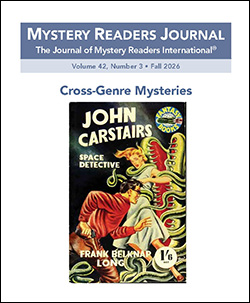
Themes in 2026: Fairs, Fetes, & Festivals; Mysteries set in France, Cross-Genre Mysteries; Mysteries set in India.


Southern California: Mystery Readers Journal
Senior Sleuths: Mystery Readers Journal
Irish Mysteries: Mystery Readers Journal
Hobbies & Crafts in Mysteries: Mystery Readers Journal

And so many more... We are now in our 42nd year. 4 themed issues a year! 

Have a look at our index of fabulous issues with articles, reviews, and essays from your favorite authors and reviewers. 
***