Showing posts with label Leslie Karst. Show all posts

Wednesday, May 28, 2025

LEFT COAST CRIME 2026: San Francisco Schemin'

Can't wait for Left Coast Crime 2026: San Francisco Schemin'. Be sure and sign up and reserve your room at the hotel. This is going to be an epic convention.  Convention rate includes convention with panels and special events, banquet, two full breakfasts, and opening reception--but so much more. It's all about friends and writers. And, San Francisco--everybody's favorite city!


Thursday, November 7, 2024

LEFT COAST CRIME 2026 NEWS!


Special Guests forLeft Coast Crime 2026 in San Francisco, California
February 26 – March 1, 2026


The 36th annual Left Coast Crime Convention will be held at the Hyatt Regency San Francisco — on the Embarcadero near the Ferry Building — from February 26 through March 1, 2026. We are finally going back to where Left Coast Crime began in 1991.
 

Registration is now open!


Visit the LCC 2026 website for more information about the convention.
 

Monday, July 29, 2024

2024 IPPY AWARDS: Independent Publisher Book Awards

The 2024  Ippy Awards  (Independent Publisher Book Awards) have multiple categories. I've highlighted here the categories of most interest to mystery readers. To view the Medalists in All Categories, go here. Photo is of Leslie Karst who is a silver medalist in the Autobiography/Memoir category! 

MYSTERY

Gold

The Shimmer on the Water

Marina McCarron

Aria


Silver

King Me 

J. A. Crawford

CamCat Books


Bronze

The Immortal Detective 

D. B. Woodling

CamCat Books


SUSPENSE/THRILLER

Gold

The Stone Secret

Amanda McKinney

Self-Published


Silver

Relentless 

Michael Maloof

Golden Oak Writer's Guild LLC


Bronze

The Sinful 

G.W. Allison

Self-Published


Bronze

Citizen Orlov 

Jonathan Payne

CamCat Books


TRUE CRIME

Gold

BROKEN: The Suspicious Death of Alydar and the End of Horse Racing's Golden Age

Fred M. Kray 

Live Oak Press


Silver

Murder on Federal Street: Tyrone Everett the Black Mafia Fixed Fights and the Last Golden Age of Philadelphia Boxing 

Sean Nam

Rushcutters Bay Books


Bronze

Behold the Monster: Confronting America's Most Prolific Serial Killer 

Jillian Lauren

Sourcebooks


TRUE CRIME - LEGAL

Gold

Toxic Exposure: The True Story behind the Monsanto Trials and the Search for Justice

Chadi Nabhan MD MBA FACP

Johns Hopkins University Press


Silver

THE FIGHT FOR JUSTICE: Lee Kreindler and Lockerbie

Ruth Kreindler and Chris Angermann

Self-Published


Bronze

The Death Penalty’s Denial of Fundamental Human Rights: International Law, State Practice, and the Emerging Abolitionist Norm

John Bessler

Cambridge University Press


AUTOBIOGRAPHY/MEMOIR I (CELEBRITY/POLITICAL/ROMANCE)

Silver
Justice is Served: A Tale of Scallops, the Law, & Cooking for RBG
by Leslie Karst
She Writes Press


Monday, April 3, 2023

JUSTICE IS SERVED: A Tale of Scallops, the Law, and Cooking for RBG - Guest Post by Leslie Karst

Leslie Karst: 
Justice is Served: A Tale of Scallops, the Law, and Cooking for RBG

RBG’s Most Enduring Legacy


As soon as I commenced writing Justice is Served, I realized that this memoir was not simply about me. Yes, the underlying tale was that of my being tasked with hosting this momentous meal and my planning and preparation of (and angsting and obsessing over) the coming event, as well as my personal journey separate from the dinner itself—how the experience affected me, and ultimately completely changed my life.


But it quickly became apparent that this book was also about the celebrated and iconic Justice Ruth Bader Ginsburg, whose own story needed to be woven throughout as part of the structure of the memoir. And so I came up with what I term the “interlude” sections that occur in each chapter: snapshots of the justice’s life and life’s work, each of which relate back to what was going on at the moment in my own life. 


A key element of RBG’s story, of course, is the legacy she left behind. For the legal battles she won in the area of women’s rights—both as a legal advocate and as a jurist—are among the most important in the history of American law. 


To my mind, however, notwithstanding the magnitude of these many victories, Ruth Bader Ginsburg’s greatest legacy is not simply the legal rulings she secured, but rather, just how she secured those results. Although RBG is often thought of has having been this firebrand ninja warrior, storming into courtrooms spouting feminist dogma and cutting down her adversaries with scathing dissents, the opposite is in fact true: As director of the ACLU Women’s Rights Project, and then later as judge and justice, she achieved the results she did, not by fireworks and emotion, but through embracing collegiality and compromise, and in seeking seeking to gently woo others to her way of thinking. 

Now, more than ever, with people so intensely polarized regarding political and cultural issues, I believe that this is the most important lesson we can glean from RBG and her life’s work: the importance of embracing collegiality and common ground in our dealings with others. 


RBG often spoke of her mother, Celia, and how she gave the young Ruth Bader this sage advice: To always conduct herself civilly and not let emotions like anger or envy get in her way. To hold fast to her convictions and self-respect, but be a good teacher and never snap back in anger, because emotions like anger and resentment only waste time and sap energy. 


Not only is this a healthy and harmonious way of approaching life, but it’s also—given all those legal victories RBG secured over the years—a strategy that clearly works. We could well do with a lot more of that collegiality today. 


Book Blurb:


In this true-life Julie and Julia meets Notorious RBG mash-up, former attorney Leslie Karst recounts how finagling her way into hosting an intimate dinner party for Supreme Court Justice Ruth Bader Ginsburg sends her on a journey of culinary discovery—and, ultimately, completely changes her life.


Justice is Served is Karst’s light-hearted, earnest account of the journey this unexpected challenge launched her on—starting with a trip to Paris for culinary inspiration, and ending with the dinner itself. Along the way, she imparts details of Ginsburg’s transformation from a young Jewish girl from Flatbush, Brooklyn, to one of the most celebrated Supreme Court justices in our nation’s history, and shares recipes for the mouthwatering dishes she came up with as she prepared for the big night. A heartfelt story of simultaneously searching for delicious recipes and purpose in life, Justice is Served is an inspiring reminder that it’s never too late to discover—and follow—your deepest passion.  


***


In addition to Justice is ServedLeslie Karst is also the author of the Lefty Award-nominated Sally Solari Mysteries, a “snarky cozy” culinary series set in Santa Cruz, California. Leslie and her wife and their Jack Russell mix split their time between Santa Cruz, California and Hilo, Hawai‘i. Visit her at LeslieKarstAuthor.com 


Tuesday, August 2, 2022

Pants-er or Recipe-er? Guest Post by Leslie Karst

LESLIE KARST: Pants-er or Recipe-er?

Authors are often asked whether we’re plotters or pantsers—do we plan out our story lines in advance and outline them in detail, or merely start writing and just see what happens?


I’ve been a devout plotter for most my fiction-writing career. And for my legal writing career as well, when I worked as a research and appellate attorney. Though truly, I can’t fathom how anyone could draft a legal brief without doing at least a little outlining. (Oh wait, come to think of it, I do believe some of those sloppy motions I received from opposing counsel over the years might well have been written without a whole lot of advance planning....)


When I set out to draft my first Sally Solari mystery, even the thought of sitting down with only a vague idea and then simply writing a mystery novel scared the heck out of me. You have to plant clues, after all, and red herrings, and suspects. How could you do that just willy-nilly? (Asks this list-making, check-everything-three-times, Virgo.)


But what’s interesting is that when it comes to cooking, I’ve always been the exact opposite. Sure, I love to read cookbooks. And my favorite day of the week for the newspaper is when the food section comes out, so I can peruse the recipes, maybe learn a new technique for rolling out pasta, and drool over all the seasonal ingredients highlighted that time of year. 


But I don’t tend to use recipes when I prepare food. In this area of my life I am a full-on pantser, tasting my sauce, adding a dash of this or that, then tasting it again. I don’t worry about messing it up, because I have a solid understanding of the chemistry of cooking, so I know instinctively what will work and what won’t. (This is the reason I’m not a keen baker—for it’s pretty darn hard to use a seat-of-the-pants method when you’re making a cake or a baguette. Bakers don’t even call them “recipes”; they refer to their preparation methods as “formulae.”)


But here’s the thing: over the years, I’ve gradually become more and more of a pantser with each of the books in my series. I had the opportunity to sit on a panel a couple years ago which included the talented Laurie R. King, and when we were asked about this plotter/pantser thing, Laurie talked about how she’d been a complete plotter for her first four books, but then switched to the seat-of-your-pants method. “By then I’d figured out how to do it, how to write a mystery novel,” she explained, “so I figured, why not try it the other way? And it worked.” She’s been a devout seat-of-the-pantser ever since.

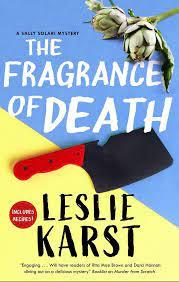
I thought a lot about what Laurie said that night, and when I embarked on this fifth novel in my series, The Fragrance of Death, for the first time in my life, I decided to throw caution to the wind and went at it without a fully fleshed-out plot. (Mind you, I did have an idea of how the book would start and finish and whodunit, but that long middle was merely the germ of an idea.)


And you know what? It was fun. But a little scary, too—especially when I’d finish a scene and then have no idea where I was going next. I found myself going on long bike rides and talking aloud to myself, asking, “What would Sally so in this situation? What if X happened to her, and then she reacted by doing Y?” The walkers along West Cliff Drive where I like to ride likely wondered why the heck this strange gal was pedaling along talking to herself about murder and mayhem. 


But hey—as with Laurie, it worked, and I’m exceedingly pleased with how this new book turned out. So perhaps I’ve made a permanent switch—maybe all those years pantsing it in the kitchen without a recipe has paid off in my writing career!


***


The daughter of a law professor and a potter, Leslie Karst learned early, during family dinner conversations, the value of both careful analysis and the arts—ideal ingredients for a mystery story. Putting this early education to good use, she now writes the Lefty Award-nominated Sally Solari Mysteries, a culinary series set in Santa Cruz, California. The next book in the series, The Fragrance of Death, releases August 2, 2022.



Wednesday, June 5, 2019

THE BLISS POINT: Guest Post by Leslie Karst

Leslie Karst:
The Bliss Point 

Knowing Janet’s love for all things chocolate www.dyingforchocolate.com, I thought that a short essay about why that sort of foodstuff is so incredibly irresistible to us humans would be appropriate for this blog.

As some of you may be aware, I worked for twenty years as a research and appellate attorney before turning my sights from drafting legal briefs to the far more enjoyable vocation of drafting culinary murder mysteries. But before matriculating at law school, I had to undergo the trial by fire of sitting for the dreaded Law School Admissions Test. And while I was preparing for the LSAT, my food of choice to keep me going during the marathon study sessions was frequently a Snickers bar.

I still love that candy bar, though I now indulge only rarely—having entered the stage of life where one’s metabolism is such that the price of the indulgence is paid directly at the waist line.

But what is it about the Snickers bar, I recently pondered, that makes it so highly addictive?

I found an answer to this question in a book by David A. Kessler, entitled The End of Overeating: Taking Control of the Insatiable American Appetite. https://www.simonandschuster.com/books/The-End-of-Overeating/David-A-Kessler-MD/9780743596800 Wondering just why a chocolate chip cookie could have such a strong power over him, Dr. Kessler spent seven years trying to discover the reason. The result was this book, in which he concludes that it’s all about the correct combination of sugar, fat and salt. Restaurants and other food businesses spend countless dollars and hours manipulating these ingredients until they reach what Kessler refers to as the “bliss point.”

We all know about this “bliss point” caused by the combination of sugar, fat and salt, even if it’s only subconscious. That’s why the tin roof sundae http://www.barrypopik.com/index.php/new_york_city/entry/tin_roof_sundae/ was such a popular ice cream treat back in my grandparents’ days, and why, more recently, dark chocolate sprinkled with sea salt has been the “new big thing” for many years running.

 Finding your Bliss Point 
(the addition of the acid in the wine adds an extra level) 

Cooks learn early on that salt is an essential ingredient in baked goods, and that adding a little sugar to savory foods can make the difference between something rather bland and something simply scrumptious. I learned this while a student at my local community college’s culinary arts program: a half teaspoon of sugar or honey added to your vinaigrette makes the taste buds stand up and take notice, providing that perfect contrast to the emulsion of acid, oil, and mustard.

Our brains are simply hard-wired to crave these things. After all, it wasn’t until pretty recently—evolutionarily speaking—that humans had much access to sugar, fat, or salt. Sweets were found only in fruits and honey; wild game would have been quite lean; and salt was rare and, when available, far too expensive for most of the population.

The problem of course, is that now that we have these ingredients in abundance, we can’t resist them. What a perfect opportunity for capitalism to go wild, and for us consumers to chow down plates of fried chicken and waffles drowning in (faux) maple syrup and to scarf enormous bags of salty, buttery popcorn along with boxes of Milk Duds at the movies.

Too bad our bodies can’t seem to handle what our brains tell us to crave.

So what about those Snickers bars? Well, according to Dr. Kessler, they are “extraordinarily well engineered.” As we chew one, the sugar dissolves, the fat melts and the caramel traps the peanuts in such a way that the entire combination of flavors is blissfully experienced in the mouth all at the same time.

And yes, they did help me get into Stanford Law School.

***

The daughter of a law professor and a potter, Leslie Karst learned early, during family dinner conversations, the value of both careful analysis and the arts—ideal ingredients for a mystery story. Putting this early education to good use, she now writes the Sally Solari Mysteries (Dying for a Taste, A Measure of Murder, Death al Fresco, Murder from Scratch), a culinary series set in Santa Cruz, California. An ex-lawyer like her sleuth, Leslie also has degrees in English literature and the culinary arts. Visit Leslie at lesliekarstauthor.com or at chicksonthecase.com