Showing posts with label San Francisco. Show all posts

Saturday, April 18, 2026

The Big Shake: The 1906 San Francisco Earthquake in Mystery Fiction - Guest Post by Randal Brandt


At 5:12 a.m. on April 18, 1906—one hundred and twenty years ago today—the landscape of San Francisco was permanently altered by a 7.9 magnitude earthquake and the massive fires that followed. Countless books on the Great San Francisco Earthquake and Fire of 1906 have analyzed the disaster from every conceivable angle: historical, geological, sociological, political, pictorial, etc. The quake has also proven to be a popular and durable plot device for mystery writers from soon after the calamitous event to the present day. 
 
The events of 1906 provide the backdrop for a significant number of crime and mystery novels. In these works, the disaster drives otherwise law-abiding citizens to commit criminal acts, provides the opportunity for people to change their identities, exposes criminal activity to the harsh light of day, and shows up as the ultimate deus ex machina, providing a solution—sometimes a permanent solution—to a particularly sticky situation. 

The first earthquake novel on the scene was Travers: A Story of the San Francisco Earthquake by Sara Dean. Although not a traditional mystery story, crime plays a central role in the plot. Published in February 1908, Travers is the ripped-from-the-headlines story of a San Francisco socialite named Gwendolyn Thornton who is awoken by a thief in her home. As she confronts the intruder, the earthquake strikes, destroying her house. After escaping—with the help of the intruder—to the safety of a refugee camp on Twin Peaks, Gwen learns that her rescuer, a British ex-army surgeon named Keith Travers, had been dismissed from his regiment following a scandal and forced into a life of crime. The earthquake offers Travers an opportunity to reclaim his reputation and standing in society. Written so soon after the actual earthquake, the novel features graphic descriptions of the city and its residents in the wake of the disaster. 
 
The great California writer Gertrude Atherton used the 1906 earthquake to propel the plot of her one foray into mystery fiction—although the mystery in The Avalanche (1919) is more genealogical than criminal. In San Francisco, in the years immediately following the earthquake, Price Ruyler is married and has firmly established himself in business and society. After he overhears an exchange between his mother-in-law and a man known to have made his living as a pimp and a gambler before the earthquake and fire, he begins to suspect that his wife’s past might not be as innocent as he was led to believe. He hires a private detective to investigate and uncovers a plot involving blackmail, betrayal, and the consequences of losing an entire city’s public records.
 
The earthquake arrives at a key moment and dramatically alters the course of the narrative in Shaken Down (1925) by Alice MacGowan and Perry Newberry. On an evening in April 1906, Patrolman Jerry Boyne of the San Francisco Police Department discovers that four-year-old Jamie Claiborne has been kidnapped and his nurse murdered. The boy’s father is convinced that his older daughter is behind the plot and vows that he will not be shaken down by the kidnappers. After being frozen out of the investigation by his superiors, Jerry decides to conduct his own investigation and soon ends up with both the kidnappers and the police after him. Just as he is about the break the case wide open—and expose the corruption of some of San Francisco’s most powerful men—the earthquake strikes and the city itself is literally shaken down.
 
Phyllis A. Whitney’s The Trembling Hills (1956) is a gothic romance/mystery novel set in 1906, where a woman's search for love unearths a dark secret involving a manipulative family and a sinister matriarch. The story follows Sara Bishop as she goes to San Francisco to pursue her childhood sweetheart, only to find herself entangled in a web of mystery, family secrets, and the devastating earthquake, which finally brings the past to light. 
 
The British join the party in The Golden Crucible (1976) by Jean Stubbs. Retired Scotland Yard Inspector John Joseph Lintott is enlisted to investigate the kidnapping of Alicia Salvador—who is the sister and assistant of the famous magician, Felix Salvador. Lintott follows the kidnappers from London to San Francisco and discovers that the plot is part of an elaborate revenge scheme. He negotiates Alicia’s release from a Barbary Coast brothel and as they are on their way to reunite with her brother the earthquake strikes. This novel stands apart from other earthquake mysteries in that the mystery is effectively solved before the quake hits. However, the disaster does manage to tie up some loose ends, meting out punishments that Lintott has no control over. 
 
Mignon G. Eberhart, who wrote over sixty novels in her long career, set exactly one story in San Francisco: Casa Madrone (1980), which takes place in April 1906. Mallory Bookever travels from New York to San Francisco in order to marry young and wealthy Richard Welbeck. When she arrives in San Francisco, she finds that Richard is an invalid in his Nob Hill mansion. In the aftermath of the earthquake, Richard is shot and killed. At first Mallory and Richard’s best friend, Scott Suydam, believe that a stray bullet fired by a patrolling soldier struck him. However, they soon suspect that Richard has been murdered in order to prevent his marriage. As the fire approaches, they relocate to Scott’s home, Casa Madrone, where they struggle to put their lives back together and unmask the killer.
 
Readers of Dianne Day’s Fire and Fog (1996) do not have to wait long for the earthquake to strike. The story opens precisely at 5:12 a.m. on April 18, 1906 as Caroline “Fremont” Jones, a plucky, independent typist-for-hire, is tumbled out of bed by the earthquake. At her office, she discovers several crates filled with Japanese artifacts, leading her to suspect that her landlords are involved in a smuggling operation. Unable to stay in her room or occupy her office, Fremont relocates to the tent city in Golden Gate Park and makes herself useful driving for the Red Cross. She also becomes entangled in uncovering the mystery of the stolen Japanese treasures. In addition to vivid descriptions of the quake and fire, this novel offers interesting visions of life in a tent city, the emerging importance of the automobile, the relief efforts, and the outdoor kitchens set up around the neighborhoods. 


Michael Castleman’s The Lost Gold of San Francisco (2003) is distinct in the canon of earthquake novels—its plot provides a direct link between the Big One in 1906 and the “pretty big one” in 1989. In April 1906, the San Francisco Mint is preparing to send a large shipment of misstruck gold pieces to Denver to be melted down. In the chaos following the earthquake, the coins disappear. In 1989, the director of a museum slated to receive a donation of one of the 1906 coins is murdered. Reporter Ed Rosenberg, assigned to cover the donation, turns his attention to the murder investigation.  As he reaches the end of the mystery, the Loma Prieta earthquake strikes, causing the death of the killer. Although this novel is filled with an incredible amount of historical detail, the central premise of the lost gold is fictional. However, an item in the San Francisco Chronicle written by columnist Herb Caen in 1987 inspired Castleman’s plot: a laborer digging the foundation for a Financial District high-rise discovered a gold coin minted in 1849 by the Miner’s Bank of San Francisco. 
 
Readers do not even have to open the cover of James Dalessandro’s 1906 (2004) to know that the earthquake and fire play a major role in this novel. The dust jacket features a photograph of a devastated San Francisco street with the burning Call Building in the foreground. Marketed with the tag line “Every disaster has a backstory,” Dalessandro’s tale is told by young newspaper reporter Annalisa Passarelli. Annalisa is secretly assisting Chief of Detectives Byron Fallon to gather evidence of the graft and corruption of the city’s mayor, police chief, and political boss Adam Rolf (an obvious reference to the notorious “Boss” Abe Ruef). When Fallon is murdered, his son Hunter takes up the investigation. The earthquake hits just as Hunter, Annalisa, and a group of honest police officers are about to enter Rolf’s Nob Hill mansion to make the arrests. Rolf and his thugs use the ensuing chaos to turn the tables on their enemies and Annalisa and Hunter have to battle both the killers and the fire in order to save themselves and their city.
 
Locked Rooms (2005) is the eighth book in Laurie R. King’s long-running series about Mary Russell, the wife and partner-in-crime-detection of Sherlock Holmes. In 1924, Russell and Holmes are in San Francisco so that she can sell the Pacific Heights house that she inherited after her family’s death in an automobile crash ten years earlier. When an unknown assailant shoots at Mary, she and Holmes begin an investigation into the secrets of the long-shuttered house and her family. Holmes hires a young, ex-Pinkerton agent/struggling writer named Dashiell Hammett to assist him. Hammett quickly uncovers evidence that the “accident” that claimed her family was no accident—it was murder. Although all of the action in this novel takes place years after the earthquake, the solution to the murders eventually leads directly back to the chaotic days of April 1906, when extraordinary events caused ordinary people to commit drastic, and sometimes illegal, acts. 
 
In the third novel in the Cree Black series, Bones of the Barbary Coast (2006), author Daniel Hecht blends historical mystery with the supernatural as a psychologist investigates a mysterious human skeleton from the 1906 San Francisco earthquake unearthed in the foundation of a fine Victorian home, uncovering secrets from the city’s infamous Barbary Coast through historical research and the 1889 diary of a woman with secrets of her own.
 
Anthony Flacco’s The Last Nightingale (2007) tells the story of twelve-year-old Shane Nightingale who survives the 1906 quake only to witness the horrific murder of his adoptive mother and two sisters at the hands of budding serial killer Tommie Kimbrough. After the fire destroys the Nightingale home, all evidence of the killings is erased, and Shane becomes just another anonymous orphan in the city. Before the quake, Sergeant Randall Blackburn of the San Francisco Police Department had been on the trail of a Barbary Coast killer nicknamed “The Surgeon” for the mutilation he performs on the bodies of his victims. When Blackburn meets up with Shane, the two become an unlikely detective duo. Shane has an unusual sense of intuition and deductive reasoning and Blackburn is experimenting with new methods of police work. 
 
Shortly before the Great Earthquake, Pirate Vishnu sailed into San Francisco Bay. In Gigi Pandian’s second book in the Jaya Jones Treasure Hunt mysteries, Pirate Vishnu (2013), globe-trotting historian Jaya Jones is drawn into the story when she learns about a map of the Barbary Coast drawn by one of her ancestors who came to San Francisco from India and died in the earthquake. Her quest to uncover her ancestor’s secrets and decipher the cryptic treasure map takes her to India. Along the way she also has to solve two murders that took place a century apart and untangle a love triangle. 
 
Rhys Bowen’s series heroine Molly Murphy ventures to San Francisco in Time of Fog and Fire (2016). After seeing a newsreel showing that her husband, New York City police captain Daniel Sullivan, is in San Francisco, Molly travels across the country with her young son. She discovers that Daniel is in danger and arrives just as the 1906 earthquake and subsequent fires devastate the city.
 
In the days before the great earthquake and fire of 1906, Levi Hayes returns from San Quentin Prison with a plan of revenge in Dietrich Kalteis’ House of Blazes (2016). After serving five years for the theft of $30,000 in gold coins from the San Francisco Mint, Levi is ready to take back what’s his from the now-powerful Healey brothers who set him up. Levi recruits his nephew, Mack Lewis, in a wild scheme that propels them through saloon halls, gambling dens, back alleys, and brothels before it backfires. In lock-up as the earthquake hits, Levi and Mack must escape the collapsing building and burning city to get to the gold coins, with the Healeys now after them.
 
Violet is one of three people grateful for the destruction of the big earthquake in The Two Mrs. Carlyles (2020) by Suzanne Rindell. The temblor leaves Violet and her two best friends unexpectedly wealthy—as long as the secret that binds them together stays buried beneath the rubble. A whirlwind romance with the city’s most eligible widower, Harry Carlyle, lands Violet in a luxurious mansion as the second Mrs. Carlyle. But all is not right and Violet soon finds herself trapped by the lingering specter of the first Mrs. Carlyle, and by the inescapable secrets of her own violent history.
 
As described in The Phoenix Crown (2024) by Kate Quinn and Janie Chang, San Francisco in 1906 is a city bustling with newly minted millionaires and scheming upstarts. Gemma, a golden-haired, silver-voiced soprano whose career desperately needs a boost, and Suling, a petite and determined Chinatown embroideress who is resolved to escape an arranged marriage, are two very different women hoping to change their fortunes. Their paths cross when they are drawn into the orbit of Henry Thornton, a charming railroad magnate whose extraordinary collection of Chinese antiques includes the fabled Phoenix Crown. His patronage offers Gemma and Suling the chance of a lifetime, but their lives are thrown into turmoil when the earthquake rips San Francisco apart and Thornton disappears. When the Phoenix Crown reappears five years later at a sumptuous Paris costume ball, Gemma and Suling are thrown together again in one last desperate quest for justice.
 
Susie Hara’s Earthquake Shack (2025) is her second novel featuring Sadie GarcĂ­a Miller. Sadie’s not an ordinary private investigator. She doesn’t claim to look for missing persons or solve murders; she specializes in finding lost things. When her estranged cousin Al offers both money and information about her father’s mysterious death years before, Sadie agrees to take his case. His daughter Ruth’s house has disappeared—completely vanished! It was one of the original cottages, or earthquake shacks, built by the Army and the Parks Commission after the 1906 San Francisco quake to provide housing for displaced people. About 5,000 tiny wooden homes were constructed, all with redwood walls, fir flooring, and cedar shingles. They need Sadie’s help to find it. She soon discovers that there is much more at stake than just a missing building. 
 
***
Randal Brandt is a librarian at the University of California, Berkeley where, among other things, he is curator of the Bancroft Library's California Detective Fiction Collection.
 

Tuesday, March 3, 2026

LEFTY AWARDS: Left Coast Crime San Francisco Schemin'

Left Coast Crime 2026 San Francisco Schemin' presented the Lefty Awards in four categories at our 36th annual convention. The categories were: Humorous, Historical, Debut, and Best. Congratulations to all!


2026 Lefty Award nominees for books published in 2025:


Lefty for Best Humorous Mystery NovelCatriona McPherson, Scot’s Egg


Lefty for Best Historical Mystery Novel for books set before 1970. 
(The Bill Gottfried Memorial): 
Rob Osler, The Case of the Missing Maid 


Lefty for Best Debut Mystery NovelAdrian Andover, Whiskey Business 


Lefty for Best Mystery Novel (not in other categories): James L’Etoile, River of Lies 

Left Coast Crime Conventions are annual events sponsored by mystery fans, both readers and authors. Held in the western half of North America, LCC’s intent is to host an event where readers, authors, critics, librarians, publishers, and other fans can gather in convivial surroundings to pursue their mutual interests. Lefty Awards have been given since 1996. 

Returning to The City, where Left Coast Crime held its first two conventions, the 36th Annual Left Coast Crime Convention took place in San Francisco, February 26 – March 1, 2026. This year’s Guests of Honor were authors Robin Burcell and Gary Phillips. Randal Brandt was the Fan Guest of Honor, and author Leslie Karst served as Toastmaster.

Left Coast Crime is a 501(c)(3) nonprofit corporation holding annual mystery conventions in the West. Each LCC convention raises money to support a local literary organization, and is staffed entirely by volunteers. This year the charity was the San Francisco Public Library literacy program.

For more information on Left Coast Crime 2026, please visit www.leftcoastcrime.org/2026/

Wednesday, February 4, 2026

SUPER BOWL: Super Bowl Crime Fiction & Football Mysteries

It's no longer just Super Bowl Sunday--it's Super Bowl Week! The game this year is being played in San Francisco - -but it's not. The game will actually be held in Santa Clara, some 30 miles south of the City. But that isn't stopping the City of San Francisco from celebrating. Lots of special events, concerts, and street closures. I am not going into the City this week! 

But that's not stopping me from posting Super Bowl Mysteries.There is a lot of real crime surrounding the Super Bowl: drugs, money, gambling, egos, and so much more. All fodder for the crime writer. So in 'honor' of the Super Bowl, I've updated my lists of Super Bowl and other Football Mysteries. These are in no way definitive lists -- just some football crime fiction for you to enjoy in case you're not watching the Super Bowl! And, you have a full week to read them all! As always, I welcome additions!

If you're interested in other Sports Mysteries and essays on Football Mysteries, Mystery Readers Journal has had several Sports Mysteries issues. The last Sports Mysteries Issue of MRJ was Volume 25:4 (Winter 2009-2010). Available as PDF download

Super Bowl Mysteries

The Hidden Key by George Harmon Coxe
Super-Dude by John Craig
Cover-Up: Mystery at the Super Bowl by John Feinstein (YA)
Black Sunday by Thomas Harris
Paydirt by Paul Levine
The Last Super Bowl by Robin Moore & David Harper
4th and Fixed by Reggie Rivers
Murder at the Super Bowl by Fran Tarkenton and Herb Resnicow
Life's Work by Jonathan Valin
Killerbowl by Gary K. Wolf

Movie:  
Ace Ventura: Pet Detective (1994)
 
Other Football Mysteries (not including British Football, of which there are many titles)


The Professor by Robert Bailey
Memory Man; The Might Johns by David Baldacci

Rough and Tumble by Mark Bavaro
Pass Judgment by Jerry Brewer
Sweeper by Steve Bruce 
Deal Breaker by Harlan Coben
Coliseum by Barney Cohen
Et Tu Brady by Joseph Collum

Football is Murder by Kathy Cranston
All Saints Day: A New Orleans Football Mystery by Sean Patrick Doles
Backfield Boys by John Feinstein
Under the Stadium Lights by Hunter Mills Gallo

Day of the Ram by William Campbell Gault
Murder at Cleaver Stadium by Douglas Lee Gibboney
Quarterback Trap by Dallas Gorham
Double Reverse; Ruffians by Tim Green
Playing for Pizza; Bleachers by John Grisham
Bleeding Maize and Blue by Susan Holtzer
Crown of All Virtues by Reece Kepler
The Prophet by Michael Koryta
Two-Minute Warning by George LaFountaine
Bump and Run by Mike Lupica
The Draft by Wil Mara
Dead Ball Foul by Kayla McGrady
A Cardinal Offense by Ralph McInerny
Parker's Blood by William Miller
Foul Play; Dead Ball; Off Side; Killer Pass; Foul Play: Own Goal by Tom Palmer

12th of Never by James Patterson and Maxine Paetro
The Jook by Gary Phillips
Foul by Will J. Robson

Winter and Night by S. J. Rozan
A Nutcracker Nightmare by Christina Romeril
Sudden Death by David Rosenfelt
Marked Man; Red Card by Mel Stein
The Footballer by Ben Stevens
The Football Manager Murders by Chris Tookey
A Touch of Death by Charles Williams

Short Stories:  

The Mighty Johns, edited by Otto Penzler

Nonfiction: 
Scoreboard, Baby: A Story of College Football, Crime and Complicity by Ken Armstrong and Nick Perry (winner of the 2011 Edgar for Best Fact Crime)
All-American Murder by James Patterson & Alex Abramovich

Children's:

Bones and the Football Mystery by David A. Adler, Barbara Johansen Newman (Illustrator)
The Mystery of the Stolen Football by T. J. Edwards, Charles Tang (Illustrator)
The Big Bling Blitz; The Two-Minute Warning by David A. Kelly
The Football Fiasco by Mike Lupica
Courtney Case and the Missing Football by Jeannie Meekins


Monday, January 5, 2026

2026 Left Coast Crime “Lefty” Award Nominations

Left Coast Crime 2026 will be presenting four Lefty Awards at our 36th annual convention, to be held this February in San Francisco: Humorous, Historical, Debut, and Best. The awards will be voted on at the convention and presented at a banquet on Saturday, February 28, at the Hyatt Regency on the Embarcadero. The Lefty nominees have been selected by convention registrants. 

2026 Lefty Award nominees for books published in 2025:

Lefty for Best Humorous Mystery Novel

The nominees are:

• Ellen Byron, Solid Gold Murder (Kensington)

 Jennifer J. Chow, Star-Crossed Egg Tarts (St. Martin’s Paperbacks)

 Elizabeth Crowens, Bye Bye Blackbird (Level Best Books)

 Catriona McPherson, Scot’s Eggs (Severn House)

 Cindy Sample, All’s Faire in Love and Murder (Cindy Sample Books)

Lefty for Best Historical Mystery Novel for books set before 1970 
(The Bill Gottfried Memorial). 

The nominees are:

 Cara Black, Huguette (Soho Crime)

 Mariah Fredericks, The Girl in the Green Dress (Minotaur Books)

 Dianne Freeman, A Daughter’s Guide to Mothers and Murder (Kensington)

 Claire M. Johnson, City Lights (Level Best Books)

 Laurie R. King, Knave of Diamonds (Bantam)

 Rob Osler, The Case of the Missing Maid (Kensington)

Lefty for Best Debut Mystery Novel

The nominees are:

 Adrian Andover, Whiskey Business (Chestnut Avenue Press)

 Kristen L. Berry, We Don’t Talk About Carol (Bantam)

 Laurie L. Dove, Mask of the Deer Woman (Berkley)

 Sue Hincenbergs, The Retirement Plan (William Morrow)

 Marisa Kashino, Best Offer Wins (Celadon Books)

 Diane Schaffer, Mortal Zin (Sibylline Press)

Lefty for Best Mystery Novel (not in other categories). 

The nominees are:

 Lou Berney, Crooks (William Morrow)

 Claire Booth, Throwing Shadows (Severn House)

 Tracy Clark, Edge (Thomas & Mercer)

 Leslie Karst, Waters of Destruction (Severn House)

 James L’Etoile, River of Lies (Oceanview Publishing)

 Gigi Pandian, The Library Game (Minotaur Books) 

Left Coast Crime Conventions are annual events sponsored by mystery fans, both readers and authors. Held in the western half of North America, LCC’s intent is to host an event where readers, authors, critics, librarians, publishers, and other fans can gather in convivial surroundings to pursue their mutual interests. Lefty Awards have been given since 1996. 

Returning to The City, where Left Coast Crime held its first two conventions, the 36th Annual Left Coast Crime Convention will take place in San Francisco, February 26 – March 1, 2026. This year’s Guests of Honor are authors Robin Burcell and Gary Phillips. Randal Brandt is the Fan Guest of Honor, and author Leslie Karst will serve as Toastmaster.

Left Coast Crime is a 501(c)(3) nonprofit corporation holding annual mystery conventions in the West. Each LCC convention raises money to support a local literary organization, and is staffed entirely by volunteers.

For more information on Left Coast Crime 2026, please visit www.leftcoastcrime.org/2026/

Wednesday, May 28, 2025

LEFT COAST CRIME 2026: San Francisco Schemin'

Can't wait for Left Coast Crime 2026: San Francisco Schemin'. Be sure and sign up and reserve your room at the hotel. This is going to be an epic convention.  Convention rate includes convention with panels and special events, banquet, two full breakfasts, and opening reception--but so much more. It's all about friends and writers. And, San Francisco--everybody's favorite city!


Thursday, November 7, 2024

LEFT COAST CRIME 2026 NEWS!


Special Guests forLeft Coast Crime 2026 in San Francisco, California
February 26 – March 1, 2026


The 36th annual Left Coast Crime Convention will be held at the Hyatt Regency San Francisco — on the Embarcadero near the Ferry Building — from February 26 through March 1, 2026. We are finally going back to where Left Coast Crime began in 1991.
 

Registration is now open!


Visit the LCC 2026 website for more information about the convention.
 

Monday, July 1, 2024

LEFT COAST CRIME NEWS: SAN FRANCISCO 2026

Left Coast Crime News


Left Coast Crime 2026: San Francisco, California

February 26-March 1, 2026

Did you leave your heart in San Francisco? It's time to retrieve it!

Left Coast Crime will return to San Francisco for the first time since Left Coast Crime #1 and #2 were held there in 1991 and 1992. Our 36th annual convention will be held at the Hyatt Regency San Francisco on the Embarcadero near the Ferry Building from February 26 through March 1, 2026. More information about the convention will appear on the LCC 2026 website this fall.

The San Francisco Cable Car stops right outside the Hyatt Regency San Francisco, the Presidio Go Shuttle provides free trips to the historic Presidio (a National Park Site), and the Embarcadero BART station is just steps away.

The Hyatt Regency San Francisco is at the end of Market Street, directly across from the 1915 Ferry Building. The Ferry Building Marketplace is packed with restaurants and shops plus a bookstore! From the Port of San Francisco you can catch a ferry to Alcatraz, Angel Island, Treasure Island, Jack London Square in Oakland, and many other destinations.

More news to come. Reserve the Date!!!

Left Coast Crime FB page

Thursday, October 12, 2023

Presenting THE RED-HOT BLUES CHANTEUSE: Guest Post by Ana Brazil

One of my earliest love affairs—at the tender age of six or so—was with the city of San Francisco. During the 1960s my mother would drive my brother, sister, and me over the Bay Bridge for dinner in Chinatown or fish-watching at Steinhart Aquarium or for a parade in North Beach. The City was magical, and no matter where I lived afterwards, I never lost my love for it.
 
Years after I fell in love with San Francisco, I also fell in love with its history. I’ve read up on the Gold Rush, Chinese immigration, the 1906 earthquake, Pan Pacific Expo history, and—thanks to my husband volunteering on The Rock for twenty years—Alcatraz Island.
 
But recently I’ve been more curious about San Francisco in the first months of 1919, a time just after the end of the world war and the almost-end of the Spanish influenza epidemic. I’ve been reading up on 1919 San Francisco because once again, I fell in love. This time the object of my affections is feisty globe-trotting vaudeville chanteuse Elsie Clark. (After inheriting Elsie’s newspaper-clipping-stuffed scrapbooks, photographs, playbills, sheet music, and recordings from my stepmother, how could I not fall in love with Elsie?)
 
Elsie’s fascinating life on the vaudeville stage inspired me to create the character of Viola Vermillion, vaudeville singer and the bodacious amateur sleuth of my upcoming mystery THE RED-HOT BLUES CHANTEUSE. Like Elsie, ambitious Viola dreams of making it to the vaudeville Big Time by headlining the Palace Theatre in New York City. 
 
And since San Francisco was home to some of the most exuberant vaudeville theatres on the West Coast, I joyfully set Viola’s first murderous adventure there.
 
Once Viola and her troupe of travelling vaudevillians (Female impersonators! Chinese acrobats! Drunken dogs!) begin their two-week run at Market Street’s Pantages Theater, however, Viola’s life come to a dead stop: She discovers her piano player and lover Stu Wiley murdered in the Pantages balcony, killed by her own gun. To remain out of jail, Viola is forced to uncover Stu’s secret past life in San Francisco and figure out which one of his lies got him killed. 

Viola’s not quite as innocent as she seems, and like her dead lover, she’s got secrets of her own. Like the encrypted notebook in her possession, which really belongs to the East Coast munitions tycoon who caused her sister’s death. Then there’s Viola’s surprising attraction to her hot new replacement piano player Jimmy Harrigan, who—unknown to Viola—is employed by the munitions tycoon and has been following her since the troupe performed in Seattle. 

As Viola unravels multiple secrets, lies, and suspicions, she still holds tight to her dream of reaching the vaudeville Big Time. But to succeed at anything, first she needs to stay alive . . .
Viola’s not quite as innocent as she seems, and like her dead lover, she’s got secrets of her own. Like the encrypted notebook in her possession, which really belongs to the East Coast munitions tycoon who caused her sister’s death. Then there’s Viola’s surprising attraction to her hot new replacement piano player Jimmy Harrigan, who—unknown to Viola—is employed by the munitions tycoon and has been following her since the troupe performed in Seattle. 
As Viola unravels multiple secrets, lies, and suspicions, she still holds tight to her dream of reaching the vaudeville Big Time. But to succeed at anything, first she needs to stay alive . . .

 
THE RED-HOT BLUES CHANTEUSE debuts on the historical mystery stage on Tuesday October 17th in ebook and paperback, and to paraphrase the vaudeville-inspired musical Gypsy, I hope you let THE RED-HOT BLUES CHANTEUSE entertain you.
 
***

Many years ago, Ana Brazil inherited the scrapbooks, recordings, and theatrical ephemera of vaudeville songstress Elsie Clark, and used this treasure trove to create Viola Vermillion, the smart, sassy, and bodacious vaudeville heroine of THE RED-HOT BLUES CHANTEUSE. Ana’s currently writing the second of her Viola Vermillion Vaudeville Mysteries, THE MAGNOLIA VOODOO BRAWLER.

Ana is a founding member of the Paper Lantern Writers historical fiction collective and lives with her husband and cat just across the bay from San Francisco. 
 

Monday, March 13, 2023

The Unique Pleasures of Writing Both Non-Fiction and Fiction: Guest Post by John McNellis

John McNellis:
 The Unique Pleasures of Writing Both Non-Fiction and Fiction
 
Switching to fiction after a lifetime of writing non-fiction is akin to a Parisian deciding to learn Spanish. It can be done, but not without effort. While many nouns are common to French and Spanish, even the occasional verb, they are different languages. Even within the world of non-fiction, there are different dialects, mostly having to do with timing. A reporter writing an ephemeral piece against a daily deadline has no time for polishing or rewriting, her style is subsumed within the facts, her voice is discouraged, she knows her words will be forgotten, all that matters is setting out the facts in a coherent, logical fashion. Who, how, what, where and why in the lead paragraph.  
 
Writing a monthly essay allows one to use his voice, more time to choose words and phrasing with care, words that will hopefully resonate, perhaps even recalled by readers days and weeks later. Yet newspaper essays, too, must be timely, rooted in the moment, tied to a current event. 
 
Writing a non-fiction book—in my case, a real estate primer—permits one all the time in the world to write, rewrite and rewrite some more. As opposed to articles and essays, the book must be timeless, its lessons hopefully evergreen. One’s voice can be relatively full-throated, but in business writing at least, everything must be explicit, the dots connected, nothing left to the imagination. The non-fiction is grounded in facts and informed opinion—flights of fancy would be as out of place as a rose in a wheat field. 
 
Writing fiction is both liberating and terrifying. Freed from the gravitational pull of the real world, one can float in the clouds, writing whatever comes to mind, however implausible. This freedom is, however, more curse than blessing. Without a strong foundation in fact—if not in setting, then in realistic characters—fiction all often becomes unsatisfying fairy tale. 

O’Brien’s Law is so heavily fact-based that some readers have supposed it my autobiography, while friends realize it’s a fiction, a painting stretched over a detailed and accurate canvas of time and place: the swinging 70’s of San Francisco. I’d say my novel is a bit like concrete, which is roughly half sand and half cement. With too much sand, concrete is loose and collapses; with too much cement, concrete is brittle and susceptible to stress fractures. That 50-50 formula works for writing; O’Brien’s Law is about half fact and half fiction. The fun part is guessing which is which. 

Frankly, my novel is heavily fact-based because, not unlike my protagonist Michael O’Brien, I’m lazy and I truly dislike doing research. I lived in San Francisco for six years in the 1970’s, kept personal journals and could thus ground the tale with a verisimilitude impossible with any other city. Setting the story in San Francisco enabled me to write about what I know and, happily, to avoid any location research. While the story is dependent upon neither San Francisco nor the 1970’s—it could unfold anywhere at any time—the City in the 70’s was so alive, crackling with everything from great culture to mediocre professional sports to counter-culture events like the Fillmore to fabulous food, all in the most beautiful physical setting of any city in America. To a 25-year-old like O’Brien, the City promised—or at least gave the illusion of—endless possibilities. That this fabulous care-free setting would have a dark underbelly of suspense and murder is what—hopefully—makes the novel enchanting. 

As for my writing process, I knew the basic story arc from the first, did an outline before any writing it and yes—spoiler alert—I always knew it would have a happy ending. But the rewriting upon rewriting upon rewriting would make even a persnickety line editor proud. 
 
***
A journalism undergraduate at Berkeley, John McNellis went to Hastings Law College, practiced law in San Francisco for half a dozen years before until he switched to real estate. Despite his successful business career, John was always writing: comedy shows for a theatrical club, a monthly column for the Registry Magazine and the San Francisco Business Timesand, ultimately, a critically acclaimed real estate primer, Making it in Real Estate: Starting Out as A Developer, now an industry standard and taught in universities nationwide. 


Monday, January 24, 2022

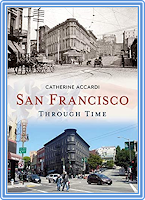
SAN FRANCISCO THROUGH TIME: Zoom Presentation with author Catherine Accardi

With over 400 officially designated local, state, and national landmarks, San Francisco is steeped in history. The City’s neighborhoods feature unique buildings and special places, some that are well known to residents and tourists but also structures and locations that have been obscured by time.

Beginning at Captain Richardson’s tent near Grant Avenue and winding our way through neighborhoods throughout San Francisco, author Catherine Accardi shares the rich history of San Francisco in contrasting images, uncovering and revealing San Francisco in new ways. 

With over 100 photographs, her book, San Francisco Through Time, takes readers on a quest to discover the places, and the stories behind them, that make San Francisco special. Join us on a journey with Catherine Accardi, the author of San Francisco Through Time with historical photographs juxtaposed alongside present-day images. 
 
~~~~~~~~~~~~~~~~~~~~~~~~~~~~~~~~~~~~~~~~~~~~~~~~~~~~ 

Click here to REGISTER for the ZOOM WEBINAR

Visit the Book Club of California website at http://www.bccbooks.org/programs/. 


Wednesday, October 2, 2019

MWA NORCAL MYSTERY WEEK: October 19-26

MWA brings mystery to NorCal!  Scattered across the chapter area, MWA NorCal members will be on panels and talks. Come for a panel and nibbles. Books sold at most venues—details are on the MWA NorCal events page, here


Saturday, Oct. 19 - LitCrawl, San Francisco
Noir at the Bar
Laurie R. King (emcee)  Randal Brandt,
David Corbett, Alan Jacobson, Claire Johnson, Eileen Rendahl, Kelli Stanley
Monday, Oct. 21 - Fremont Library
Writing Mysteries Can Be Murder
Heather Haven (M), Janet Dawson, Camille Minichino, Ann Parker, Rob Swigart
Tuesday, Oct. 22 - El Cerrito Library
Chills, Spills, and Mystery Writing Thrills
Randal Brandt (M),  Kelli Stanley, Gigi Pandian, S.A. Lelchuk, Terry Shames
Wednesday, Oct. 23 - Redwood City Library
How Writers Scare Readers and Why Readers Love It
Ellen Kirschman (M), Mysti Berry, Margaret Dumas, Jerry Kennealy, John Billheimer
Thursday, Oct. 24 - Santa Cruz Library
Murderous Intent: Making a Killing on Mystery
Laurie R. King (M), Ellison Cooper (Jennifer Dornan-Fish), Katherine Hyde, Mary Feliz
Friday, Oct. 25 - Lafayette Library
From Historical to Cozy to Romantic Suspense, There's a Mystery for Every Reader
Janice Peacock (M), Laurie R. King, Heather Haven, Peggy Lucke, Michael Cooper
Saturday, Oct. 26 - Petaluma Library
The Why of Where
Nancy Tingley(M), Susan Shea, Patricia Royal, Glenda Carroll, Domenic Stansberry

Wednesday, September 26, 2018

NOIR AT THE BAR: SAN FRANCISCO

Join Mystery Writers of America NorCal & Lit Quake for NOIR AT THE BAR 
October 20:  San Francisco


This great event is part of MWANorCal's Mystery Week! More info to come!

Friday, August 17, 2018

Writing a Sequel in a Murder Mystery Series: Guest Post by Peter Moreira

Peter Moreira: 
Writing a Sequel in a Murder Mystery Series 

My wife has got into the habit of asking me how “Number Two” is going. That’s her name for the second book in my mystery series. Some days, I wish she’d use the book’s title. Other days, well, her name seems quite apt.

The fact is that writing the sequel to a murder mystery is hard. To illustrate why, I need to start with my novel THE HAIGHT, which I hope will be the first book in the Jimmy Spracklin series of crime novels.

THE HAIGHT (just published by Poplar Press) tells the story of Spracklin, a San Francisco homicide detective, who is investigating the murder of an artist in Haight-Ashbury in 1968. He knows the neighborhood – the vortex of hippie culture – all too well, for he’s spent a year there searching for his runaway stepdaughter.

In writing the sequel, I have to develop the story of Jimmy Spracklin and his family, while writing a whodunnit that can stand on its own and reward the reader. Here are five things I’ve learned in the process of writing and rewriting “Number Two”:

1. The second book is an essential volume in a series. Book 2 is not just another episode. Let’s assume that Book 1 is good enough that readers want to revisit the world the author created. If Book 2 falls short, the reader (and likely publisher) won’t bother with any further books in the series. Everyone will assume that there’s just not enough there to generate a series. You can probably get away with Book 8 being a lemon, but a weak second book is fatal.

2. Each book needs its own centre of emotional intensity. To draw in the reader, the hero has to love someone or something more than life itself, and that passion has to evolve as the series progresses. The incidents that define the long-term relationship have to be woven into the fabric of each book. In THE HAIGHT, the key relationship is Spracklin’s love of his stepdaughter, Marie. In the sequel, he risks everything to protect her, to the detriment of his own marriage.

3. You have to lose and add characters. This is a technical thing, but I find it really important. If you don’t absolutely need a character from Book 1, cut him or her out of Book 2. Each murder mystery needs characters to kill and its own rolodex of suspects. Ideally, they’ll all have their own stories and specific incidents that will bring out their characters. Don’t confuse your reader by cluttering your text with legacy characters. Lose old characters. Gain new ones.

4. Repeat the magic of the first book without belaboring it. There’s something unique about your book that made readers love it. With THE HAIGHT, I strove to create the atmosphere of Haight-Ashbury in the 1960s without interrupting the plot with tedious tracts of description. It’s harder in the second book because I need new elements of Haight-Ashbury to describe. The murder in the second book is set against a free music festival in Golden Gate Park, creating the same aura as Book 1 but with fresh descriptions.

5. Aim to write a novel at least as good as the first book. That sounds like a no-brainer, but rarely (if ever) does the sequel live up to the original. For my own part, I’m delighted by the way THE HAIGHT turned out and the feedback I’m getting from readers. My goal is to write a better book second time around. Will I succeed? Dunno. But by aiming to exceed the first book, I hope I improve my chances of producing a worthy successor.

I’ve almost finished the second draft of the new novel. I think I’m pleased with the way it’s progressing, but you’re never really sure how good your book is until other people have at it. The story is centred on the murder of a minor character from THE HAIGHT, who shows up dead on Hippie Hill, where a long-haired impresario is staging a rock festival. The working title is THE DEAD DEALER OF HAIGHT STREET. I’m not completely sold on the title, but I like it better than NUMBER TWO
***

Peter Moreira is the author of THE HAIGHT, the first Jimmy Spracklin crime novel. It is now available from Poplar Press.

Tuesday, June 26, 2018

Buried in Books & The Three Musketeers: Guest Post by Kate Carlisle

Kate Carlisle is the NYT bestselling author of two ongoing series: the Bibliophile Mysteries featuring San Francisco bookbinder Brooklyn Wainwright, whose rare book restoration skills uncover old secrets, treachery and murder; and the Fixer-Upper Mysteries, featuring Shannon Hammer, a home contractor who discovers not only skeletons in her neighbors' closets, but murder victims, too. Hallmark Movies & Mysteries is bringing the Fixer-Upper Mysteries to TV in a series of movies starring Jewel and Colin Ferguson. A native Californian, Kate worked in television production for many years before turning to writing.

Kate Carlisle: 
Buried in Books and The Three Musketeers
 
Alexandre Dumas said in The Three Musketeers, “The merit of all things lies in their difficulty.”

In other words, the more challenging something is, the more worthwhile. And it's true that one of my favorite things about writing the Bibliophile Mysteries is also the hardest: echoing the themes of the rare book at the center of the mystery. While plotting the modern-day mysteries, I look for ways, both subtle and overt, to give a literary nod to the rare book in question—and to give my most astute readers the added pleasure of a sort of scavenger hunt within the mystery.

(That said, I assure you—if you haven't read The Three Musketeers, don't worry. Buried in Books is a contemporary mystery novel that stands on its own.)

In Buried in Books, Bibliophile Mystery 12, a national library convention comes to San Francisco the week of bookbinder Brooklyn Wainwright's wedding to her partner in crime-solving, British security expert Derek Stone. Along with the convention come two of her best friends from library school. They called themselves the Three Musketeers. All for one, and one for all. . . until Sara stole Heather's boyfriend, and their friendship blew up.

Heather and Sara both come to Brooklyn's surprise bridal shower with gifts in tow. A rare copy of The Three Musketeers from one, and of The Blue Fairy Book from the other. At first it seems that all is forgiven, until Brooklyn discovers that one of the books may be a forgery. Dumas said, "Never trust the enemy that gives you presents"—but now Brooklyn doesn't even know if she can trust her friends.

It's always delightful to find ways to incorporate the themes of the rare books into the contemporary murder mystery, but especially so with Buried in Books because The Three Musketeers is such a zip-bang story, filled with thrilling action and laugh-out-loud humor. During the plotting process, I often found myself walking around in a daze, my mind a swirl of ideas.

Without giving away too much about Buried in Books, here's a glimpse into how I reflected the characters from the historic novel in this Bibliophile Mystery.

Brooklyn is Athos, the most level-headed of the Musketeers. She's the peacemaker, the intellectual of the group.

Heather is Aramis, the quietest of the three, still morose years after being torn away from the love of her life.

Sara is Porthos, full of her own importance and unsympathetic toward Heather's feelings. Like Porthos, Sara is a fashion plate. In fact, fashion plays a bit of a role in the murder. I won't say more than that, but you'll understand when you read the book.

Sadly, one of these friends will die, and Brooklyn will have to determine whether the other friend committed the deed. While entertaining librarians from around the country and getting ready to marry the love of her life.

Dumas claimed that difficult tasks have more merit. Do you agree or disagree? Why? 

ABOUT BURIED IN BOOKS 

Matrimony and murder collide as San Francisco book-restoration expert Brooklyn Wainwright walks down the aisle. . . Brooklyn has it all covered. She's triple-checked her wedding to-do list, and everything is on track for the upcoming ceremony with the love of her life, security expert Derek Stone. 

Not everyone has been as lucky in love as Brooklyn. Her old library college roommates Heather and Sara lost touch twelve years ago when Sara stole Heather's boyfriend. Brooklyn was caught in the middle and hasn't seen her former besties since their falling-out. When they both arrive in town for the annual librarians' convention and then show up at her surprise bridal shower, Brooklyn is sure drama will ensue. But she's touched when the women seem willing to sort out their differences and gift her rare copies of The Three Musketeers and The Blue Fairy Book. 

Brooklyn's prewedding calm is shattered when one of her formerly feuding friends is found murdered and Brooklyn determines that one of the rare books is a forgery. She can't help but wonder if the victim played a part in this fraud, or if she was targeted because she discovered the scam. With a killer and con artist on the loose, Brooklyn and Derek—with the unsolicited help of their meddling mothers—must catch the culprit before their big day turns into a big mess.