
***

Amber Royer: Art as Growth in Cozy Mysteries
In my latest cozy mystery, A Shot in the 80% Dark, my chocolate-maker sleuth learns about treating chocolate as an art medium. I hadn’t really thought about what that would do to Felicity as a character or to the structure of the book. Rather, I was just focusing in on a different aspect of what can be done with chocolate. Felicity doesn’t see herself as creative or artistic. And that’s probably my fault, as her author. I had given her so much to deal with in life that I hadn’t really let her have the breathing room to sit down and reflect on her creative side.
Her artistic instincts are there, from the way she handles chocolate to the way she has decorated her business, to the labels she’s done for her chocolate bars. She just assumes that because she doesn’t have talent for drawing or painting, she can’t do art with a capital A. But then the gallery she’s been commissioned to do a chocolate sculpture for wants to host an immersive exhibit surrounding the photographs of cacao trees that Felicity has taken in her visits to the origin of the beans she uses in the chocolate she makes. Felicity has thought about those photographs as stock for her social media – but having someone see the beauty in the images makes Felicity realize that maybe her whole social media account has been a creative outlet that has been serving her as a lifeline all along.
I’m big about writing characters with sound psychological responses, and if you look at Maslow’s hierarchy of needs, Self-actualization is at the top. Felicity has been dealing with grief (she lost her husband prior to the first book) and has been gradually realizing that she needs to empathize more and to take more time listening to her friends if she wants to have the deep connections you that will get you steady on the rung of Love and Belonging. But over the first three books, she’s been building those connections, so now, it’s psychologically plausible for her to reach up towards that higher rung.
By moving her upwards, I let her have more positive energy in her life, which does wonders for the people around her. It also helps keep it from feeling like the series is stagnating. With cozies, so much of it has to stay the same in order not to confuse readers coming in at the middle of the series, or alienating readers who loved the first books. Giving Felicity’s outlook an arc, and her artistic side aspirations helps keep it interesting to write, too.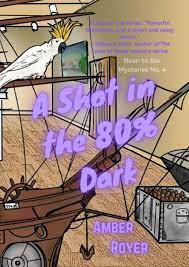 Now that I’ve included Felicity’s artistic side, I feel like I need to lean into it in later books in the series. The book-after-next is going to be titled A Study In Chocolate. There will be a chocolate portrait involved in the plot. Painting with chocolate or on chocolate is actually more common than you might think. (I took a class a couple of years ago where I got meta and painted a cacao tree on a chocolate bar. I’m not the best with a paintbrush, but I do like to tinker with art forms that require that kind of skill. I’m better with photography and graphic design – or words – but you don’t have to be objectively “good” at a specific form of art to have fun doing it.)
Now that I’ve included Felicity’s artistic side, I feel like I need to lean into it in later books in the series. The book-after-next is going to be titled A Study In Chocolate. There will be a chocolate portrait involved in the plot. Painting with chocolate or on chocolate is actually more common than you might think. (I took a class a couple of years ago where I got meta and painted a cacao tree on a chocolate bar. I’m not the best with a paintbrush, but I do like to tinker with art forms that require that kind of skill. I’m better with photography and graphic design – or words – but you don’t have to be objectively “good” at a specific form of art to have fun doing it.) Felicity doesn’t even have a favorite artist at this point. (There is mention in the first couple of books in the series that she appreciates the local sculptures that have been carved out of dead trees as a symbol of resiliency, and the sculptures of endangered sea turtles – one of which is practically on her business’s doorstep. But I don’t think this really counts as a favorite artist, since she connects more with the reason for the art.) I need to spend some time thinking about WHY she doesn’t have a deeply personal favorite. After all, everyone connects to art in some way. It may be an overly popular choice, but my favorite artist is Van Gogh. I did a project on the impressionists, and I kept coming back to his Café Terrace at Night, because it was so warm and inviting. As I learned more about the artists, I kept feeling a connection to Van Gogh more than to the others. His struggles with his art, the way he felt like an outsider in many situations, his tumultuous changes in career – these all mirrored things I had felt, but in a magnified way. He knew what it was like to pour himself into a project only to have it crash and burn. He kept creating art in the face of that, kept trying to move forward despite the breakdown that held him back, doing painting after painting of that tree he could see out of his window, because he needed his creative outlet. I’ve been much the same with words. I find that when I don’t write, I’m more prone to anxiety and depression, because I lose both my sense of routine, and my ability to use my creative side to put order to my life and help process emotion.
Felicity is familiar with a number of painters. When she finally has to choose a favorite artist in A Study in Chocolate, I don’t think Van Gogh is going to wind up being hers too. As research for that book, my husband and I recently visited Galveston’s Art Walk Event. (The books are set on Galveston Island, with Felicity’s fictional shop on the Historic Strand.) We got to see images of local landmarks, and some of my favorite marine animals, done in different scales and styles. Given all of that, and the vibrancy of the local art scene, I’m beginning to think that Felicity’s favorite painter might turn out to be a local artist.
It will be fun to have the excuse to experience more art to find out.
It will be fun to have the excuse to experience more art to find out.
***
Amber Royer writes the Chocoverse space opera series, and the Bean to Bar Mysteries. She is also the author of Story Like a Journalist: a Workbook for Novelists, and has co-authored a chocolate-related cookbook with her husband. She also teaches creative writing and is an author coach.


