Showing posts with label Lucy Worsley. Show all posts

Wednesday, November 20, 2024

LUCY WORSLEY’S HOLMES VS. DOYLE - PBS

LUCY WORSLEY’S HOLMES VS. DOYLE
: a three-part series featuring the popular British historian and lifelong Sherlock Holmes fan who seeks to answer why author Arthur Conan Doyle came to despise the character that made him rich and famous. 

Throughout the series, Worsley explores the parallel lives of Doyle and Holmes in the historical context of their times. From the dying years of Victorian England, through the imperial crisis of the Boer war, the optimism of the early Edwardian years, to the trauma of the First World War, Arthur and Sherlock lived through them all. 

LUCY WORSLEY’S HOLMES VS. DOYLE premieres Sundays, December 8-22, 2024, 8:00-9:00 p.m. ET (check local listings) on PBS, PBS.org and the PBS App. 

Featured in over 60 original stories and countless film and television adaptions, Sherlock Holmes has intrigued and excited fans with his intellect and powers of deduction for more than a century. Over the course of three episodes, Worsley investigates the curious relationship between detective and author. 

In Episode 1, “Doctor and Detective” (December 8), Lucy unearths Holmes’ origins in Doyle’s early life as a medical student in Edinburgh. She unpacks the early stories, revealing the dark underbelly of late Victorian Britain, from drug use to true crime. She explores how Doyle infused his stories with cutting-edge technological developments and traces the author’s growing disenchantment with his detective, heading to Switzerland to visit the site of one of the most famous deaths in literature. 

In Episode 2, “Fact and Fiction” (December 15), Lucy explores Doyle’s desire to distance himself from Sherlock after the detective’s apparent death at the Reichenbach Falls. From the delights of the ski slopes to the horrors of the Boer War, she reveals how far Doyle went to make himself the hero of his own story. He even took on the role of detective himself in one of the most important legal cases of the 20th century.  

In the finale, “Shadows and Sleuths” (December 22), Lucy investigates the return of Sherlock. Doyle began the Edwardian age delighting in all it had to offer, but as the First World War approached, the darkness of the later stories mirrored the reality of Doyle’s life. After losing his eldest son, he became an evangelist for spiritualism, and his star declined after a public spat with a famous magician. Sherlock Holmes, in contrast, found a life beyond his author on stage and screen. 

LUCY WORSLEY’S HOLMES VS. DOYLE will stream simultaneously with broadcast and be available on all station-branded PBS platforms, including PBS.org and the PBS app.

Sunday, November 19, 2023

AGATHA CHRISTIE: LUCY WORSLEY ON THE MYSTERY QUEEN: December 3-17, 2023 on PBS

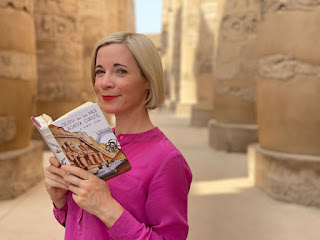
Lucy Worsley on location at Karnak
New Three-Part Series Premieres Sundays, 
December 3-17, 2023
 
Join Historian Lucy Worsley as She Travels the World in Christie’s Footsteps, Unraveling the Secret Life of the Enigmatic Writer Who Revolutionized Detective Fiction 

In her new three-part series, popular British historian Lucy Worsley turns her powers of investigation to the mysterious figure of Agatha Christie, uncovering the story of one of the most famous, complex — and misunderstood — women of the 20th century. How did this seemingly conventional British matron write so convincingly about the dark art of murder? As in the best of Christie’s novels, clues are hiding in plain sight, and Lucy uncovers surprising new evidence and some carefully concealed secrets that illuminate the life of a writer whose work continues to delight readers worldwide. AGATHA CHRISTIE: LUCY WORSLEY ON THE MYSTERY QUEEN premieres Sundays, December 3-17, 8:00-9:00pm ET (check local listings) on PBS, PBS.org and the PBS app.
 
Over 100 years since the publication of her first novel, Agatha Christie remains the most successful novelist of all time, outsold only by Shakespeare and the Bible. In 75 novels, plays and countless short stories, she defined the detective genre. But the real woman behind the literary persona has long remained an enigma.
 
In this series, Lucy Worsley, who recently published the acclaimed biography, Agatha Christie: An Elusive Woman, explores how the arc of Christie’s life follows the dynamic history of the 20th century. She witnessed extraordinary upheaval: not just two World Wars but revolutions in scientific understanding and enormous social change. Attitudes toward everything from class and gender to race, science, technology, psychology and politics were challenged. And — touched by these changes in very personal ways — she plowed all of it into her books. 
 
In each episode, Lucy gets to the heart of Christie’s personal experiences — her family, marriages, influences and inspirations, as well as her sorrows and struggles. She traces the novelist’s footsteps, from the beautiful countryside of the Devon coast to the landscapes of Istanbul and Egypt and analyzes the many hints of her life that the novelist planted in her works. 
 
Episode 1: “Cat Among the Pigeons” (Sunday, December 3)

Historian Lucy Worsley investigates the complex factors that shaped the dark imagination of a refined Devonshire lady, discovering family secrets and a childhood haunted by a sinister figure. Focusing on the first third of Christie’s life, Worsley unearths the surprising roots of the author’s most compelling themes, the inspiration for some of her greatest creations, and the secrets that the enigmatic Christie kept carefully hidden from public view. Worsley’s investigation follows the trail of pivotal moments in her life — and the nation’s — to weave a picture of a woman who was both of her time and thoroughly ahead of it. And it explores how, far from being cozy whodunnits, Christie’s early books tap into and capture the social upheavals of one of the most tumultuous periods of the 20th century.
 
Episode 2: “Destination Unknown” (Sunday, December 10)

On the evening of December 3, 1926, Agatha Christie left her home. The next morning, her car was found abandoned, balanced precariously on the edge of a quarry. Christie's coat, suitcase and driver's license were all inside, but the author herself was gone. What followed was the most extensive manhunt yet seen in Britain. Was this a publicity stunt? A hoax? Or was she the victim of foul play? Ten days later, Christie was discovered in a hotel in Harrogate, claiming to have lost her memory. In this episode, Lucy digs into the mystery, visiting the site where the author crashed her car and Abney Hall, the grand house where she took refuge. Lucy reveals connections between Christie's real-life experience and her novels and uncovers new evidence on her mental health and the cutting-edge psychiatric treatment she went on to receive.
 
In the late 1920s, Christie experienced betrayal, bereavement, divorce, and writer's block, but she also journeyed to Iraq, an experience that would boost her confidence and begin her reinvention and recovery. In this period, the author created perhaps her most famous character: the tenacious elderly sleuth, Miss Marple. Lucy uncovers the factors that shaped this beloved protagonist and discusses the mystery writer’s subversive brilliance with modern authors, including Jean Kwok, Kate Mosse and Ruth Ware.
 
Episode 3: “Unfinished Portrait” (Sunday, December 17)

In the final episode, Lucy Worsley examines Agatha Christie’s later life and discovers how, amid the turbulent social and political change of the 1930s and 1940s, newfound personal happiness ushered in a golden age for her writing. In 1930, recovering from a personal crisis, Christie traveled to the Middle East. On an archaeological dig in Iraq, she met Max Mallowan, and, despite an age difference of 14 years, they fell in love and married. Soon, Christie entered into the most prolific and successful chapter of her career. Lucy follows in the novelist’s footsteps to discover the roots of some of her classics, from the luxurious Egyptian steamship that inspired Death on the Nile to Burgh Island, the inspiration for her most successful but most controversial mystery, And Then There Were None.
 
Lucy observes how Christie achieved global celebrity in her later life but remained the anonymous observer hiding in plain sight. She uncovers the surprising true crime story that inspired the author to write The Mousetrap, the longest-running play in history. And she discovers how the novelist finally embraced the lure of Hollywood in old age, securing a legacy for her stories for future generations.

 
About Lucy Worsley
Lucy Worsley is the Chief Curator at Historic Royal Palaces in the U.K
. and the author of numerous historical publications, including biographies of Queen Victoria, Jane Austen, and most, recently, Agatha Christie: An Elusive Woman. She is the host of several popular PBS specials and series including LUCY WORSLEY’S ROYAL MYTHS AND SECRETS, A VERY BRITISH ROMANCE WITH LUCY WORSLEY, 12 DAYS OF TUDOR CHRISTMAS, VICTORIA & ALBERT: THE WEDDING, TALES FROM THE ROYAL BEDCHAMBER, and many more.

 

Monday, October 13, 2014

10 Best Fictional Detectives

From Publishers Weekly:

Lucy Worsley's The Art of the English Murder is a fascinating look at how the detective novel was born from crime reporting, and how, eventually, detective fiction gave way to the darker American-style thriller of the Cold War era. Here, Worsley picks the 10 best fictional detectives.

Around the turn of the nineteenth century, Britons were flooding from the countryside into towns and cities. Their lives were safer now from nature and its dangers — famine, wild animals, disease. Their thoughts turned instead to the stranger living next door. Who was he? What might he do? Could he be a murderer, like the criminals who filled the pages of the cheap newspapers they read? 

And so crowded cities like London needed a new professional: the detective. He, or she, was a super-hero for the age. In their scary new urban world, the Victorians found it reassuring to read about crimes being solved and justice served, which is why so many of our great fictional detectives were birthed during that period. Here is a list of the best of them.

Read her picks HERE.

What do you think?

Wednesday, September 17, 2014

Lucy Worsley's A Very British Murder: The Story of a National Obsession

Worsley, Lucy. A Very British Murder
Reviewed by Jane Mattisson Ekstam

A Very British Murder: The Story of a National Obsession (BBC Books, 2013) explores two important issues relating to Britain’s obsession with murder: When did the British start taking a ghoulish pleasure in violent death? And what does this tell us about British people? Touching on real-life murders and the history of crime, it demonstrates how the British have enjoyed and consumed the idea of murder since the beginning of the nineteenth century. It also explains why writing about murder has proved so profitable. 

Published by the BBC, A Very British Murder is a complement to Lucy Worsley’s BBC Four television series (http://www.bbc.co.uk/programmes/p01ftzlq) of the same name. While crime novels have generally been regarded as trash, they are, as Worsley argues, the genre which taught working-class people how to enjoy reading. It was what they wanted to read and is the very essence of guilty pleasure. Nothing has changed, claims Worsley: for the last 200 years, murder has been the topic to which readers from all backgrounds turn both for comfort and pleasure. 

One of the most intriguing chapters is ‘The Bermondsey Horror’, a true story which ended in 1849 with an old-fashioned hanging in public. The murder, occurring at the same time as a cholera epidemic that claimed the lives of 10,000 Londoners, is the story of a sordid death involving a love triangle in Bermondsey in south London. Frederick and Maria Manning were a husband and wife team. Frederick had a rival in the form of Maria’s ex-lover, Joseph O’Connor. O’Connor was a frequent visitor at the Mannings’ home. Passions ran high on occasions and on the fateful evening of 9 August, the Mannings shot O’Connor and bashed him 17 times on the head with a crowbar. The couple buried his body in quicklime in the hope that it would decompose quickly and then buried it near beneath the slabs near their kitchen fireplace. The body was later identified by means of O’Connor’s false teeth. It seems that the Mannings were, as Worsely points out, rather inept criminals. 

Immediately after the murder, the couple split up. The story of their capture and trial was covered by the press, The Times alone running no fewer than 72 stories on the murder and trial. Maria was cold throughout the trial, her lack of emotion causing scorn among the general public. She was regarded as the more shocking of the two accused due to her lack of morals. Her husband’s barrister summarised Maria’s behaviour as follows: ‘History teaches us that the female is capable of reaching higher in point of virtue than the male, but that when once she gives way to vice, she sinks far lower than our sex’ (117-8). A crowd of 30,000, including Charles Dickens, attended the joint execution. As Worsley explains, ‘Going to a public hanging had many of the same qualities as a trip to a tragedy at the theatre. There were the crowds, the food- and drink-sellers, and better seats for those rich enough to afford them’ (118). Dickens, for example, hired a room especially for the occasions, invited friends and organised refreshments. 

As Worsley reminds us, the last public hanging in Britain took place in 1868; capital punishment, however, continued, taking on new forms – behind the walls of prisons. This was, as Worsley underlines, a vital precondition for the classic detective story to emerge: ‘Detective fiction, unlike melodrama, or “Penny Blood” fiction, didn’t care about retribution. Its concern was more the solution of crime’ (124), argues Worsley. 

A Very British Murder demonstrates that the story of crime in Britain is associated primarily with city living despite its earlier occupation with small country villages. Crime fiction tells us most about our age, and this is why as early as 1939, novelists understood that ‘If he wishes to study the manner of our age . . . a historian of the future will probably turn, not to blue books and statistics, but to detective stories’ C.H.B. Kitchin, in Worsley, 294). Worsley’s study is highly readable, written with empathy, and also scholarly. The annotated bibliography and numerous illustrations enable the reader to understand how crime was turned into art. At the same time, A Very British Crime is a riveting investigation into the British soul by an historian, who is equally at home with television and books. A captivating history of one of Britain’s most enduring and enjoyable pastimes, A Very British Crime is an invaluable aid to anyone wishing to understand why crime fiction continues to fascinate British people and what this tells us about their psyche.

Jane Mattisson Ekstam is an Associate Professor of English at Kristianstad University, Sweden. She specialises in nineteenth-century British literature, American and Canadian fiction and detective fiction. She is currently writing about detective fiction set in the 1920s and 1930s.