
Showing posts with label Reading. Show all posts
Showing posts with label Reading. Show all posts
Tuesday, April 14, 2026

Wednesday, April 8, 2026

Monday, March 2, 2026
Dr Seuss's Birthday & Read Across America Day!

The more that you read, the more things you will know.
The more you learn, the more places you'll go."
— Dr. Seuss, I Can Read With My Eyes Shut! Even though Green Eggs & Ham is the most popular of the 'food' Seuss books, and, by all means read it and make some green eggs and ham, since it's Dr. Seuss's Birthday, read Happy Birthday to You and Bake a Cake! Check out a copy from your library or buy a copy and read it to or with a child. To enhance the experience, bake a few chocolate cakes, cupcakes, or buy a chocolate Sheet Cake, and have the children decorate.

You could also read Thidwick, the Big-Hearted Moose and serve Chocolate Mousse sprinkled with red candy hearts.
Here's a classic recipe for Cat in the Hat Cookies: Melt white chocolate in the microwave. Dip a round cracker or cookie in the white chocolate, place on wax paper and top with a marshmallow. Allow to cool. Pipe bright red icing as rings around the marshmallow and cover the top.
And from Parents Connect, here's a recipe for Dr. Seuss's Sneetch Treats. Perfect as a companion to reading The Sneetches.
Dr Seuss's Sneetch Treats
Ingredients
8 ounces butter, melted
1 1/2 cups brown sugar
2 eggs
1 tsp vanilla
1-1/2 cups flour
1 tsp baking soda
1/2 tsp salt
3 1/2 cups uncooked, 1-minute oatmeal
1/2 cup chopped walnuts
1 cup golden raisins
2 chocolate bars, chopped into squares
6 large marshmallows
Wooden skewers soaked in water or BBQ forks
Directions
Preheat oven to 350°
Combine melted butter, brown sugar, eggs, and vanilla in a bowl. Mix well.
In separate bowl, combine flour, baking soda, and salt. Slowly add to butter mixture.
Add oatmeal, walnuts, and raisins. Mix well.
 Drop batter (1 Tbsp at time) onto ungreased cookie sheets.
Flatten each cookie slightly with the back of spatula.
Drop batter (1 Tbsp at time) onto ungreased cookie sheets.
Flatten each cookie slightly with the back of spatula.Bake 12 minutes until golden and firm. Remove cookies to cake rack to cool.
Once cookies have cooled, put square of chocolate onto each cookie.
Heat up grill (or smoker... or fire pit... or oven).
Place marshmallows on skewers or BBQ forks. Slowly roast marshmallows over grill until golden on each side.
Carefully slide marshmallows off forks and onto t chocolate-covered cookies.
Place another cookie on top of the Marshmallow.
Theodor Seuss Geisel (March 2, 1904 – September 24, 1991) was an American writer and cartoonist best known for his classic children's books under the pen name Dr. Seuss. With millions of books in print, and nearly all of his titles still available for sale, Dr. Seuss was, up until his death in 1991, one of the most prolific living writer behind Barbara Cartland. His Green Eggs and Ham is the third largest selling book in the English language. He wrote 44 children’s books. His best-sellers included: Green Eggs and Ham, The Cat in the Hat, One Fish Two Fish Red Fish Blue Fish, Horton Hatches the Egg, Horton Hears a Who!, and How the Grinch Stole Christmas. Seuss’s first book And to Think That I Saw It on Mulberry Street was published in 1937 after being rejected almost 30 times.

Check out this cute Cat in the Hat Birthday Cake from Christine Guzman, owner of The Quaint Cake Co in Boca Raton, FL. It was a chocolate cake, of course! They're no longer making cakes, but be sure and check out their gallery...site is still up for your enjoyment!

Saturday, March 8, 2025

Sunday, February 2, 2025

Thursday, January 30, 2025

Thursday, March 28, 2024
Paaskekrim: Norwegian Easter Crime Wave


This is a very peculiar national activity. Publishers in Norway actually time series of books known as "Easter-Thrillers"or Påskekrim, and dates of publication are moved to Spring and released at this time when the sale of mysteries goes up 50%. TV stations, radio and newspapers follow suit by running detective series based on the works of famous crime novelists such as Agatha Christie, P.D. James, Simenon and Ruth Rendell. Many of the Norwegian crime series are rerun.

Why does Norway choose Easter to delve into crime solving? According to one widely accepted theory, the tradition began in 1923 as the result of a marketing coup. Advertisements that resembled news items were published on the front pages of several newspapers, shocking readers who failed to grasp that it was a publicity stunt. This idea spread like wildfire among other publishing houses, and the crime novel became one of the few forms of entertainment available during the Easter break. Cafes, restaurants and movie theatres were closed during Easter, which was supposed to be a time of introspection and repentance. There was no radio, and of course no television either. But everyone could read, and so the Easter crime novel was born.

Some Norwegian Crime Writers

Some Norwegian Crime Writers
Jorgen Brekke
Samuel Bjork
Camilla Bruce
Alex Dahl
K.O. Dahl
Thomas Enger
Karin Fossum
Vigdis Hjorth
Anne Holt
Jorn Lier Horst
Unni Lindell
Jon Michelet
Jo Nesbo
Kjersti Sceen
Gunnar Staalesen
Agnes Ravatn
Pernille Rygg
Linn Ullman
Great websites about Norwegian crime writers
Scandinavian Crime Fiction
Scandinavian Books
International Noir Fiction
Detectives without Borders
Euro Crime
There are 2 Scandinavian issues of Mystery Readers Journal. They're still available.
Volume 30:4 (Winter 2014-15) Scandinavian Mysteries
Volume 23:3 (Fall 2007) Scandinavian Mysteries
Hardcopy and PDF -- Reviews, articles and Author! Author! essays, many by and about Norwegian crime writers.
Subscribe to Mystery Readers Journal HERE.
Sunday, December 31, 2023

Monday, May 1, 2023
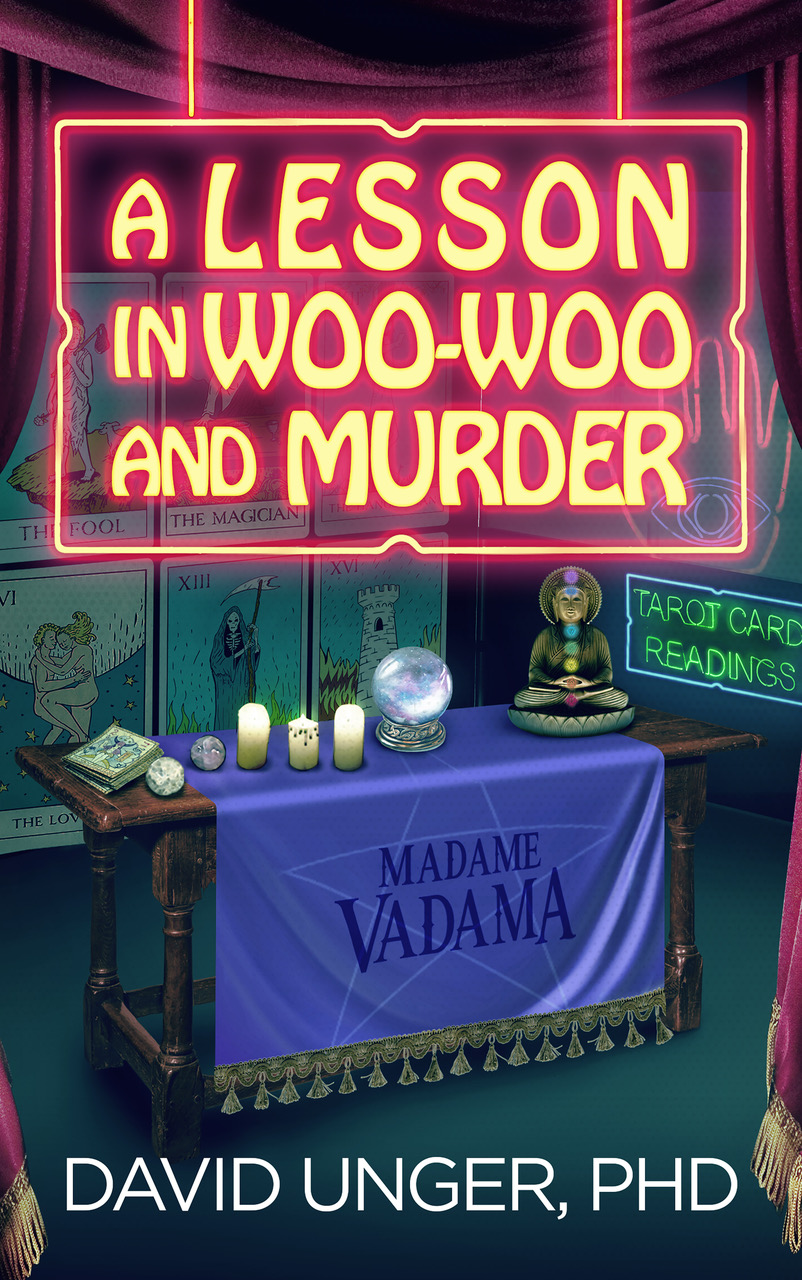
What Reading Mysteries Says about You: Guest Post by David Unger, Ph.D
.jpeg)
Most people like to believe they have free choice. Certainly, when it comes to what book you select to read you’d like to think the choice is your own. And, for the most part, once you are out of school, the choice is yours. But is it really? Why do you pick this book over that? Maybe a friend recommended it or you read a good review. But we’ve all heard recommendations we didn’t heed and reviews we didn’t follow up on. So, why are you reading what you’re reading?
And, even more interesting is why are you reading this now. To get more insight into you? Do you know? And, do you know why the genre you prefer is what you mostly select? Why cozies, why historical fiction, why noir, why why why?
I’ve been a therapist for my entire career. I’ve helped people peel back the layers to discover why they do the things they do and what they can do to improve their lives. Let’s see if we can gain some greater understanding into why you read mysteries and what you get from the experience.
For starters, why do you think you choose the mysteries you read? Perhaps you like discovering the pieces of the puzzle and putting them together. Maybe you like the tension and intrigue. Maybe you like observing how the evil doers get their comeuppance.
Whatever your initial response to why you like mysteries, chances are the answer lies deeper within you. Therapists know that “the conscience mind is the last to know.” Your unconscious very well knows the answer, but it’s hard to tap into that. Maybe tomorrow you can recall a dream you have tonight and get a clue, but in the absence of hearing from your unconscious let me offer some possibilities.
Freud thought our personalities were basically in place by the time we were five. Let’s just say that is partially true. You have a lot of clear memories from back then? Most people don’t. That leaves a lot of the causes for your motivation out of reach. You spend enough time in a therapist’s office you might unravel some of that, but your insights and suspicions are rarely verifiable. So, the real truth about why you read mysteries will remain unsolved but let me give you a leg up.
Like any good story mysteries take you away from your life and put you into another realm. A realm where things are out of control but where someone is able to make sense of it all. There are twists and turns. You think you’re on to something and then you’re not. But almost all mysteries end with the mystery being solved, some order restored and you get to feel that someone out there is able to make things better.
We all want to make things better, have our act together, bring order to our universes and have the things that confound us no longer frustrate us or make us feel less able. No matter a mystery’s protagonists limitations they are able to rise above them and for a moment in time make the world a better place and we all want that.
My sleuth has his shortcomings, but with a dash of humor and a ray of hope he is able to bring the guilty parties forward and restore some semblance of order to the world. That is, until he gets called forth again and has to grapple with other forces of evil. It’s an endless battle, which is why mystery series are so much fun. You can join again with your sleuth of choice as they take on the world’s injustices. You know how your sleuth does their thing and you become part of the posse. I invite you to join in.
***
DAVID UNGER, PhD, is a writer, therapist, educator, and author of the mystery series A Lesson in…, which currently has nine books, with two more coming soon. He is also known for his series of relationship training manuals, which includes a guide to parenting teens. A graduate of UCLA, he lives in California. He’s been a licensed therapist and Chair of a graduate psychology program most of his career. A Lesson in Woo-Woo and Murder launches today.
Wednesday, April 12, 2023

Saturday, March 4, 2023
The Need for Mystery Fiction Novels to be Given Their Due Respect: Guest Post by Manjiri Prabhu

Time and again I have heard this comment about a mystery novel –
“Not great literature but a crackling story….”
“No profound philosophy but a super book….”
Such comments rankle, but they stem from a stereotypical basic classification of literary and mainstream and good and bad literature, but which to my mind evokes debate at best.
I won’t go into definitions and arguments (which would change with changing times anyway) but will base my points on my own fiction writing of more than 30 years and my own experiences with readers.
I have written novels in a variety of genres from mystery, children’s fiction, science fiction to research-based non-fiction and covered many themes and topics. I consider writing mystery fiction the most skillful. Writing Mystery fiction to me is an art - a complete art form which can be distinguished by the virtue of two features –content and craft.
Without going into the structure of a mystery novel, content wise, mystery fiction can touch upon almost all emotions, stages and elements of life and can encompass other genres within itself. It can comment on socio-political, cultural, religious, and emotional issues, and offer deep insights into the psyche of human beings – all under the guise of beautiful prose and an entertaining mystery story. As such, I feel it fulfils the definition of a classically ‘complete’ novel, in its role and purpose.
Writing a mystery novel requires a certain command over the craft. Not only in engaging the reader actively in the whodunnit guessing game, but in the manner in which the novel unfolds, the setting, the pace, the plot etc. One of the main yardsticks of a successful mystery novel is the art of holding the reader in surprise, right till the finale. As such, this essential characteristic of mystery fiction which rates the success of the novel, is deeply embedded in the ability of the writer, in effectively deceiving the reader. The writer may employ literary techniques, can create complex yet believable plots and characters, but the ultimate crucifying end-goal is the victory of the writer over the reader.
I am listing just a few objectives of good, quality fiction here -
1. Touches hearts
2. Helps you reflect
3. Triggers thoughts, sentiments, memories
4. Introduces you to something different and unique
5. Is written in apt and good prose
6. Stays in your memory long after the book is over.
7. A story that has something more to offer than reality and its issues.
8. Which creates a profound emotional reality for the reader
9. Enhances the pleasure of reading
4. Introduces you to something different and unique
5. Is written in apt and good prose
6. Stays in your memory long after the book is over.
7. A story that has something more to offer than reality and its issues.
8. Which creates a profound emotional reality for the reader
9. Enhances the pleasure of reading
I believe that good mystery fiction has the capacity to do all of this and more. I will cite just two examples to illustrate what I mean.
My first novel A Symphony of Hearts written in 1994 was romantic suspense. Almost 20 years later, I got an earnest mail from a reader asking me if I had a copy of the novel, because she simply had to read a paragraph from the book every day as a form of ritual and no matter which page of the book she opened, she got guidance for the day. But now her sister seemed to have misplaced the copy, and she desperately wanted another copy of the book, which was now out of print. I obliged her with a pdf copy of the book, feeling deeply grateful for her email. She made me feel that my writing is worthwhile and crucial to her well-being.
When The Cosmic Clues was published in the US, I got several e-mails from readers across the world. The novel was about a lady detective from Pune, who solved different cases with the help of Indian Vedic Astrology. One day, a particular lady from Lucknow telephoned me and spoke to me at length about how the novel had helped her come out of deep depression, was changing her life, and had given her hope. After that, for a year, she continued to connect with me and to share her experiences and progress in life.
These are just two examples of the many that made me reflect on the role of books and the depth of words on paper. And I am sure, mystery fiction writers across the world have their own heart-warming tales to share.
These are just two examples of the many that made me reflect on the role of books and the depth of words on paper. And I am sure, mystery fiction writers across the world have their own heart-warming tales to share.
When your written words and your world of fiction have the capacity to touch a core, impact, and change lives and help people, those words and that ‘world’ deserve to be taken seriously. In such a capacity, mystery fiction with its multiple, 360 degrees purpose and function can certainly fall in the category of ‘good literature’.
Now, with my latest destination thriller series, my mystery fiction has taken on the role of cultural diplomats. These novels use chosen cities and countries like characters, not merely as a backdrop but with clues, trails, and mysteries embedded into the fabric of that country. The Trail of Four which takes place in Austria, Voice of the Runes in Sweden, and Legend of the Snow Queen in Germany – propagate the themes of Peace and Harmony, thus promoting ideas of democratic values, expression of thought, and feelings of co-existence. As such these well-researched novels try to bridge the gap between the culture of another country and the composite culture of India and in the process, the novels help create an experience of shared cultures and an emotion of rising brotherhood and sisterhood.
For me, mystery fiction in its varied roles, demands to be taken seriously. And I think we should grant it that respect. I strongly believe that the tag and the popularity of a genre should not go against the judging of its quality fiction. Labelling the mystery genre as ‘frivolous’, ‘un-serious’, or ‘un-great’ subverts the requisites of quality fiction. A book is either good or bad literature. Equating good with serious and ‘un-serious’ as popular and hence ‘un-good’ without considering the merits of the individual work, is unfair and fallacious. Good fiction should rise above genres. When a work of fiction is evaluated at its own literary merit, mystery fiction would automatically be awarded its deserved credit and place in the world.
***
Dr. Manjiri Prabhu is an award-winning international author of 19 books, mystery and thriller writer, a Short-Film-Maker and the Curator & Founder/Director of two international festivals Pune International Literary Festival and International Festival of Spiritual India (for Humanity & Wisdom). Her latest novel is LEGEND OF THE SNOW QUEEN, a Re Parkar Destination Thriller based in Germany.
YouTube Channel : https://www.youtube.com/channel/UCUkJZhGe9OZyuTYkLRLic7w
YouTube Channel : https://www.youtube.com/channel/UCUkJZhGe9OZyuTYkLRLic7w
Award-winning international Author, a Short-Film-Maker and the Curator & Founder/Director of two international festivals
Website : www.manjiriprabhu.in
Facebook : https://www.facebook.com/prabhumanjiri
Twitter : https://twitter.com/manjiriprabhu
Instagram : https://www.instagram.com/manjiri11.11/
Tuesday, October 25, 2022

Tuesday, September 28, 2021
MYSTERY READERS ARE THE SMARTEST: Guest Post by Larry Maness

No one, writers and readers alike, enjoys discovering an error in a book. However small, be it a misplaced comma, incorrect spelling, or in the case of one Barry Thomas Reed who pointed out in a precisely crafted letter to my publisher what he called a ‘factual conflict in the early pages’ of my novel, Nantucket Revenge. Mr. Reed writes that on page 26, lines 9-10, on page 30, lines 2-3, and on page 32, line 19, there appears to be some confusion on whether the passenger ferry Eagle sailing out of Nantucket ran aground before or after the Coast Guard boarded her.
I wrote Mr. Reed a warm Thank You note pointing out a different line on page 26 stating that the Coast Guard successfully boarded the ferry and had her towed back to the dock after she’d grounded. Conflict resolved.
Over the years I have had occasion to correspond to readers with questions ranging from who a certain character is modeled after—if any-to where best to begin a hike given the locations mentioned in A Once Perfect Place set near New Hampshire’s Pitcher Mountain.
All reader’s questions and comments reinforce something that I’ve believed since I began writing mysteries: Mystery readers are some of the most intelligent and actively engaged readers in the reading world.
Years ago, I was one of several book reviewers for “Boston Review” and “The Boston Phoenix.” In the days before electronic submissions, publishers sent advanced copies or galleys to Arts Editors who made reviewer assignments, if we did not find on our own something that we wanted to read. Finding that soon-to-be-reviewed tome involved a trip to one office or the other and rummaging through stacks of books until selecting a book.
Other reviewers did the same and would often make comments on a book someone had selected. The jab went something like, “Why review that (substitute any genre here) when you could write about something more serious?” The slight was obvious: mystery, thriller, Sci-Fi (add any genre fiction) is less than so-called serious fiction. To take that thought further, genre readers are somehow inferior to readers of serious fiction. They want page-turning escape. They want to ignore the struggles of life, which is the purview of the serious novel.
P.D. James and John D. MacDonald, both excellent stylists to name but two, would likely challenge the notion that their best fiction was anything other than serious work, and that their readers were somehow inferior. In my view, readers who enjoy puzzling out the guilty in the pages of a well-written mystery are actively engaged in characters, plots, and places like no other readers.
One reason for this is that the nature of a mystery novel invites the reader to participate in solving a puzzle. A crime or murder is committed. What was the motive? How was it done? Who did it? These and other questions create a unique bond between writer and reader. As the characters develop and the plot hurries along, the mystery reader transforms him or herself into an additional detective trying to solve the case along with the fictional characters. This is especially true when the author writes in first person since the reader and the fictional detective learn about the crime and possible solutions simultaneously.
This participation in the novel occurs because readers of mysteries are basically curious. To solve the mystery requires careful, thoughtful reading mixed with a bit of logic that helps spot the red herrings. These readers really do want to know who did it. But they don’t want the answer to come too easily. Readers feel cheated when after 100 pages they have figured it all out. No, they want a challenge and good mysteries provide that.
There is another, perhaps more important, reason that mystery readers are actively engaged like no other readers and that relates to their book selection process. Publishers’ marketing research has been done in how the background color of the dust jacket and shelf placement effects sales. Books with black covers placed on the bottom of the retail book shelf sell fewer copies than novels with lighter covers placed near the top. But more than the cover and shelf placement, readers of mysteries relate to the underlying theme of all mystery novels: The never ending battle between good and evil played out in a familiar arena.
In the real world, crime often does pay and amoral, vicious men and women can and do get away without penalty. In most mystery novels, the good and virtuous win. The victory may not be tidy, some rough edges may remain, but the bad guys pay their debt. The victory over evil is sweeter when the protagonist overcomes his or her many flaws to gain the upper hand. Again, in the real world, our flaws are often not overcome. We don’t win all the entered races and the girl of our dreams may have run off with the crook who lives next door.
In a mystery novel, the crook gets busted, the girl comes to her senses, and we are all breaking the tape when we cross the finish line first. So for all the Barry Thomas Reeds out there who take the time to spot a factual conflict in any of my work, I thank you in advance for taking my and all other mystery writers novels seriously enough to offer your thoughts. We are, after all, moving through the pages together.
***
Larry Maness is the author of Nantucket Revenge, A Once Perfect Place,
and Strangler—all featuring Jake Eaton, Private Investigator. The Jake
Eaton mysteries and his novel The Voice of God were reprinted last year
by Speaking Volumes Publishing who published his newest novel, The Last
Perdoux, in the Spring.
Thursday, June 17, 2021

Thursday, November 12, 2020
THE SECRET TO A GREAT MYSTERY: MAKE ME FEEL SOMETHING: Guest Post by Mary Anna Evans

The Secret to a Great Mystery: Make Me Feel Something
When I think of my favorite mystery writers (Agatha Christie, Tony Hillerman, Donis Casey…) or my favorite mystery characters (Miss Marple, Joe Leaphorn, Alafair Tucker…), it’s not hard to put my finger on the reason why I enjoy those writers and those characters. While it’s a given that these are authors who craft tight, intelligent narratives, and Christie in particular is known for her puzzle plots, I think that they offer readers something more. I also think that this extra special “something” isn’t directly related to the plot at all. This may be a surprise to people who consider reading crime fiction to be a purely intellectual exercise focused on determining “whodunit,” but I somehow doubt that devoted crime fiction enthusiasts think of their favorite books in that limited way.
For me, part of the delight in mystery novels comes from spending time with characters with whom I feel a connection. My favorite protagonists feel like friends to me. My favorite antagonists also strike an emotional chord. They are more than just crazed killers. They are realistic people who have chosen to do evil. I may not agree with their reasons, but those reasons make logical sense. Most importantly, the ideal antagonist’s actions make emotional sense. When they are unmasked and their crimes are revealed, I feel a sense of relief that justice has been served, but the real artists are those writers who are able to portray the criminal’s motivations so convincingly that I feel a twinge of regret that things have gone so badly for them. When I love a book, it is because its writer made me feel something.
As a writing professor, I tell my students that if they take just one thing away from their time with me, it is the phrase “Make them feel something.” If they are so inclined, I suggest that they make a poster with just those four words and hang it over their computer. The relationship between a reader and a writer takes place over a long distance, but it is real. Sharing emotions with someone so far away, not to mention the many others who have also read the book, is satisfying. It makes us want to repeat the experience. When young readers encounter a book that makes them feel something, they become readers for life.
Put a book in my hands that touches my emotions, and I’ll be back for more.
***

Mary Anna’s favorite books by the authors featured in this post are:
Witness for the Prosecution and Other Stories by Agatha Christie
Dance Hall of the Dead by Tony Hillerman
The Old Buzzard Had It Coming by Donis Casey
Monday, February 4, 2019
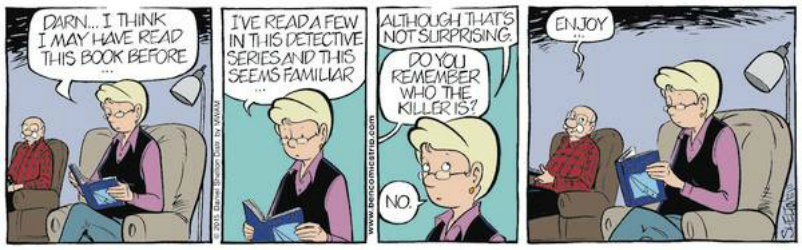
VINTAGE FEBRUARY MAGAZINE COVERS: READING
Love these Vintage Magazine Covers, especially since they're about reading. Be sure to scroll down to see both.


Friday, November 4, 2016
Tuesday, August 30, 2016

Tuesday, June 28, 2016

Monday, April 25, 2016
Worst. Reading. Ever. - Guest post by Adrian McKinty

ADRIAN McKINTY:
WORST. READING. EVER.
It was nice of JK Rowling to share her early stories of rejection and humiliation with us. Rejection, of course, is part of the book business but no humiliation is quite as abject as that of the book reading gone awry and Jo Rowling doesn’t seem to have had many of those to complain bout.
Like comics celebrating their bad gigs however pretty much every other author can humble brag about book readings they have given where only two or three people came. This is far more common than you would think and in fact the majority of all book readings are probably for “crowds” of a dozen or less. You don’t get to hear much about these sad events because this never happens to celebrity authors or best selling writers, though for the majority of novelists it’s the humiliating norm: the crowd of four, two of whom are asleep, one of whom is clearly mad and the last person is your auntie.
Far more impressive to me are the authors who can boast of zero attendance at their book readings. For zero people to show up you have to be particularly skilled in the arts of non persuasion. This has happened to me half a dozen times, and now I quite look forward to these nihilities as they are, actually, pretty easy situations to handle. If no one comes, you simply sign stock and go home early free of the whole unpleasant business. Much trickier is the circumstance where one person shows up. Then you feel obliged to go on with the show, sometimes to the annoyance of the shop owner who is forced to go through the motions with you. Once in the Boulder Bookstore as I proceeded to read to one person (my wife’s cousin), the owner began aggressively putting away the clangy metal chairs he had laid out for twenty.
I’ve got many other reading horror stories. At a book reading in Spain once my host began the event by throwing my book on the table, pointing his finger angrily at me and demanding “why I had betrayed the revolution?”
But my worst reading of all was in Boston, Massachusetts where I had to deal with a heckler. Comics are used to dealing with hecklers but not authors. I’ve had my share of online trolls, of course, where it’s easy for someone to say that you’re a “terrorist sympathiser” or a “provocateur working for MI5”; but it requires courage to show up to someone’s book reading and try that on.
At this particular store in Boston I had a respectable crowd of about eleven, and I’d been reading for about five minutes when I noticed a man in the front row (they’re always in the front row) start to get agitated. He was about thirty, well built, tall, wearing black jeans, work boots and a button down white shirt. He looked completely normal, but evidently something I was doing was driving him crazy. Finally he could take it no more and yelled out: “This is shit!”
I decided to ignore him and carry on but a minute later he interrupted again, looking at his fellow audience members for support: “Can’t you all see this? This is such utter shit!”
Authors go through a lot of self doubt over their manuscript, and as you read and re-read the book in the proofing and editing stages the jokes start to seem flat, the plot points predictable and the characters dull. Part of you is always thinking: “Can’t you all see this? This is such utter shit!” If I’d been, say, Stewart Lee, I would have articulated all of this and potentially disarmed the man, but as it was I kept ignoring him and attempted to continue. Incensed, he stood up, went to the podium, and tried to snatch the book out of my hand.
“Look, what’s the problem, mate?” I asked.
“This is shit.”
“Specifically what’s the problem?”
“What’s with all the big words? Who do you think you are? What can’t you talk in normal fucking English?”
A line from Fawlty Towers rose up in my head that I unwisely gave vent to: “What? Pretentious, moi?” I said.
This only maddened him further and he successfully snatched the book out of my hands. I tried to grab it back before he muttered: “I have a knife!”
So do I, I thought, a whole kitchen full of them until it occurred to me that he probably meant with him, here, tonight.
This particular bookshop had no security of any kind and enjoying what was turning out to be a much livelier event than advertised, no one in the crowd was calling the police.
“This word, what does this word mean?” he said shoving the book in my face and pointing at the word ‘tenebrous’.
“It means ‘shadowy’ or ‘dark’,” I said.
“What can’t you fucking say ‘dark’ or ‘shadowy’ then?”
“I could have, but I’d said ‘darkness’ earlier on the page, and if I remember rightly I liked the association the word ‘tenebrous’ conjured up with the Catholic liturgy of—”
“My point exactly! You could have fucking said dark!” the man yelled triumphantly and stormed out of the bookshop still holding my book.
The reading more or less ended there in mass embarrassment for everyone, and, if it had, in fact, been the worst book reading ever, the audience would have agreed with the heckler about my purple prose and left with him. Actually I got more sympathy purchases of the book than normal, although I still wouldn’t recommend this as a strategy for boosting your book sales up into the JK Rowling territories.
Subscribe to:
Posts (Atom)