Showing posts with label Gothic. Show all posts

Friday, September 20, 2024

THE TURN OF THE SCREWDRIVER: 50 Dark and Twisted Literary Cocktails Inspired by Gothic Horror Books

I love tie-in Mystery Cookbooks--and Mystery Cocktail books. This one focuses on horror, but it's still a welcome addition to my shelf: The Turn of the Screwdriver: 50 Dark and Twisted Literary Cocktails Inspired by Gothic Horror Books by Iphigenia Jones. With Halloween coming up, you'll want to grab a copy! 

Dark and brooding cocktails with 50 drink recipes inspired by your favorite gothic horror books, including Interview with a Vampire, Frankenstein, Jane Eyre, and Wuthering Heights. It is the perfect gift for booklovers and mixologists!

Written by Iphigenia Jones, The Turn of the Screwdriver: 50 Dark and Twisted Literary Cocktails Inspired by Anne Rice, Mary Shelley, Edgar Allan Poe, and Other Legendary Gothic Authors!  (Ulysses Press; July 2024) celebrates gothic literature, both classic and modern, and encourages readers to toast to how much fun these books have brought us.

• THE HAUNTING OF HIGHBALL HOUSE
(The Haunting of Hill House by Shirley Jackson)

• THE PORTRAIT OF DORIAN GREY GOOSE
(The Portrait of Dorian Gray by Oscar Wilde)

• THE LEGEND OF SLUSHY HALLOW
(The Legend of Sleepy Hollow by Washington Irving)

• HER BRANDY AND OTHER PARTIES
(Her Body and Other Parties by Carmen Maria
Machado)

• MEXICAN HOT GOTHALATE
(Mexican Gothic by Silvia Moreno-Garcia)

• LESTAT’S BLOODY SAZERAC
(Interview with the Vampire by Anne Rice)

• AND MORE!

Friday, May 29, 2020

SHRIEKS IN THE NIGHT: Guest Post by Camille Minichino

Camille Minichino:
Shrieks in the Night

Do you know the difference between terror and horror, and who gave us that distinction?

I was one of the last to know, oblivious until last month when I completed a class in Gothic Literature. I’m halfway through an MFA program in Creative Writing, and this intense course got wedged into my schedule as a “required elective,” no one noticing the oxymoron.

It turns out it was Ann Radcliffe, in an 1826 article published posthumously, “On the Supernatural in Poetry,” who gave us the distinction. Briefly, in my less than eloquent paraphrasing, she advised us: terror is a sense of fear and anxiety that something horrible might happen, but you turn around and there’s nothing there; horror is the shock that comes when face to face with the dreaded monster.

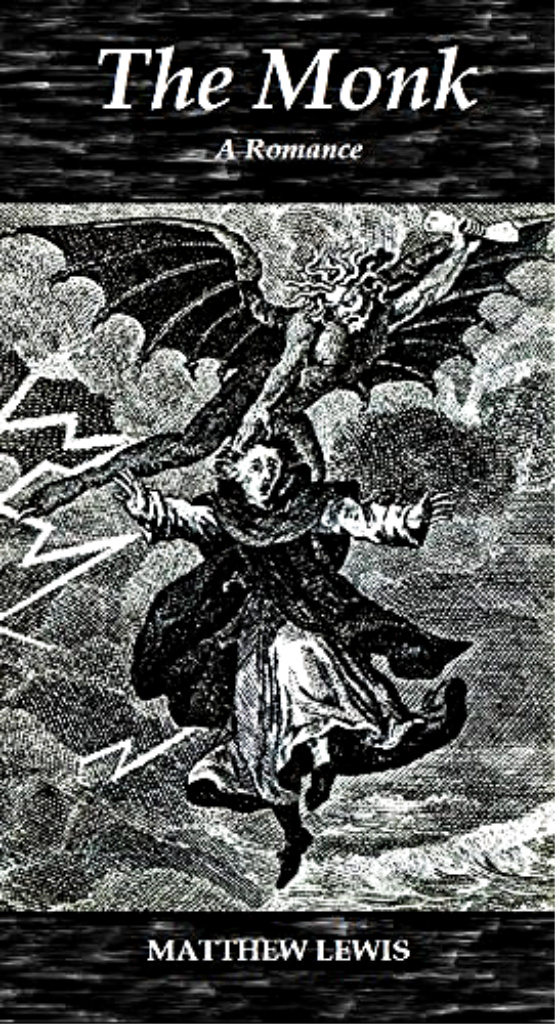
If Radcliffe epitomizes terror in her novel, The Italian, Matthew Lewis is the master of horror, author of the shocking and gory novel, The Monk (1796). In it, you’ll have your fill of real horror, in the form of depravity, torture, and mob violence.

Radcliffe wraps up any loose supernatural ends with a real-world explanation, whereas Lewis leaves us with specters, mystic rites, and demonic forces.

Critical reviewer Samuel Taylor Coleridge ripped apart The Monk. The review reads in part:

“We trust, however, that satiety will banish what good sense should have prevented; and that, wearied with fiends, incomprehensible characters, with shrieks, murders, and subterraneous dungeons, the public will learn, by the multitude of the manufacturers, with how little expense of thought or imagination this species of composition is manufactured.”

In spite of this condemnation, or maybe because of it, The Monk was a huge success, a best seller.

Lucky for us, we get to hear what Stephen King, the modern day Goth-er, has to say. In Danse Macabre, he adds a third element to terror and horror: revulsion. King explains the hierarchy thus:

“I recognize terror as the finest emotion and so I will try to terrorize the reader. But if I find that I cannot terrify, I will try to horrify, and if I find that I cannot horrify, I’ll go for the gross-out. I’m not proud.”

The readings and assignments in the Gothic Literature class nearly did me in with their volume and intensity, but in the end, I’m glad I experienced it. There’s hardly a better way to gain a sense of the foremothers and forefathers of the darker writings of some of my favorite authors: Edgar Allan Poe, Stephen King, Joyce Carol Oates, and Martin Cruz Smith, who occasionally goes off his beaten path of police procedural.

You may be familiar with my attachment to the writers Margaret Grace, Ada Madison, Jean Flowers, and most recently Elizabeth Logan. They all write cozies. Not a lot of fear, very little dread, some suspense, and definitely no horror or revulsion. So what’s the story?

Under all these pen names, I may write cozies, but that doesn’t mean I read them.

From time to time, I try to write characters like Dexter or Rosemary’s baby Adrian/Andrew, or Mrs. Danvers, or even Mr. Ripley, with his sometimes charming side.

So far, it hasn’t worked out for me. It’s one thing to immerse myself in these characters for a few hundred pages; it’s another to live with one, to stay inside his or her twisted head for the months it takes to write a novel.

After this class, however, immersed in the highly emotional world of crypts, omens, curses, nightmares, hauntings, and evil in the asylum, I’m ready to take on the project again.

Watch, and listen for the scream!
***   

Camille Minichino received her Ph.D. in physics from Fordham University, New York City. She is currently on the faculty of Golden Gate University, San Francisco and teaches writing throughout the Bay Area. Camille is Past President and a member of NorCal Mystery Writers of America, NorCal Sisters in Crime, and the California Writers Club. She has written more than 25 mystery novels.    The Periodic Table Mysteries, featuring retired physicist Gloria Lamerino,set in Revere, Massachusetts; 
The Miniature Mysteries (as Margaret Grace), featuring miniaturist Gerry Porter and her preteen granddaughter in a northern California town; 
The Professor Sophie Knowles Mysteries, featuring a math professor at a small New England college; 
The Postmistress Mysteries (as Jean Flowers), featuring Cassie Miller, postmistress in a western Massachusetts town; 
The Alaskan Diner Mysteries (as Elizabeth Logan), featuring Charlotte "Charlie" Cooke, and her sleuthing crew in a fictitious Alaska town  The first Alaskan Diner Mystery MOUSSE AND MURDER was released in May.

Tuesday, July 3, 2018

Inspiration for The Night Visitor: Guest Post by Lucy Atkins

Lucy Atkins:
Inspiration for The Night Visitor

When I was growing up in a picture-postcard village in the south of England, I had a friend whose home was nothing like my own. It was huge, for a start—a Victorian Gothic Manor House with ten bedrooms, a sweeping staircase, a ballroom, and a minstrel’s gallery. To get to the house you had to pass through tall iron gates and travel down a long, tree-lined driveway, at the end of which loomed the grey flint house, magnificent but also kind of terrifying.

The interior was in a state of creeping dilapidation. There were cobwebs in the corners, damp shadows on the plasterwork, rattling casement windows with cracked panes, and a pervasive smell of mildew in the air. It was always cold and dark inside, even in summertime. It turned out that my friend’s father, a gambling man, had won the house in a bet some time in the 1970s and, with no money for repairs, upkeep, or modernization, it was stuck in time, a flinty Miss Havisham, hell bent on decay.

I remember crazy teenage parties where we’d run screaming across the tattered lawns, sure that we were being pursued by something ghoulish. I remember everyone cramming into the kitchen because a ghost had been spotted in the minstrel’s gallery. My friend, a tall, blonde, loyal girl, told me that she would often wake in the night to find an old lady sitting on her chest, pinning her to the mattress. My friend was paralyzed when this happened, unable to move or cry out for help.

When I began to research The Night Visitor, two elements of my childhood memory resurfaced: the malevolent old lady “night visitor,” and the Manor. That house became “Ileford Manor” in my novel, a grand place that is stuck in time, hiding complicated secrets. I updated things a little: my housekeeper, Vivian Tester, is proud and competent; she lives alone in the manor with her rescue dog, Bertie, and works hard to keep the damp at bay, dealing with spiders and dust and falling roof slates. What I did recreate though, was that “unheimlich” feeling in the house, the sense of uncanny unease, the knowledge that things are just not right there.

The Night Visitor is about two very different women: Olivia, a glamorous British historian in her forties who makes TV shows about Victorian women, and Vivian, the housekeeper, in her sixties and definitely not glamorous. When Vivian finds a Victorian diary in the house, she takes it to Olivia and the two women begin to work together on a book about the diary’s author. As the novel unfolds, and events move between the manor house and a glorious vacation rental in the South of France, it becomes clear that Vivian is not what she seems.

In my novels, settings are crucial for building tension. I loved the contrast I could draw between the sunny French villa and my threatening, Gothic English house. I have no idea what made the Manor (and its unsettling old lady) resurface in my mind after so many years, but I’m so grateful that it did. I don’t know if I could have written The Night Visitor without it.

***

Lucy Atkins is an award winning British author and journalist. Her novels The Night Visitor (2017), The Other Child (2015), and The Missing One (2014) are all published by Quercus. She has also written seven non-fiction books, two of which have won national awards.