Showing posts with label Hawaii. Show all posts

Monday, September 22, 2025

Rosemary and Larry Mild: Recipients of Hawai‘i Literary Arts Council Elliot Cades Award for Literature

Husband-and-wife mystery novelists Rosemary and Larry Mild have been named recipients of the 2024 Elliot Cades Awards for Literature, Hawaiʻi’s most prestigious literary honor.  An annual award presented by the Hawaiʻi Literary Arts Council, the Elliot Cades Award honors established writers who live in Hawai’i.

Novelists Rosemary and Larry Mild have lived in Honolulu since 2013 and visited every winter from Maryland for 20 years before then. Larry grew up in New Haven, Connecticut, and served in the U.S. Navy during the Korean War. He spent most of his post-military career designing electronic equipment for the U.S. Government. He met and married Rosemary, a Smith College graduate and former assistant editor at Harper’s magazine, after his first wife, Hannah, died in 1986. Rosemary grew up in Milwaukee, Wisconsin. On their blind date Larry told Rosemary, “When I retire, I’m going to write a novel and I want you to help me.” Since then, the Milds have collaborated or worked separately on 22 published books, including mystery and suspense novels, short story collections, and memoirs. Two of their novels, Cry Ohana and its sequel Honolulu Heat, are set in Hawaiʻi. The 13 detective stories in Copper and Goldie are also set in Hawaiʻi.  
The Hawai‘i Literary Arts Council was founded in 1974 to encourage and promote literature and literary activity of all sorts in Hawai’i. The Cades Award has been presented since 1988. 
Rosemary and Larry Mild’s latest work, The Morning Lisa, will be released in October. The Moaning Lisa features protagonists Paco and Molly LeSoto, an unforgettable duo who captivated readers in Locks and Cream Cheese, Hot Grudge Sunday, and Boston Scream Pie.

***

Rosemary and Larry Mild are frequent contributors to Mystery Readers Journal and Mystery Fanfare. Read this 2018 interview, Partners in Crime, in Mystery Fanfare. 

Tuesday, April 29, 2025

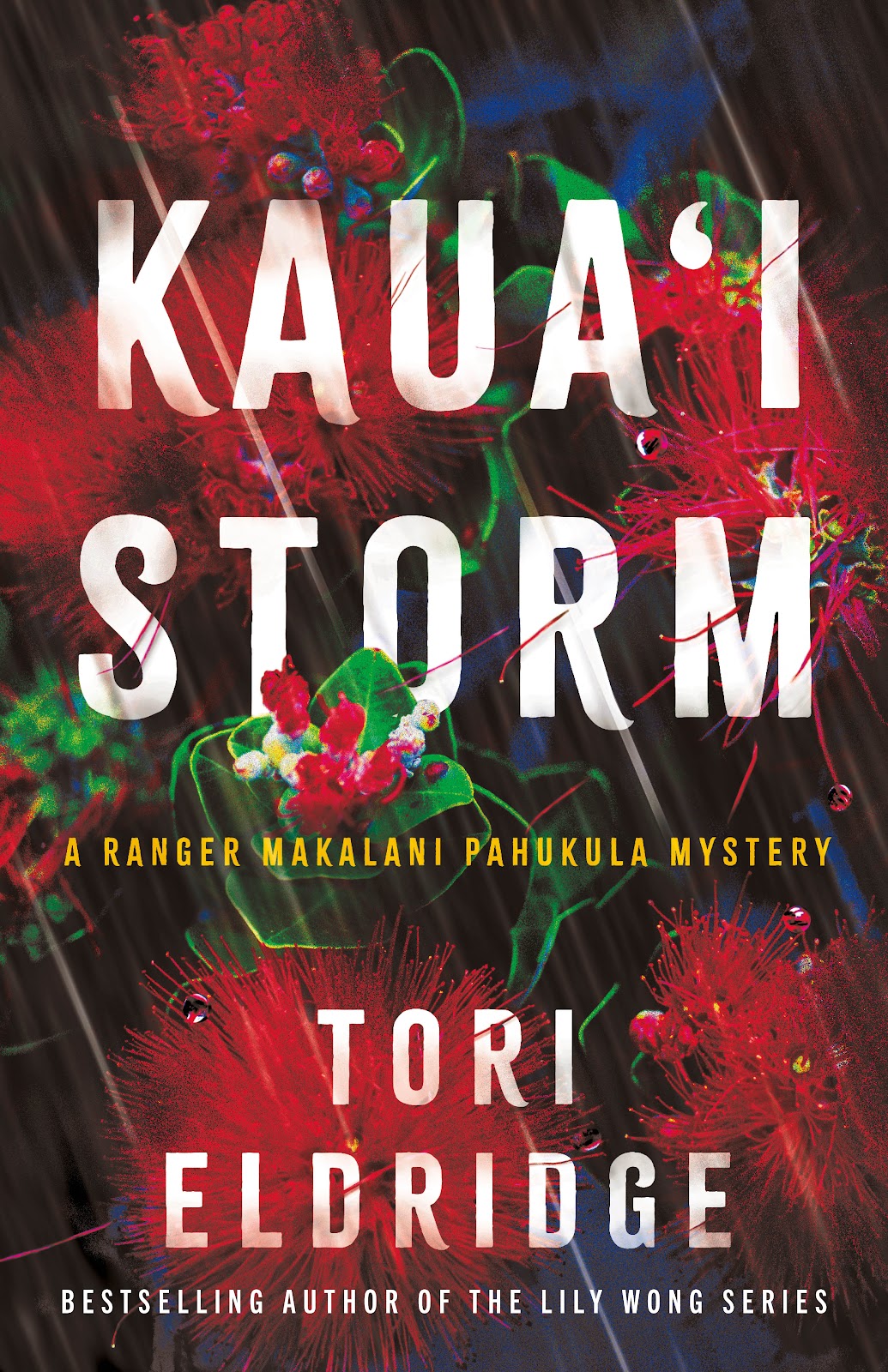
Grandma? Nope. Only Tūtū for me! Guest Post by Tori Eldridge


After receiving the blessed news of an approaching grandbaby, I—like every expecting grandparent—faced the all-important decision of what to be called. With a multicultural and international family like mine, the decision required thoughtful consideration and care.
My daughter-in-law is Chinese from Hong Kong, so my assumption was that our wee one would call me Ah-ma or Maa-maa‚—common choices for a paternal grandmother in Cantonese—or Nāinai, the grandma name used in Mandarin. This would have been fine by me since I’m almost half Chinese.

But I’m also Native Hawaiian, born and raised.

Much to my surprise and insurmountable joy, my son and daughter-in-law decided to name our granddaughter Moana after the empowering heroine in the Disney movie they both loved! And since they would be honoring my Native Hawaiian heritage, I knew only Tūtū would do.
 
Not only would Moana and any future grandchildren call me by the affectionate Hawaiian name for grandma, I would consciously and lovingly share our Hawaiian heritage with them.
 
The only wrinkle? Moana was born in Shanghai!
 
How could I possibly share my aloha for Hawai‘i with her when China, during the pandemic, would not let me in?
 
Fortunately, they moved back to Portland, Oregon, before her second birthday. Unfortunately, I was still living thousands of miles away in Los Angeles. Not only was I still separated from her, I had been separated for decades from my ancestral roots.
 
Writing Kaua‘i Storm gave me a way to reconnect with my homeland and heritage—and, by extension, my granddaughter and new grandson, Nahele—in a deep and meaningful way. It was also paramount that I dive below the cultural surface that is more commonly revealed and write about Hawaiians in Hawai‘i as well as those of us who have moved away and might try to come home.
 
As with my protagonist, Ranger Makalani Pahukula, I left the islands to attend college and pursue a career, which for me involved performing on Broadway, television, and film. Makalani, on the other hand, became a law enforcement ranger at Oregon’s Crater Lake National Park. As with many people who move away from their home town, state, or country, we both became a little out of step with what was happening back home.
 
The challenges of returning home and feeling out of place are universal and play a major theme in Kaua‘i Storm.
 
The experiences for Hawaiian diaspora are especially nuanced and fascinating since Hawai‘i is a formerly sovereign nation with its own kānaka maoli (true people), ‘ōlelo Hawai‘i (Hawaiian language), and a rich history with valuable traditions that our conquerors sought to subdue. We may be considered the fiftieth state, but unlike the other forty-nine, our origin story, ancestry, and struggles are unique.
 
If I was going to write a novel set in Hawai‘i, it had to be written from a Native Hawaiian’s ancestry and point of view—Makalani’s and my own.
 
One way in which I did this was to give Makalani her own “Tūtū” who could serve as the family’s cultural touchstone and remind Makalani where she comes from and the values by which she should live. I gave Makalani’s Tūtū the knowledge I wanted to possess and the empowering influence I hoped to be.
 
Now, to my endless joy, my husband and I live in Portland, Oregon where I can greet my mo‘opuna (grandchildren) with “Kakahiaka nō!” —Good morning! — and remind them that Tūtū loves them, “Aloha o Tūtū iā ‘olua.”

Needless to say, writing this new book series about Makalani and her multigenerational ‘ohana has enriched my life and influenced my role as Tūtū in my grandchildren’s lives.
 
 ***
Tori Eldridge is the bestselling author of the newly re-released Lily Wong mystery thriller series—The Ninja Daughter, The Ninja’s Blade, The Ninja Betrayed, and The Ninja’s Oath—as well as a two-time Anthony Award nominee, Lefty and Macavity Awards finalist, and winner of the 2021 Crimson Scribe Award for Best Book of the Year. Born and raised in Honolulu—of Hawaiian, Chinese, and Norwegian descent—she lived in New York and Los Angeles before settling in Portland, Oregon, where her mo‘opuna live. Kaua‘i Storm is the first of her new Ranger Makalani Pahukula Mysteries.

Friday, June 9, 2023

An Accidental Experience Leads to a Novel: Guest Post by Robert McCaw

An unexpected experience can spark a novel. In the 1980s, I visited the summit of Mauna Kea, one of two 14,000-foot volcanoes that comprise most of Hawaii Island. My goal was to see the array of telescopes atop the mountain and experience the special place in Hawaii that is first to see the sunrise and last to enjoy the sunset. Along the switchback gravel road to the summit, a sign led me to discover the Mauna Kea Adze Quarry. At this stone age industrial site, ancient Hawaiians mined and shaped an especially hard rock for high-quality adzes from around 1000 AD until they abandoned the quarry sometime before Western contact in the late 18th century.
 
You might not think a rock quarry would inspire imagination until you consider the details. The quarry is vast, covering roughly seven and a half square miles. Its main extraction pits lie between 11,000 and 12,400 feet in elevation on the southern slope of Mauna Kea, where the air is thin, and wintertime temperatures drop to zero degrees Fahrenheit with wind speeds of up to one-hundred miles per hour. Even today, snow frequently covers the mountain’s upper slopes in winter. So why would anyone—especially ancient Hawaiians wearing woven sandals and little protective clothing—choose this site to mine stone?
 
The answer lies in a quirk of nature. Lava is everywhere in Hawaii, but most of it is porous, crumbles under pressure, and is thus unfit for good stone tools. The basalt near the top of Mauna Kea is different. During the Ice Ages, glaciers covered the summit of Mauna Kea. When lava erupted under the ice, it cooled rapidly to form a particularly dense and hard stone called Hawaiite.
 
Now comes the imagination part. How did the ancient Hawaiians—who’d probably never seen snow before reaching the Big Island—find this rugged rock more than 11,000 feet above sea level? How many adze makers worked on the mountain, and how did they organize an industrial-sized mining and production site? To create the rock shelters, numerous religious shrines, and piles of stone chips more than twenty-five feet deep that still exist at the quarry site, they must have lived there for months at a time. If they had time to build and visit shrines, did they also create other art, such as petroglyphs that dot other places around the island? Did they maintain their own tribe with its own hierarchy of chiefs, or did they report to local chiefs from where they were born? Since they worked the quarries for hundreds of years, how did they pass their leadership and manual skills from generation to generation? Since it is improbable that they stayed on the summit through the winter, where did they go during the inclement months—back to home villages more than 25 miles away along the coast or to some more temperate workshop at a lower elevation? And perhaps the greatest mystery of all, why did they abandon the quarries before Western contact?
 
These and other questions led me to imagine a society of adze makers forming one of the major themes of my first book—Death of a Messenger. In that novel, the discovery of a mutilated murder victim leads to the opening of a concealed workshop in the saddle lands between Mauna Kea and Mauna Loa, where the adze makers could have shaped their stone tools during the winter when the weather prevented their work near the summit. To determine whether there is a connection between the murder and this extraordinary fictional archeological site, my protagonist, Hilo Chief Detective Koa Kāne, must explore the cavern. This setup allowed me to paint a picture of how the adze makers might have lived and incorporate some of the Hawaiian legends and mysteries surrounding their existence.
            
It also set the stage for introducing a grave robber trafficking in looted artifacts. I’d love to take you step by step from the gruesome discovery of the murder victim at the cavern to the looters and beyond, but nobody likes spoilers! I hope you will enjoy the book, which Amazon and other distributors are giving away for free in Kindle format during the month of June 2023, and if so, remember, it all started by accident.

***

Robert McCaw 
grew up in a military family, traveling the world. He is a graduate of Georgetown University, served as a U.S. Army lieutenant, and earned a law degree from the University of Virginia. Having lived on the Big Island of Hawaii, McCaw’ s writing is imbued by his more than 20-year love affair with this Pacific paradise. He now lives in New York City with his wife, Calli. Retribution is the fifth in his Koa Kāne Hawaiian Mystery Series.  For more information visit, www.robertmccaw.com


Thursday, September 19, 2019

COPPER AND GOLDIE: 13 Tails of Mystery and Suspense in Hawai‘i: Guest post by Rosemary & Larry Mild

I see you’ve just opened a copy of Copper and Goldie, 13 Tails of Mystery and Suspense in Hawai‘i. Now, my dear reader, sit back and fasten your seat belt. Just imagine you’re being transported across the Pacific Ocean to the most isolated place on earth, the Hawaiian islands. To some it is called paradise, to others it is a former kingdom—rich in local culture, and yet to others, it is the melting pot of the Pacific. But like the rest of the U.S., the fiftieth state has its dark side too, a fertile place that unveils mystery and suspense fodder for writers like coauthors Rosemary and Larry Mild who now call Hawaii their home.

You find yourself on the island of Oahu, walking along the sidewalks of Kuhio Beach in Waikiki. A cab pulls up to the curb—a classic yellow Checker Cab, and the driver is a smiling, handsome Hawaiian. You slide into the back seat and discover there’s another smiling face staring right back at you: a beautiful golden retriever harnessed in the shotgun seat right alongside the broad-shouldered man up front.

“What’s her name?” you ask.

“Goldie,” he replies. Goldie turns her head and gives you her best doggie grin. You can hear her tail thumping against the vinyl seat back.

“Where to?” the driver asks.

You tell him you want to see the sights of Oahu, and he tells you his Circle Island price. You agree, and he whisks you down Kalakaua Avenue to its end. Skirting the base of Diamond Head, the cab heads for the main highway, past Koko Head Crater toward Blow Hole, a natural water spout on the east end. Then it’s up the Pali highway to the Pali cliffs lookout for a panorama of the island’s windward side. On to the Valley of the Temples, through the pineapple and cane fields, to the leeward side again to Pearl Harbor and Punch Bowl—the National Cemetery of the Pacific and its mosaic panels depicting the wars in the Pacific.

At some point in the trip you become curious and ask him how he came to be a cabbie. He tells you his name is Sam Nahoe, and he used to be one of Honolulu’s Finest, a homicide detective in the Honolulu Police Department (HPD).

“Used to be?” you question.

“Yeah, I took one in the spine, so now I’m medically retired. Driving a taxi is about all I can do these days. I walk with Cane and Able, no, not the biblical spellings.” He points to two canes tied to the dashboard. “It even ended my marriage. I only get to see my little girl, Peggy, every Sunday.”

“How old is Peggy?” you ask.

“She’s thirteen now, but she was only nine when I got shot. Our separation was hard on her. She’s pretty clever—takes after her mom, Kianah—the spittin’ image of my ex-wife too.”

“I can see in the rear-view mirror that you light up when you talk about your family. Is there any chance you’ll get back together?"

“There’s always a chance, but not any time soon. We’re on good terms—now. Nothing like the nasty times I created when I first learned of my forced retirement. There was no living with me.“Did you grow up in Hawaii?

“Sure did,” he replies. “We had some rough times growing up. My sister and brother and I had to go to live with our grandparents until I was old enough to earn a living for myself.”

“What happened to your parents?”

“That’s kind of personal,” he replies.

“Sorry! Are your siblings still in the islands?

“No, they’ve both passed.”

 “Is that a PI license I see on your dashboard?”

“Had to get it after Goldie and I ran into some tough situations a while back.”

“Tough situations?” you repeat.

“You know, bank robbers, kidnappers, burglars, vengeful wives, killers, and the like. There are thirteen complete and satisfying mysteries I could tell you about, but I won’t spoil them for you just now. And Goldie here helped me solve them. I trained her to do all sorts of tricks to catch those lowlifes.”

“How do you manage to chase crooks when you have to use those canes to get around?”

“That’s where Goldie comes in handy. Mostly, I use my head to figure things out. And I still have some excellent connections at HPD headquarters.”

Arriving at your final destination, you lean over Goldie to settle with Sam and get a surprise lick on your left cheek. As you stand back and watch the cab disappear into infinity, you can still see the palm trees sway in the salty breeze. Suddenly you realize the only way you’re going to learn more is to read the book about your newfound friends. 
***

ROSEMARY AND LARRY MILD are cheerful partners in coauthoring mystery, suspense, and fantasy fiction. Larry conjures up plots and writes first drafts, leaving Rosemary to breathe life into their characters and sizzle into their scenes. A perfect marriage of their talents. They are active members of Sisters in Crime; Mystery Writers of America; Hawaii Fiction Writers; and the Honolulu Jewish Film Festival committee. When Honolulu hosted Left Coast Crime in 2017, Rosemary and Larry were the program co-chairs for “Honolulu Havoc.”

Their popular Hawaii novel, Cry Ohana and its sequel Honolulu Heat, vibrate with island color, local customs, and exquisite scenery. Also, the Paco and Molly Murder Mysteries: Locks and Cream Cheese, Hot Grudge Sunday, and Boston Scream Pie. And the Dan and Rivka Sherman Mysteries: Death Goes Postal, Death Takes A Mistress, and Death Steals A Holy Book. Plus Unto the Third Generation, A Novella of the Future, and three collections of wickedly entertaining mystery stories—Murder, Fantasy, and Weird Tales; The Misadventures of Slim O. Wittz, Soft-Boiled Detective; and Copper and Goldie, 13 Tails of Mystery and Suspense in Hawai‘i. 

Visit them at www.magicile.com.

Tuesday, March 24, 2009

Left Coast Crime Hawaii

I can't believe I haven't mentioned in my blog that Left Coast Crime was absolutely fabulous. The location, well, it was Hawaii, so what's not to like? Programming was outstanding. Hats Off to Bill and Toby and the entire committee. Great job. Well done. Lee Goldberg was fantastic as Toastmaster. Rhys Bowen and Barry Eisler were terrific Guests of Honor. Pam Dehnke and Vallery were wonderful Fan Guests of Honor, and this year's quilt (Pam and Vallery make the quilts for each LCC) raised over $800 for charity. The Awards ceremony was great--and the awards themselves were beautiful. Lefty Award went to Tim Maleeny for Greasing the Pinata (Poisoned Pen Press) The Bruce Alexander Memorial Historical Mystery Award went to Kelli Stanley for Nox Dormienda, A Long Night For Sleeping (Five Star) and The Hawaii Five-0 went to Neil S. Plakcy for Mahu Fire (Alyson Books). Congratulations to the winners and all the nominees.

Everyone had a great time. There were participants from the U.S., the U.K., Germany, Sweden, Australia, Canada and Japan--and turtles from the Pacific. Definitely an international convention in Paradise. I especially liked that there were so many families.

My panels: I interviewed Lee Goldberg who regaled us all with great stories on writing, TV and Hollywood. I also co-moderated the discussion on Left Coast Crime 101 with Toby Gottfried. Everything and anything you'd need to know about the convention and Hawaii. My last assignment was mystery bookgroups, and I'll be setting up a yahoo group to discuss different types of bookgroups, as well as keep track of what the bookgroups are reading. Some very unique formats for groups. I liked Gillian Roberts 'kindergarten' concept. Every participant in the group (mystery or whatever genre) has to bring a sentence, paragraph or page that they think is pivotal to the book or to their appreciation of the book. That quickly eliminates the "I liked it/I hated it" syndrome. More on this in a later blog.

As always it was great to see old friends and make new ones. That's what conventions are all about, at least for me.

Wednesday, February 4, 2009

Hawaiian Mysteries

Right about now, you're thinking, "I'd rather be in Hawaii." Well, Left Coast Crime, one of the premiere mystery conventions, will be held on the Big Island, March 7-12, 2009 at the Marriott Waikoloa, and it's not too late to register. Airfares are low, and the hotel rates are great! Guests of Honor: Barry Eisler and Rhys Bowen. Toastmaster: Lee Goldberg, Ghost of Honor: Earl Derr Biggers. Here's a list of other authors and fans registered. This will be an unconventional convention with panels, interviews, Luau, a performance of House without a Key (adapted by Hal Glatzer), Desserts to Die for, Awards Brunch, trips and tours and so much more.

I always like to read mysteries set in the place I'm going to visit, so to get ready for this trip I've consulted the LCC website for a great list of mysteries set in Hawaii. For another list and "all things Hawaiian," go to Hawaian Eye: Mark Troy on Crime Fiction.

Say Aloha to Murder!

Tuesday, November 25, 2008

Left Coast Crime 2009: Say Aloha to Murder

The November Newsletter is just out for Left Coast Crime 2009. This year Left Coast Crime will be held in the very far West coast--the West Coast of the Big Island of Hawaii at the Marriott Waikoloa Beach Resort. March 7-12, 2009. March is high-season, but the LCC committee was able to snag some great rates.

There's some fantastic programming for fans, readers and writers. Critique workshops, Book discussion groups, The Play: House without a Key, Luau, chocolate, 15 minutes under the Palms, forensic experts, and so much more. Great pre- and post- trips. This is one mystery convention you won't want to miss!

Register now and Say Aloha to Murder!