
Growing up in Honolulu, the first of May meant flowers, music, and hula. My friends and I would raid the neighborhood for flowering trees. Plumeria was always the easiest to find, mostly white with yellow centers, sometimes red and pink. But my favorite place to raid was the fence on the ninth fairway of the Wai‘alae golf course, along which I also lived.
The best part about growing up on a golf course was playing tackle football on the fairways after school and swimming in the ditches after a big storm. Never mind that we had a swimming pool, it was way more fun to splash around with the tiny frogs and grass. No idea why! The other big fun was to ride skim boards across the clipped grass after a rain. Needless to say, my golfing parents and the country club security guards took a dim view of this.
But on the last day of April, I headed to the house on the ninth fairway, whose fence was covered by thick stephanotis vines. Those little white flowers had a powerful scent. When the vines were in full bloom, the fragrance traveled all the way to the green. They were so thick, no one in the house could see picking until my paper grocery sack was full.
Back home, I strung the stephanotis into a rope-style lei using a kui (piercing) technique, threading my needle through the stems so the faces of the white star-like blossoms all faced out. It was as thick as a double carnation lei with a sweet scent that was even stronger than ginger or the tiny green pakalana flowers I love.
The next day, I would wear my lei to school, as most of the kids and teachers did. And since I was a dancer, I would wear more lei with my costume for the annual May Day pageant. I danced in some sort of May Day performance from pre-school all the way to twelfth grade.
Different types of dance merited different types of lei. We braided haku lei with leaves and flowers to wear on our heads and often around our wrists and ankles when we danced to a chant. We twisted pikake (Hawaiian jasmine) with maile or tī vines, wili style, for hula and sometimes let the ends hang down the front of our holokū (missionary-style dresses with yokes and a train).
So many flowers. So many beautiful colors and scents.
I thought of these lei when I wrote the memorial scene near the beginning of my new Ranger Makalani Pahukula mystery, Hawai‘i Rage.
A shocking death on a North Kohala ranch had brought the Hiapo family and other paniolo (Hawaiian cowboy) friends up the mountain on horseback to say their final farewell. My protagonist, Makalani Pahukula, rides up in a UTV with her cousin Brian, as he points out the family members in their tan palaka (checkered) shirts and lei.
The somber occasion is made beautiful by the horses, the family, and the flower lei they wear.
A procession of horses climbed beside them, each bearing a rider bedecked in colorful flower lei and paniolo attire. Only a dark-gray Appaloosa with a blanket of white on her rump walked alone with a thick rope of tiny green pakalana flowers on the saddle where her rider would have sat.
Makalani nudged Brian with her knee. “You didn’t want to ride with everyone else?”
“Not enough horses at the ranch. Rosie and some of the part-time ranch hands don’t have their own. With all the paniolo and immediate family riding in the procession, I volunteered to drive and bring you.”
“It was gracious of the family to invite me.”
“You’re ‘ohana.”
“Only by marriage.”
“Same thing to Rosie. She insisted you come.”
Brian’s wife rode a chestnut gelding the same color as her shoulder-length hair. A pink rose haku lei encircled the woven straw pāpale on her head. A matching rosebud lei rested against the fitted bodice of her tan-and-white-checkered palaka blouse. Instead of jeans, she wore wide gaucho-leg pants and matching cowboy boots. The outfit showed off her Hawaiian and Mexican roots.
“How much vaquero blood does she have?”
“Only one sixteenth, but it shows stronger with her Hawaiian than the haole or Japanese.”
“I don’t see the Japanese.”
“It’s less than a quarter, but combined with my Chinese and Korean, that makes Vinnie three kinds of Asian.” Brian widened his eyes. “Imagine what his great-great-grandparents would think of that.”
Makalani understood what he meant. The Chinese, Koreans, and Japanese had a tumultuous history to say the least. And yet, the combination blended beautifully with the Hawaiian, haole, and traces of Mexican in Brian and Rosie’s eight-year-old son. He rode behind his mother on a buckskin mare with a black mane, tail, and legs, broken up by three white feet.
“Vinnie sits his horse well.”
Brian rolled his eyes. “Too well for his own good.” But he said it with pride.
***
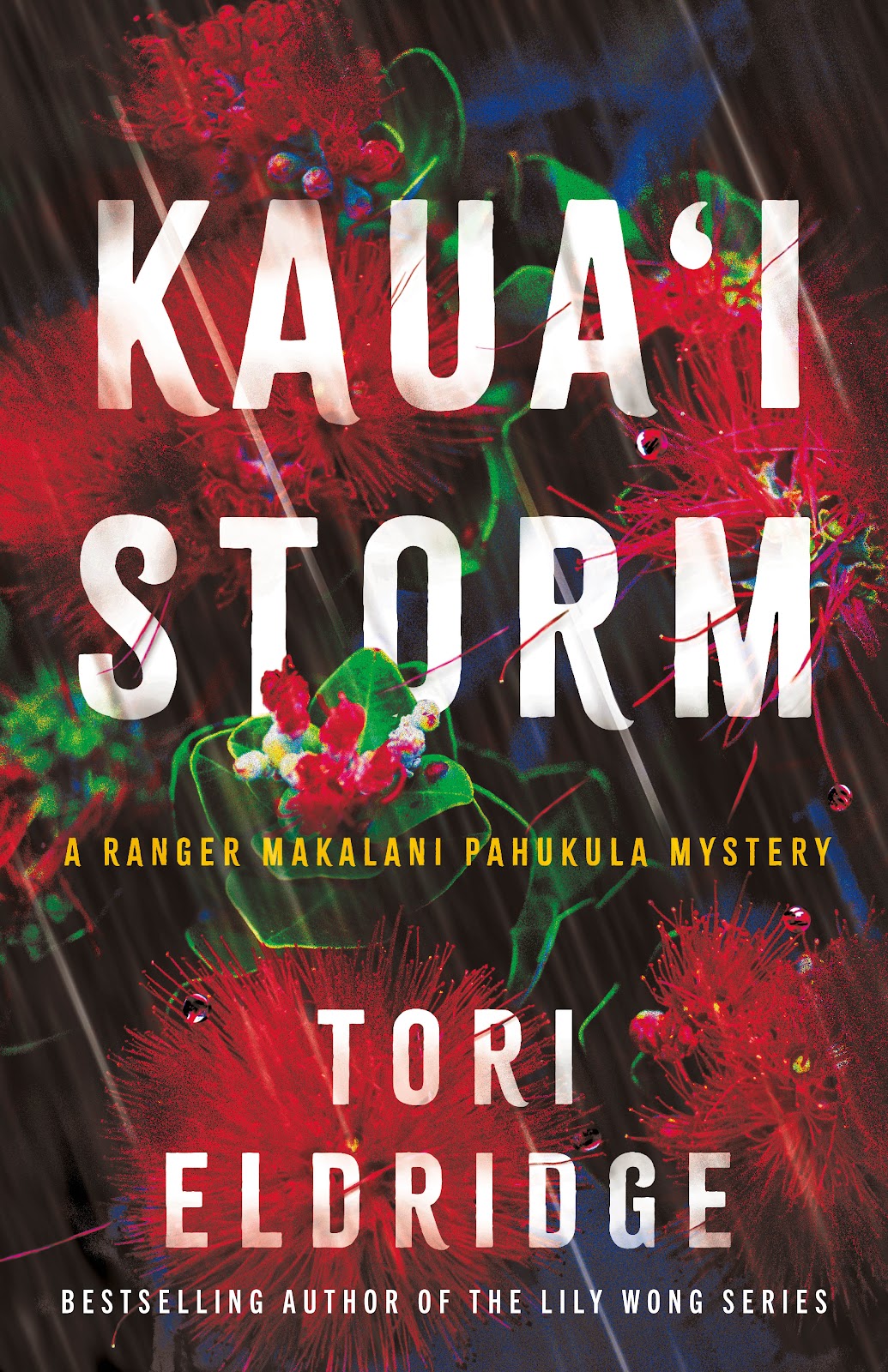
Tori Eldridge is the author of Hawai‘i Rage, Kaua‘i Storm, and the acclaimed Lily Wong ninja thriller series. Born in Honolulu—of Hawaiian, Chinese, and Norwegian descent—Tori graduated from Punahou School with classmate Barack Obama before performing as an actress, singer, and dancer on Broadway, television, and film, and earning a fifth-degree black belt in To-Shin Do ninja martial arts. Her literary works have garnered Anthony, Lefty, and Macavity Award nominations and the 2021 Crimson Scribe for Best Book of the Year. Tori lives in Portland, Oregon, with her husband, where she helps care for her precious mo‘opuna (grandchildren). Learn more about Tori and her books at ToriEldridge.com.