Showing posts with label Noir. Show all posts

Sunday, October 19, 2025

NOIR CITY: Philadelphia, November 14-16, 2025


Coming soon: NOIR CITY: Philadelphia

NOIR CITY: Philadelphia returns to The Colonial Theatre in Phoenixville, Pennsylvania, November 14-16, 2025, for a three-day extravaganza. Join Eddie Muller for a film noir lineup that shines the spotlight on women whose cinematic legacy is entwined with film noir. Several of this year’s films star additional actresses profiled in Muller’s Dark City Dames: The Women Who Defined Film Noir — Ella Raines, Ruth Roman, and Jan Sterling.

Festival highlights include three rarely screened films: tiki-noir Hell’s Half Acre(1954) with Evelyn Keyes and Marie Windsor, John Farrow’s Faustian tale Alias Nick Beal (1949) with Audrey Totter, and Max Ophüls’ suspenseful 1949 film The Reckless Moment featuring one of Joan Bennett’s finest performances.

A 35mm restoration performed by UCLA Film & Television Archive and funded by the FNF will also play: Joseph Losey’s The Prowler (1951), written by Dalton Trumbo with Van Heflin and Evelyn Keyes in the leads.

Festival program schedule, double-feature tickets, and weekend passes (includes all ten films) are available on The Colonial Theatre’s website.

Wednesday, May 7, 2025

The Top Five Classic Noir Novels Ever Written: Guest Post by Art Bell


I turned to classic noir novels in high school after finishing all the Sherlock Holmes stories (annotated, no less). I thought I would never love any mysteries or thrillers more than I loved Holmes, but I was so taken with noir that I read some of the classics several times. Many novels written today are counted as noir, so the genre survives. But, I wondered, what makes “noir” noirish?

Recently, as I was reading a noir novel written in the 1950s by an author unknown to me, I spent time thinking about classic noir novels and how their writing established the genre’s conventions. Below are my top five classic noir novels and how they defined noir.


The Maltese Falcon—Written by Dashiell Hammett; 1941 film directed by John Huston.

Having read The Maltese Falcon twice as a teenager and seen the movie countless times over the years, The Maltese Falcon defined noir for me for several reasons, including the dark urban setting and the tough-guy detective (Sam Spade, played by Humphrey Bogart in the film). And I loved the downbeat ending: Spade, investigating his partner’s murder, learns that the murderer is the woman he’s fallen in love with. Despite her begging him not to turn her in, Spade tells her, “You’re taking the fall,” and the cops handcuff her. It doesn’t get more downbeat or noirish than that!


When I think of The Maltese Falcon, a big part of what I found so enjoyable was the snappy dialog. One of Spade’s most memorable lines (for me, anyway) comes in a conversation with a punk kid played by Elisha Cooke, Jr., who is sent to corral Spade for a meeting with his gangster boss. When Spade laughs at his imperious tone, the kid says, “Keep on riding me and they’ll be picking iron out of your liver.”  Spade responds, “The cheaper the crook, the gaudier the patter.” I’ve remembered the line ever since I first heard it. The way the characters speak to each other, even in the most stressful situations, is a big part of what makes noir fun for me. Hammet was a master of this tough guy repartee, and John Huston, who wrote the screenplay, was clever enough to lift much of the dialog directly from the book. 


Double Indemnity and The Postman Always Rings Twice by James M. Cain.

Both of these classic novels have a story kicked into motion by a beautiful, beguiling woman seducing the average guy narrator into helping her murder her husband. The insurance money is part of the motivation. But it’s the narrator’s smoldering desire for the wife that ensnares him and causes him to do her bidding, even when it involves murder. In both books, things end badly for these poor guys. Having been taken for a ride and duped, they suffer the ultimate punishment. One is left awaiting execution (The Postman Always Rings Twice) while the other is killed by his co-conspirator seductress—a literal femme fatale (Double Indemnity).


The Big Sleep—Written by Raymond Chandler; 1946 film directed by Howard Hawks.

Does writing a thriller require tying up all the loose ends? Doesn’t the reader deserve that? Maybe not! I couldn’t help thinking of Raymond Chandler’s classic, The Big Sleep, in which the chauffeur is murdered, but by whom? Chandler fails to reveal the identity of the killer. It didn’t diminish the novel in my mind, but it was confounding for director Howard Hawks. During the filming in Hollywood, an exasperated Hawks called Chandler from the movie set and asked him who killed the chauffeur. Chandler responded, “I have no idea.” 


Often, the plots in noir are complex or filled with shady characters who play only a minor role. Sometimes, as in the case of The Big Sleep, even the killer’s identity is left hanging. Given all the complications, twists, and turns in many classic noir novels, as well as in modern mysteries and thrillers, sometimes things aren’t neatly tied up at the end. And according to the great noir novelist Raymond Chandler, that’s okay.


The Moon in the Gutter by David Goodis.

A couple of years ago, I happened to read Goodis: Five Noir Novels of the 1940s & 50s. I had never read David Goodis before, nor had I even heard his name, but the novels were beautifully written and great examples of noir storytelling and characters. One novel, The Moon in the Gutter, stood out for me. It’s the story of William Kerrigan, a dockworker in Philadelphia whose sister supposedly committed suicide in a dark alley. He suspects she was murdered and is obsessed with finding her killer. A high-society woman who enjoys photographing handsome dockworkers is drawn to Kerrigan, and they begin a love affair. It turns out she may know something about the death of Kerrigan’s sister. 


The Moon in the Gutter is a wonderful novel full of colorful characters, and after reading it, I had a revelation: So many noir stories are, at their heart, love stories. Sometimes, the romance between the main characters is doomed by circumstance, as it was by the clash of high and low Philadelphia society in The Moon in the Gutter. Sometimes, it’s a victim of deception, double-dealing, or murder. Sometimes, it’s a love triangle, as is the case in The Moon in the Gutter. Often, in keeping with the downbeat nature of noir, the hero chooses to give up the woman he truly desires in favor of someone less problematic. After all, a romance with a femme fatale doesn’t seem to be a great foundation for a sustainable marriage. Whatever the reason, the love story in noir thrillers is often as important as the crime.


***

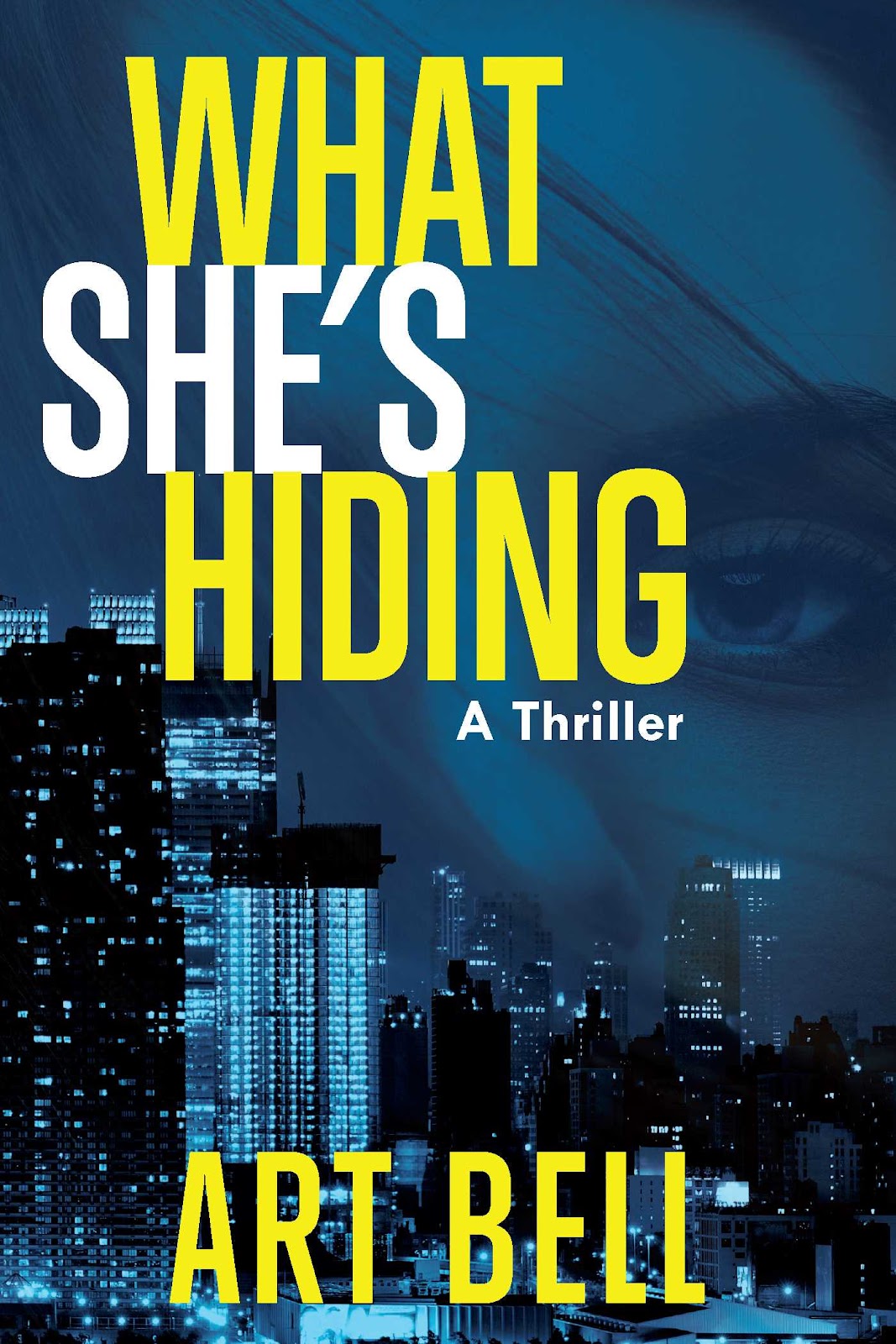
Art Bell's first novel, What She’s Hiding—A Thriller, is now available wherever books are sold.  


Monday, December 23, 2024

Merry Murder with a Santa Noir: Guest Post by Jeri Westerson

Santa Noir? What the heck?
Actually, I wrote a paragraph of it for a Facebook post with an image I shared of a bearded bro sort of Santa, just a few lines of parody taking from several noirs and hardboiled crime stories I enjoy. 

All my friends and followers seemed to like it so much that I decided to expand on it and wrote a short story, bringing in all the tropes from Raymond Chandler, Dashiell Hammett, and others to make a world-weary Santa dread the investigation of the murder of one of his reindeer in a sort of seedy version of Christmas Town, going all out for the humor. Santa laments in the story, in a parody of the words of Sam Spade, “When someone murders one of your flying reindeer, you’re supposed to do something about it.” And it’s up to him to bring down the culprit. 

You just don’t know what’s stuck in your head until you get on the parody kick and then it just flows out to make a humorous tale; a drunken penguin desperate to snitch on his pals for just one more hit; one of the reindeer addicted to candy canes (“he’s on the cane”) and willing to talk to Santa, but only alone under a frozen bridge; and a mob boss walrus that sounds suspiciously like Sidney Greenstreet from Casablanca who owns the Blue Penguin café and wants to make a deal. 

It’s definitely an admiring hat tip to all the books and stories I have loved over the years. Even Frosty the Snowman makes an appearance. And when other writers and readers know these stories just as intimately, then, well…it’s just a community sharing in the joke. 

The title “Last Pole on the Left” is reminiscent of Where the Sidewalk Ends or One Way Street, wonderful noir films from the 1950s, where people get caught up in their own corruption with really no way out. That’s the fun of noir anyway, to see how tangled the characters can get as they try to worm their way out of trouble and only get themselves deeper in by foolish choices. When I wrote my fifteen-book series the Crispin Guest Medieval Noir novels, they were definitely along the same lines, with a hero who just couldn’t get out of his own way, but managed to do the right thing, though still losing it all and getting knocked around a bit too. 

I wanted to lighten it up with this short story. 

It’s all in good fun to bolster your holiday spirit, but keep it away from the kiddies. This isn’t the Santa they’re looking for. But it just might be the Santa we need. 

Find it on Draft2Digital or Amazon: https://a.co/d/cJfhkIG

***

Jeri Westerson is currently writing a Sherlockian pastiche, An Irregular Detective Mystery series, with a former Baker Street Irregular as a new sleuth under the guidance of Sherlock Holmes. Westerson writes medieval mysteries, Tudor mysteries, several historical standalones, and a few paranormal series. See JeriWesterson.com for the entire oeuvre. 

Thursday, November 21, 2024

NOIR CITY XMAS: Who Killed Santa Claus?


NOIR CITY Xmas is on its way! Join host Eddie Muller on Wednesday, December 18, 7:30 pm, at Oakland's historic Grand Lake Theatre for NOIR CITY Xmas! To darken your Yuletide spirit, the Film Noir Foundation is presenting Who Killed Santa Claus? (L'Assassinat du père Noël), a 1941 French mystery. The evening will also feature the unveiling of the program (and poster!) for NOIR CITY 22, the 22nd year of the world's most popular film noir festival, coming to the Grand Lake Theatre January 24 - February 2, 2025. 

Tickets for NOIR CITY Xmas are available online from Eventbrite for $15 and can also be purchased at the theatre box office on the day of the show. Doors will open at 6:30 pm on the day of the event. What a Great Deal!!!

Saturday, December 2, 2023

Holiday Homicide: Classic Crime Thrillers of the 1960s: Online Panel, December 5: FREE

Holiday Homicide! I've signed up for this event.  Sign up now. FREE.


I’m Dreaming of a Noir Christmas: Classic Crime Thrillers of the 1960s
with Geoffrey O’Brien, Sarah Weinman, Gene Seymour, and David Lehman

Join Library of America for a killer lineup of panelists as they explore classic crime thrillers of the 1960s, from Donald Westlake-writing-as-Richard Stark’s taut smash-and-grab heist novel The Score to Patricia Highsmith’s eerie potboiler The Tremor of Forgery

Join Geoffrey O’Brien, editor of Crime Novels of the 1960s, along with noir maven Sarah Weinman (The Real Lolita), cultural critic Gene Seymour, and poet David Lehman (The Mysterious Romance of Murder) for an arresting dive into nine astonishingly inventive novels that pulse with the energies of a turbulent, transformative decade. 

Tuesday, December 5 6:00–7:00 PM ET 


 This online event is free, but you must preregister to attend.

Tuesday, April 11, 2023

Bright Lights and Stuffy Seats: Guest Post by Azma Dar

AZMA DAR: 

In my new novel, Spider, the main character, Sophie, is an aspiring actress, and I drew on some of my own experiences of working as a playwright with actors whilst creating her character. Sophie has her fair share of embarrassing moments during her struggling career, and although they weren’t inspired by anything that happened to me, I realised there have been a few cringey occasions in the theatre when I’ve also wished that I could just disappear. So here are three awkward little anecdotes from my time in that world…

1 CHAOS

Chaos was the first piece of writing that I ever had produced. Set in London post 9/11, it was a play about a dysfunctional Muslim family and a twenty minute excerpt was performed as a reading by  Kali Theatre, a wonderful company who produce new writing by women of South Asian descent.

At the end of the reading, the cast unexpectedly decided to call me up on to the stage to take a bow with them. Surprised, I trotted off nervously down the stairs, tripped slightly and sent one of my sandals flying. Rather than stop to put it back on and draw more unwanted attention to myself, I climbed up on to the stage and faced the applause with only one shoe, hoping the audience wouldn’t notice my bare foot.
Thankfully it didn’t do the play any harm and Kali Theatre produced Chaos as a full length show two years later.


2 NOOR

Another Kali production, Noor, about a Sufi Indian WW2 undercover radio operator in Paris, was performed in London last year. I went to see the show on Press Night with my niece, Nadi, who is only four years younger but a head taller than me, and is, poor girl, prone to mysterious attacks of light headedness, which, despite numerous medical tests, remain undiagnosed. 

I like to sit at the back when I watch my own plays, so I can watch audience reactions, but Nadi excitedly grabbed a front row seat. It was a traverse set, a long, train carriage shaped stage in the middle of the theatre, with the audience seated one either side of it, facing each other across the action. This meant we were only about half a metre away from the stage, and under the glare of the bright lights.

There were about fifteen minutes left till the end of the show when Nadi muttered, “I’m feeling funny,” and began fanning herself with the programme. I spent the next fifteen minutes on tenterhooks, my eyes darting constantly from Nadi’s face to check whether she was about to dizzily topple over off her seat on to the stage, to the two exits, in opposite corners of the room, trying to map out the route I was going to squeeze through and stumble along as I tried to drag her out if she need to leave.

Luckily she survived till the end of play still conscious, and at the after party was surrounded and pampered by other audience members asking if she was ok- apparently they’d all noticed the incident.

3 HAMLET

This time, I was an audience member only and had no creative role. It was 2009, and I managed to get a ticket for the production at Wyndham’s Theatre in London starring Jude Law.

I also, around that time, in 2009, developed a habit of falling asleep, almost instantly sometimes, in the day time at any odd moment.

And when I fall asleep, I snore. Very loudly. The sound has been likened to a train, an earthquake and various wild animals. It’s ruined many a slumber party, driving other participants to any cold, empty corner of the house with enough soundproofing to allow them a couple of hours of sleep.

I went to see Hamlet on a hot July day. After a short time, I got drowsy, and despite fighting it as much as I could, nodded off about half an hour into the performance. The next thing I remember is the lady next to me saying, “Excuse me. I can’t hear the play.”

Probably the most embarrassing moment of my whole life. The lady changed seats with her friend after the interval. 
 
To conclude- 

Don’t wear backless sandals to anywhere there’s the remotest chance you might be called up on stage without warning.

Don’t sit in the middle of the front row if you’re susceptible to fainting fits caused by bright lights.

Never, ever go to watch Shakespeare on a hot day if a stuffy, quiet atmosphere sends you into a snooze.


***
Azma Dar is an author and playwright. She has written three full-length theatre productions, several short plays, a radio play for BBC Asian Network and the play entitled NOOR produced at Southwark Playhouse. Her debut novel, The Secret Arts, was published by Dean Street Press in 2015. 

Spider, a domestic thriller, is out today. Martin Edwards says about Spider"A well-written and engaging story of domestic suspense with a difference, set in the Muslim community of West Yorkshire. Multiple viewpoints are juggled skillfully to deliver a real page-turner.”


Sunday, January 15, 2023

NOIR CITY: FILM NOIR FESTIVAL

NOIR CITY
, the most popular film noir festival in the world, celebrates its 20th anniversary in the Bay Area with a ten-day extravaganza featuring 24 films from the heart of Hollywood's noir movement, 1948. Every film on the schedule is celebrating its 75th anniversary, with several of the movies having never before been screened at NOIR CITY. 

Join Film Noir Foundation founder and Turner Classic Movies host Eddie Muller and a slew of special guests for a swanky, sexy, and sinister excursion back in time. With the ongoing turmoil over the future of San Francisco's Castro Theatre, the festival's home for most of its existence, Muller opted to move NOIR CITY across the bay to Oakland, a decision that proved successful last spring when the Grand Lake Theatre was filled with appreciative fans for an abbreviated 4-night version of NOIR CITY 19. “The Grand Lake may be smaller in capacity than the Castro," said Muller, "but it's a jewel of a movie palace, and it intends to remain a movie house—so it's a great fit for what we do—which is to offer a contemporary equivalent of the classic movie-going experience for a new generation of fans.” 

TICKET INFO 
Purchase advance tickets through Brown Paper Tickets with any of the ticket links in the program guide above. Doors open at 6:00 p.m. for evening shows; noon for matinées. 

NOIR CITY 20 PASSPORT 
Purchase a NOIR CITY PassportSecure your spot for the 10-day/24-film festival with an all-access pass for $200—a $40 savings over the regular ticket price! The Grand Lake Theatre will have a Passholders' queue for early admittance. 

All FNF proceeds from festival ticket sales aid the Foundation's mission of rescuing and restoring noir films. This is your chance to have a terrific time AND preserve a valuable art form. 

Noir City Program 


Monday, September 19, 2022

NOIRCON AWARDS 2022


NoirCon
, a biennial convention, held in Philadelphia, has canceled its in-person convention this year and replaced it with a virtual event October 21-23. The 2018 and 2022 Awards will be presented at that time. 

2018 Awards
David Goodis Award: Walter Mosley
Anne Friedberg Award for Contributions to Noir and its Preservation: Dana Polan
Kogan Award For Excellence: Geoffrey O’Brien and Max Rudin

2022 Awards
David Goodis Award: Megan Abbott
Anne Friedberg Award for Contributions to Noir and its Preservation: Sarah Weinman
Kogan Award For Excellence: Marcia Muller and Bill Pronzini

NoirCon is a three-day symposium celebrating noir in all its artistic incarnations with live and pre-recorded events, including panel discussions, award ceremonies, author talks, art exhibitions, movie screenings, and more.

Click Here to Register


HT: TheRapSheet

Saturday, April 18, 2020

PERRY MASON REBOOT

I know this won't have the 'authenticity' of the original Perry Mason series with Raymond Burr, but I'm looking forward to watching this production with Matthew Rhys as Perry Mason. I do love courtroom drama, but this may not be that. It promises to be much more Noir.

This HBO series is set to debut on June 21 and will star Matthew Rhys. Time period: 1931 Los Angeles -- the time of the Great Depression, but also including an LA oil boom, the Olympic Games, and the growing film industry.

Can't wait until June? Catch up on the original series. Available on several different streaming services and YouTube. 

Here's the Trailer for the new Series.


Thursday, December 12, 2019

NOIR CITY Xmas Coming Next Week: San Francisco

NOIR CITY Xmas Coming Next Week!
Wednesday, December 18, 7:30 p.m., a special evening of yule cruelty! The Film Noir Foundation presents a dark holiday classic from south of the border—and reveals the entire schedule for NOIR CITY INTERNATIONAL II, a program of noir from around the globe, coming January 24–February 2, 2020, to the majestic Castro Theatre. 

This year there will be a screening of Roberto Gavaldon's La Otra /The Other (1946). Dolores del Río, one of the most beautiful actresses of all-time, stars in this noir-laden thriller as identical twins: María, a manicurist who lives in near-poverty, and her sister Magdalena, who married the wealthy man María once loved. When the estranged sisters reunite at the funeral of Magdalena's husband, María can't help but imagine how different life would be if she could only trade places with her sister. Uh-oh. Take a guess where this is headed. Co-starring José Baviera, Agustín Irusta, and Victor Junco, with extraordinary cinematography by the great Alex Phillips. 

Tickets for NOIR CITY XMAS available now at Brown Paper Tickets. Tickets will also be available at the Castro Theatre box office the day of the show.

Monday, May 20, 2019

The Icepick Shortlist: 2019 Iceland Noir Award for Best Crime Novel in Icelandic Translation

O.K., this is a bit esoteric and the books on the list are not new in English, but it's a great list and definitely worthy of posting here. These five books have been shortlisted for the 2018 Iceland Noir Award for the Best Crime Novel in Icelandic translation. Winner to be announced in November.

 Double Indemnity, by James M. Cain;
translated by Þórdís Bachmann
 The Devotion of Suspect X, by Keigo Higashino;
translated by Ásta S. Guðbjartsdóttir
 A Stranger in the House, by Shari Lapena;
translated by Ingunn Snædal
 Three Days and a Life, by Pierre Lemaitre;
translated by Friðrik Rafnsson
 After the Fire, by Henning Mankell;
translated by Hilmar Hilmarsson

The winner is expected to be announced in November.


HT: The Rap Sheet

Thursday, March 28, 2019

NOIR CITY HOLLYWOOD

NOIR CITY: Hollywood Opens This Weekend!
NOIR CITY: Hollywood returns to the American Cinematheque's Egyptian Theatre, March 29-April 7. To celebrate the 21st anniversary of Los Angeles' longest-running film noir festival, programmers Eddie Muller, Alan K. Rode, and Gwen Deglise have gone deep into the archives to present a sizzling slate of sinister cinema. Muller and Rode will guide audiences through a program of "Film Noir in the 1950s" that offers many titles not seen in the fest's recent San Francisco and Seattle editions. Opening night, Friday, March 29, will feature the FNF's latest 35mm restoration—Richard Fleischer's Trapped, a 1949 noir from short-lived Eagle-Lion Films, starring Lloyd Bridges and scandal-plagued starlet Barbara Payton. There will be an opening night reception for all ticket buyers between Trapped and the 1950 "B" offering, Robert Siodmak's The File on Thelma Jordon. 
This year's program extends last year's chronological pairings of 1940s "A" and "B" films into the '50s, offering viewers a slate of films that tracks noir through the declining studio system and into a fresh cinematic landscape where noir was refashioned, both subtly and radically, for a new generation. The 2019 program features an eclectic mix of established classics like Orson Welles' Touch of Evil (1958), as well as rarely screened obscurities culled from studio vaults and film archives like Joe Pevney's 1954 Playgirl and John Auer's Hell's Half Acre (1954). Eddie Muller will introduce the festival screenings March 29-31 and April 5-7. Alan K. Rode will take the reins April 1-4. Schedule and tickets are now available at the Egyptian Theatre's website.

Monday, November 26, 2018

NOIR CITY XMAS: San Francisco

Ring in the holidays with a Cruel Yule courtesy of the Film Noir Foundation! Wednesday, December 19, 7:30 p.m., at San Francisco's Castro Theatre for Charles Laughton's The Night of the Hunter (1955). The holiday season is the perfect time to share this timeless noir fairytale about the eternal human struggle—between avarice and atonement, sinners and saviors, good and evil. Robert Mitchum gives a legendary performance as a vile and conniving ex-con masquerading as a man of the cloth. He's not about to let two innocent children come between him and a long-hidden bounty. Shelley Winters may be a gullible mark for this faux preacher, but spinster Rachel Cooper (a memorable portrayal by Lillian Gish) knows the devil when she sees it. Actor Charles Laughton created a stunning work of magical realism, the only picture he'd ever direct. Why not quit while you're ahead? This is a one-of-a-kind masterpiece not to be missed.
In addition to bearing gifts of compelling cinematic artistry at NOIR CITY Xmas, host Eddie Muller will reveal the program for the upcoming NOIR CITY 17 festival January 25–February 3, 2019 at the Castro Theatre. Plus, for your holiday shopping pleasure, there will be NOIR CITY 17 Passports (all-access passes) for sale, along with select FNF merchandise, on the Castro mezzanine.
Holiday Giving at NOIR CITY Xmas
Here's your chance to prove it's not such a bitter little world after all! At this year's NOIR CITY Xmas, there will be collection bins available for both the San Francisco Firefighters Toy Program and the SF-Marin Food Bank. The San Francisco Firefighters are looking for toys and books for kids, infants through 12 years old. Items must be not be gift wrapped. The SF-Marin Food Bank needs the following: peanut butter, low-sugar cereal, whole-grain rice, pasta, oats, low-sodium soups and stews, tuna and other canned meats, and canned fruits and vegetables. Please no glass, opened items, perishables, or items past their "use before" date. 

Thursday, November 8, 2018

NOIR OR NOT: Guest post by J.L. Abramo

J.L. ABRAMO:
NOIR OR NOT 

My latest novel, American History, is many things. In some respects, it is a work of historical fiction. A multi-generational, century-long saga. An epic tale of two Italian-American families related by blood but divided by hostility. It might be considered a mystery, a thriller, a crime novel, or a cops and robbers drama. What it is not is noir. Which, considering the recent flux of crime fiction calling itself noir, is not necessarily a bad thing.

Works featuring large doses of degradation—gratuitous violence, sex, and vulgar language—do not, I believe, automatically qualify as noir either.

Of all the sub-genres which huddle together under the umbrella known as crime fiction—mystery, private eye, thriller, police procedural—noir is possibly the most specific.

“Noir fiction is about losers, not private eyes,” says Otto Penzler, “the noir story with a happy ending has never been written, nor can it be.”

Dennis Lehane suggests, “Noir represents working-class tragedy—it is a genre of men and women unable to roll with the times, so the changing times instead roll over them.”

Strictly speaking, much of what I have heard read at Noir at the Bar gatherings (including my own readings) does not truly fit these descriptions. However, more and more lately, noir is hot. But what is noir and what is not? And are many crime writers trying to force square pegs into round holes?

Defining a category of writing—or of any art for that matter—too specifically, can create controversy. It is or it isn’t what you call it, so be careful what you call it. Either we redefine what is considered noir to make the label more inclusive, or we use more general terms like crime fiction, detective fiction, or simply good old fiction and not risk calling what is not a spade a spade. Otherwise, labeling a sub-genre—or in some cases a sub-genre of a sub-genre—has little meaning.

I’ve never considered my work noir. The Jake Diamond series is certainly not. Jake is more over-easy than hard-boiled. Gravesend and Coney Island Avenue are about NYPD detectives who are, for the most part, righteous. The closest I’ve come to noir is Brooklyn Justice. My protagonist, Nick Ventura, has a shady past and a subjective morality. But Nick is a private eye, a borderline professional, and he sometimes accidentally stumbles upon a happy ending.

Of late, I have been invited to contribute s short story to a noir anthology—and I have a decision to make. Pass—with the justification that it’s just not my thing—or try to round off the peg.

I have a general idea. More James M. Cain or Jim Thompson than Raymond Chandler or Dashiell Hammett. More After Dark, My Sweet or House of Games than Harper or The Rockford Files. But how much more. How many straight bourbons. How many non-filter cigarettes. How many sexy double-crossing dames. How much more than simply a body count.

When James M. Cain wrote The Postman Always Rings Twice, did he set out to pen noir fiction or did he—when he was a journalist covering the Snyder-Gray murder trial in 1927, where Ruth Snyder and her lover Henry Gray were accused of killing Snyder’s husband for the insurance money—simply get a good idea from a pair who had a terribly bad idea. When an interviewer for The Paris Review mentioned to Cain that he was so well-known for his hard-boiled manner of writing, Cain replied, “Let’s talk about this so-called style. I don’t know what they’re talking about—tough, hard-boiled. I tried to write as people talk.”

The question, for me, is can one write noir for noir’s sake? Can the gloom and desperation suggested by Penzler, Lehane and others be manufactured—or does it need to be called up from something authentic inside the writer? And what is the risk, psychologically, of stirring up such darkness?

In any case, I’ve decided to give the gracious invitation to contribute to a noir anthology my best shot. Start writing something I think might fit the bill, something noirish, and see where it takes me. And even if it only gets part way, I’ll at least have a little something to read if and when I’m invited to another Noir at the Bar event.

Meanwhile, readers can track down a copy of American History almost anywhere difficult-to-categorize novels are available.
***

J.L. ABRAMO was born and raised in the seaside paradise of Brooklyn, New York on Raymond Chandler's fifty-ninth birthday. Abramo is the author of Catching Water in a Net, winner of the St. Martin's Press/Private Eye Writers of America prize for Best First Private Eye Novel; the subsequent Jake Diamond Novels Clutching at Straws, Counting to Infinity and Circling the Runway (Shamus Award Winner); Chasing Charlie Chan, a prequel to the Jake Diamond series; and the stand-alone thrillers Gravesend, Brooklyn Justice, and Coney Island Avenue, a follow-up to Gravesend. His latest novel is American History. Abramo is the current president of Private Eye Writers of America. For more please visit: www.jlabramo.com www.facebook.com/jlabramo


Friday, October 5, 2018

NOIR CITY D.C.: October 12-25, 2018

Mr. Muller and Mr. Rode Go to Washington
NOIR CITY returns to the AFI Silver Theatre and Cultural Center in Silver Spring, MD, October 12-25. Taking attendees back to the golden age of film noir, NOIR CITY will present this year's films as they were experienced upon original release––pairing a top-tier studio "A" with a shorter, low-budget second feature or "B" film. In addition, there will also be a teaming of both versions of The Killers: Robert Siodmak's 1946 classic with Burt Lancaster and Ava Gardner, playing with Don Siegel's 1964 reimagining with John Cassavetes and Angie Dickinson, which puts more emphasis on the killers, played by Lee Marvin and Clu Gulager. The FNF's latest restoration, The Man Who Cheated Himself (1950), shot on location in San Francisco, will screen along with Paramount's new digital restoration of Byron Haskin's I Walk Alone (1948), featuring a trio of powerhouse players: Burt Lancaster, Kirk Douglas, and Lizabeth Scott. 
Opening weekend screenings, Friday, October 12–Sunday, October 14, will be introduced by author and FNF board member Alan K. Rode. Eddie Muller will take over hosting duties Friday, October 19–Sunday, October 21. The full NOIR CITY: D.C. schedule and tickets––plus the all-access NOIR CITY Pass––are available on the AFI Silver's website.

Sunday, August 19, 2018

NOIR CITY Returns to the Motor City!

NOIR CITY Detroit returns to its home at the historic Redford Theatre September 22-23 with all the violence, corruption, and melodrama that Detroiters have come to expect from this annual film noir festival. This year's 2-day event kicks off on Saturday night with a double bill of Act of Violence (1949) and The Killing (1956) and closes with a midnight screening of Taxi Driver (1976). Sunday afternoon brings a double bill of big-city corruption––Force of Evil (1948) and the independent crime feature Inside Detroit (1956) shot entirely on location in the Motor City! On Sunday evening, the festival wraps up with two noir melodramas––a new digital restoration of I Walk Alone (1948) and No Man of Her Own (1950).

FNF founder and president Eddie Muller will introduce all the films. The $30 NOIR CITY All Movie Pass grants access to all festival screenings plus entry to an exclusive reception with Eddie on Saturday, September 22, from 6:00 p.m. to 7:30 p.m., prior to the evening shows.

Monday, June 11, 2018

SAN FRANCISCO NOIR: Guest Post by Paul D. Marks

Paul D. Marks:
San Francisco Noirs

When I talk to people about film noir they generally tend to bring up L.A. and New York as the best known locations for noir movies. San Francisco seems to slip under the radar. So I wanted to talk about film noirs set in and around the City by the Bay. Some of my favorite noir films are set there: Born to Kill, D.O.A., Lady from Shanghai, Out of the Past. And neo noirs like Pacific Heights. This is not an analysis of San Francisco noirs, just a few personal comments. Nor is it a complete list.

CLASSIC NOIR: 

Born to Kill – One of my favorite noirs, but you’ll want to shower after you hang with this crew. Lawrence Tierney’s Sam Wild is an amoral psychopath, equaled only by Claire Trevor’s Helen. Elisha Cook, Jr. is terrific as always. This movie has one of my favorite lines of any movie: Delivery Boy: “My, that coffee smells good. Ain't it funny how coffee never tastes as good as it smells.” Arnett (Walter Slezak) responds: “As you grow older, you'll discover that life is very much like coffee: the aroma is always better than the actuality. May that be your thought for the day.” Locations include the Sutro Mansion and the Ferry Building.

Dark Passage – I had seen this movie 2-3 times and really liked it. I knew it was based on a novel but I wasn’t sure about the writer: David Goodis. Eventually, I went and looked him up. And started buying his books, starting with this one. This was before the internet, so I had to get the books the old-fashioned way. I had to hunt them down and buy them used as they were out of print. I started reading and fell in love with Goodis, called the “poet of the losers” by Geoffrey O’Brien. My fave book is Down There (aka Shoot the Piano Player after the movie by Francois Truffaut. Personally, I like the book much better). Dark Passage uses several terrific San Francisco locations. The most recognizable is Lauren Bacall’s apartment: The Malloch Apartment Building at 1360 Montgomery Street. Still there and still looking terrific. I love this place – I want to live there! Also the Filbert Steps, Filbert Street, The Tamalpais Building, Golden Gate Bridge, San Quentin (San Francisco adjacent).

D.O.A. – The ultimate “high concept” movie. A man finds out he’s been “murdered” (poisoned) and before the poison kills him tries to find who the killer is. I’ll watch this any time it comes on TV and if it doesn’t I’ll stick in a DVD. I like to have a fix at least once a year. Locations include, Justin Herman Plaza, the current site of The Fisherman bar/club, where Edmond O’Brien gets poisoned. The St. Francis Hotel, now the Westin St. Francis. The Mark Hopkins. Powell and California streets, the Southern Pacific Memorial Hospital, the Embarcadero. Various background shots. And as a bonus the amazing Bradbury Building in Los Angeles (semi San Francisco adjacent). 

Lady from Shanghai – A good noir by (and with) Orson Wells and Rita Hayworth that travels the world with a terrific climax in a funhouse hall of mirrors at Playland at the Beach in San Francisco. Other locations include the Mandarin Theatre, Golden Gate Park, Chinatown, the Steinhart Aquarium, Sausalito. I liked the climax scene of this so much I adapted it for my early website logo. 

The Lineup – Two stone-cold killers smuggle dope into the country via unsuspecting travelers. A good movie. I like it, but it’s not one of my faves. That said, it has a laundry list of terrific San Francisco locations. The two most interesting to me are the Sutro Baths and the Cliff House, maybe because they’re the least familiar to me. Sutro burned down, but the Cliff House is still there. Other locations include the Embarcadero, Steinhart Aquarium, Golden Gate Bridge and the Oakland Bay Bridge, the Legion of Honor Museum, the Mark Hopkins Hotel and more. So if you want a tour of 1958 San Francisco, this is your ticket.

The Maltese Falcon – A classic. What can you say. But the problem with many older movies is that they’re mostly studio bound. “Set” in SF with some background location shots at the Golden Gate Bridge, Bush Street, and the Ferry Building.

Out of the Past – One of my top 3 film noirs (with Double Indemnity and Postman Always Rings Twice, the Garfield-Turner version). Set in northern California, a rural town, Lake Tahoe and San Francisco. Again, mostly studio bound for the San Francisco city scenes. Mostly background shots for the locations. They did, however, shoot on location for some of the more rustic shots.

This Gun for Hire? – Based on a novel by Graham Greene. The first of 7 teamings with Alan Ladd and Veronica Lake, and one of the best, though my fave would be the Blue Dahlia (scripted by Raymond Chandler). Though partially set in San Francisco, the film itself is very studio bound and it doesn’t appear any actual scenes were shot on location.


Vertigo – Tied for my fave Hitchcock movie (with the Lady Vanishes, though Vertigo is the much better film). Set in San Francisco and along the coast. This flick is a surrealistic daydream, or should I say nightmare. The movie is a guided tour of 1958 Baghdad by the Bay. From Fort Point at the Presidio, where Madeleine jumps into the bay, to Scottie’s apartment at 900 Lombard Street. The Essex Club on Montgomery, which doubled as Ernie’s Restaurant in the movie. The California Palace of the Legion of Honor, where Madeleine visits the portrait of Carlotta Valdes. Muir Woods, Mission Dolores, Mission San Juan Bautista and more, all visually stunning in the movie.

NEO NOIR AND MORE MODERN SUSPENSE MOVIES: 

Basic Instinct – Controversial Neo-Noir that makes use of plenty of San Francisco and adjacent locations. Another ramble through the streets of San Francisco that takes us from Catherine Tramell’s Pacific Heights mansion to Telegraph Hill. From Chinatown to Stinson Beach, Big Sur, the Hall of Justice, Steinhart Aquarium, the Embarcadero and North Beach, among many other sites.

Bullitt – Steve McQueen’s out to get his man in this one. You don’t need me to tell you what it’s about. Famous for its celebrated chase scene through the streets of San Francisco. Bullitt roars through Russian Hill, the no longer existent Embarcadero Freeway, the Marina District and more. Other locations include Grace Cathedral Episcopal Church, the Thunderbird Hotel, now the Clarion. Bullitt’s apartment on Taylor Street. North Beach, San Francisco International Airport, SF General Hospital, SF PD HQ on Bryant. And the usual more.

The Conversation – Francis Ford Coppola’s excursion into paranoia, makes use of many San Francisco locations, including Portrero Hill, where Harry Caul’s (Gene Hackman’s) workshop is. Alamo Square, the Financial District. Neiman Marcus in Union Square and Union Square. Cathedral Hill. And the usual mas.

Dirty Harry – Love ’im or hate ’im, DH will make your day. Harry blazes his way through a ton of San Francisco locations. I’m surprised there’s anything left of the city in his wake. He tears through Kezar Stadium, Golden Gate Park. Marina Green in the Marina District. The Holiday Inn downtown. California Hall. City Hall. The Hall of Justice on Bryant Street. Mission Dolores makes another appearance, where Harry gets off the street car to use a phone booth. SF General Hospital. Noriega Street, where Scorpio commandeers the school bus. The Roaring 20’s Nightclub on Broadway, where Harry surveils Scorpio. Chinatown. Washington Square, North Beach. The Dante Building where Scorpio is looking for a victim and spotted by a helicopter. 

Final Analysis – This flick doesn’t get great ratings, but I like it a lot. Richard Gere, Kim Bassinger and Uma Thurman in a twisty story that reminds me of Hitchcock and might have been something he would have done if he was still around. Some interesting scenes, reminiscent of Hitchcock at Pigeon Point Light Station in Pescadero, California, which I’d call SF adjacent. Bix Restaurant at 56 Gold Street, SF. The Sir Francis Drake Hotel. The SF Courthouse. Golden Gate Bridge. City Hall.

Pacific Heights – This is one of my guilty pleasure movies. Not really – I really like this. It’s totally creepy. Because it’s not all that far-fetched. I don’t think the Zombie Apocalypse is going to come and get me. But a creep like Michael Keaton’s character, who takes over your life, that can happen. While supposedly located in Pacific Heights the Pacific Heights house is actually on Portrero Hill. Also Chinatown, the financial district. And SF in general.

So there you have it. A mini noir tour of the streets of San Francisco.

***

Paul D. Marks is the author of the Shamus Award-Winning mystery-thriller White Heat. Publishers Weekly calls White Heat a “taut crime yarn.” Broken Windows, the sequel, is being released on 9/10/18. His story Ghosts of Bunker Hill was voted #1 in the 2016 Ellery Queen Readers Poll. Bunker Hill Blues came in #6 in the 2017 Readers Poll. Howling at the Moon (EQMM 11/14) was short-listed for both the 2015 Anthony and Macavity Awards. Midwest Review calls his novella Vortex “… a nonstop staccato action noir.” The anthology Coast to Coast: Private Eyes from Sea to Shining Sea, co-edited by Marks, is nominated for an Anthony Award. And his story from it, Windward, has been selected for the 2018 Best American Mystery Stories (fall 2018), edited by Louise Penny & Otto Penzler, and is also nominated for a Shamus Award.